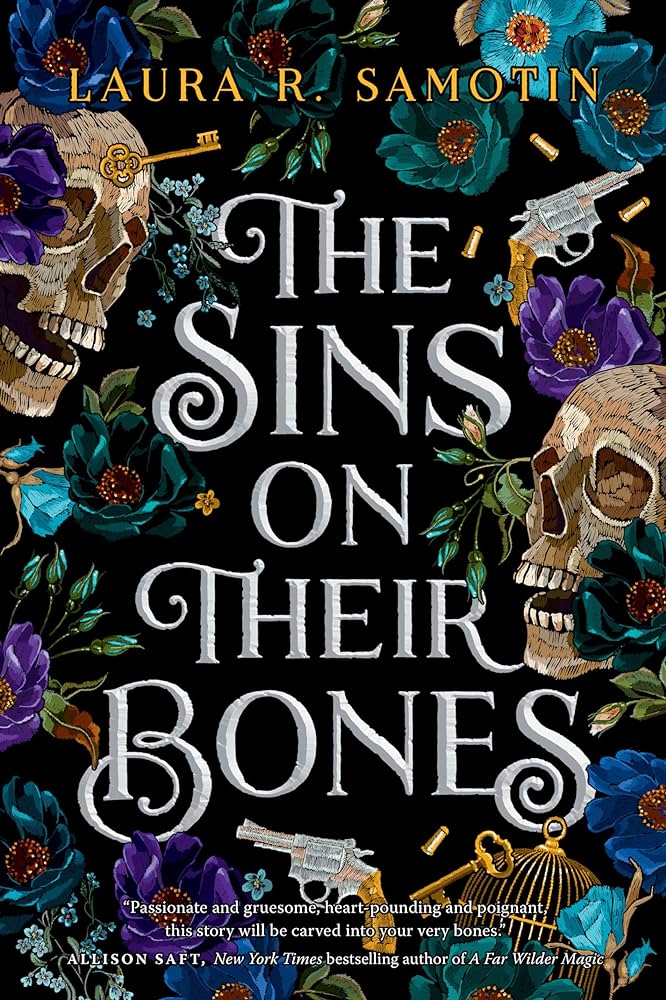
#REVIEW: The Sins on Their Bones, by Laura R. Samotin

This is going to be One of Those Reviews, I think. I am beginning this review at 7:30 PM on Saturday, which, you will notice, was yesterday. You may have noticed that yesterday-which-for-me-is-still-today’s post is also a book review.

I am writing the second book review of the day because I woke up this morning, read the last two hundred pages of To Cage a God, wrote a review, ate lunch, took a shower, and then read The Sins on Their Bones fucking cover-to-cover in what wasn’t quite a literal single sitting but may as well have been. The eArc I read was four hundred and eighteen pages. I read the entire book in roughly six hours, less if you deduct a couple of pee breaks, some light web surfing and doom scrolling, and a few pieces of frozen pizza for dinner.

The real miracle? I don’t have a physical copy of this book. I’ve read plenty of books in a single sitting before. I don’t think I’ve ever done that with an ebook. Like, literally never. This is the first time.

I also paused to order the book from Amazon, because I got sent this by a publicist in return for a review, and I don’t actually have a physical copy. It comes out May 7th.

You may be wondering what I meant by “one of those reviews” in the first paragraph, there. Here’s the thing: This book started out as an uh-oh, developed into something I was grudgingly respecting, and then moved into fuck it, five stars territory by ending very well. I’ll get into what it’s actually about in a few minutes but it’s very much the type of book that if I talk about too much you’ll think I hated it. I did not! I liked it a lot. But all of the interesting things I have to say about it are gonna feel like gripes. I’m annoying that way sometimes.

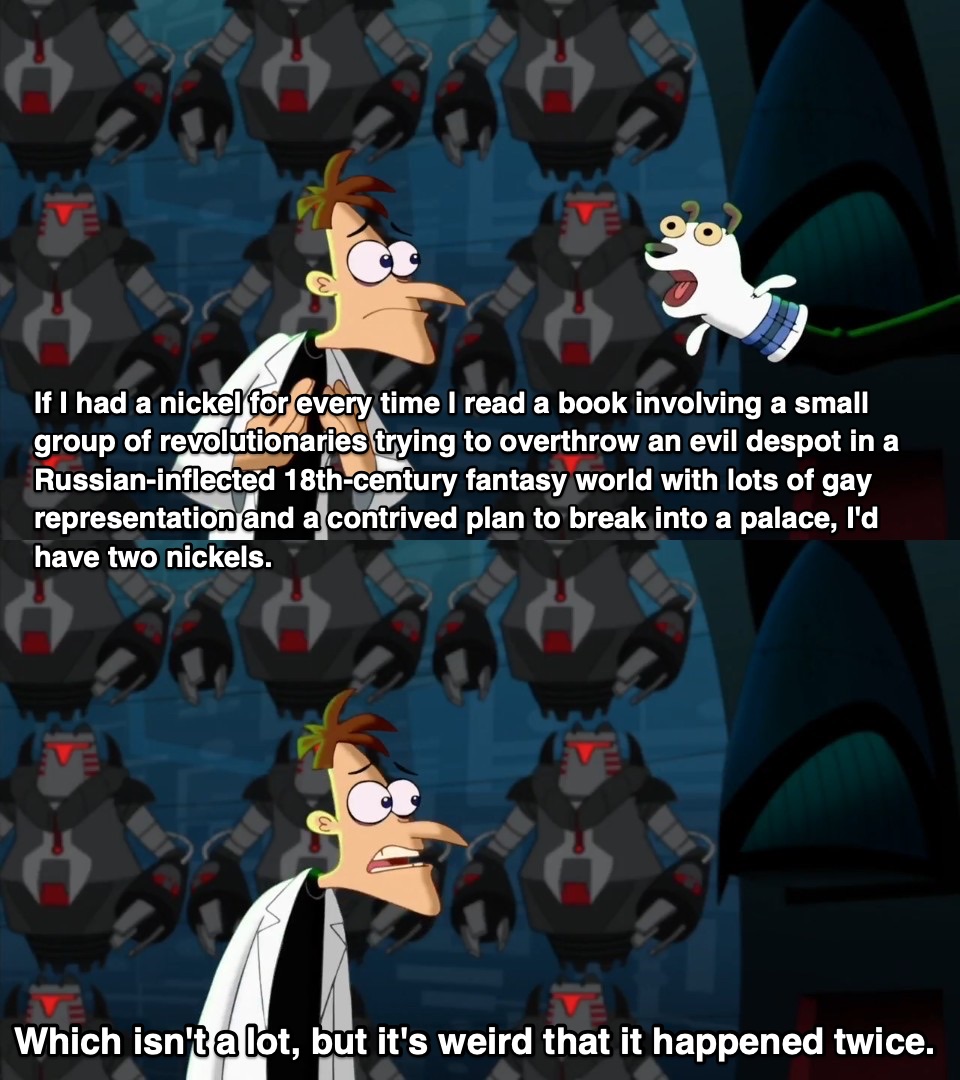
But let’s talk about To Cage a God for a second more, because, completely by accident, this book echoes that one quite a lot. Both are set in a proto-Russian setting, with roughly eighteenth- or nineteenth-century technology (guns are mentioned in Bones, but don’t really belong on the cover) and both are mostly about a plot to remove an unjust ruler. Both have substantial gay representation; both have magic, although we’ll get to talking about Sins on their Bones’ magic in a bit. The good guys even get into the bad guys’ palace at the end with more or less the exact same deception, which is one bloody odd coincidence. For a while, I was genuinely concerned that reading both of them in one day was poisoning my opinion of Bones, but as I said: once it heats up it heats up fast.

Let’s go back to the queer representation: I feel bad about complaining about this, but Sins on Their Bones might actually have too much, as I’m pretty sure that literally every character in the book with a speaking role is queer, including two tzars and the entire surviving court of the deposed one. One character gets to give a whole speech about being asexual. I did not notice any trans characters but the rest of the book is so gay that I genuinely think I probably missed an obvious clue somewhere; I refuse to believe everyone in this book is cisgendered. There’s a throwaway line at the end of the book about someone receiving a ton of marriage proposals from across the continent, implying that every other ruling family is super gay too. And there’s a point where someone has to convince a side character who has barely appeared in the book at all that they knew each other as kids, and he tells her that he remembers her first crush, which was on another girl, because of course it was.

And, like, the main character is the deposed tzar, who is married to the guy who deposed him, and he and his court are in hiding for most of the book. He’s very mopey about it. You’ve seen Monty Python’s Holy Grail, right? Remember the bit with the prince in the castle who just wanted to sing? Imagine that guy was the tzar of Russia, only instead of singing, he wanted to have sex with his husband. That’s the vibe for a lot of the book. He snaps out of it eventually, but he’s very sad for basically the whole first half. Also drunk. And the interactions between the main group of characters really don’t feel like an exiled potentate and his court. They’re more like a bunch of grad students in a polycule. At one point they go to a magic library– the magic library is probably my favorite part of the book and I would gleefully read an entire book about Aleksandr, the librarian, and his disembodied head coffee table, and no, I’m not explaining that. But they go to the magic library and they’re sitting in a room listening to the librarian talk and one character sits on another one’s lap. There’s a bit where they’re expositing at each other early in the book and three of them are basically lying in a cuddlelump on the floor.

I don’t know any kings and I definitely don’t know any tzars but I feel like typically the word “cuddlelump” doesn’t get applied to them often. And from now on whenever I think about Cabinet meetings I’m going to imagine Pete Buttigieg walking in and confidently sitting on Merrick Garland’s lap, and none of you can stop me.

Also, everybody’s Jewish, except they aren’t, and I don’t know how I feel about that. Now, Jewish mysticism and Jewish magic are a thing, and they are fascinating, and I have read several really goddamn good books that take inspiration from Kabbalah. The phrase “inspired by Jewish mysticism” was half of what got me to jump at the chance to read this early. But the word “Jewish” doesn’t show up anywhere in this book, and the place names are all clearly drawn from real places in Russia, and it’s not like it’s a pastiche on Judaism, these folks are Ashkenazi Jewish. They’re praying in Hebrew and wearing prayer shawls and the names of God play a big role and churches are called shuls and there are angels whose names are clearly only barely modified from their Biblical equivalents, and it’s so obviously Judaism that it’s really weird to me that the author didn’t just make them Jewish. There are literal Bible quotes scattered around, just without actual chapter and verse references. I mean, there wasn’t ever a Jewish tzar of Russia, but there wasn’t a gay tzar of Russia either, nor did the gay Jewish tzar of Russia have a nonbinary person and an asexual person and a bisexual person and the fourth person was probably the trans person and I didn’t catch it, in their inner court. If we’re gonna go with homonormative 18th century Russia, we can also have homonormative 18th century Russian Jews.

I dunno. The author is Jewish, and I’m not, and I’m not, like, offended by it or anything, but I feel like you can only draw so much “inspiration” from Jewish mysticism before you have to just admit that everybody is an actual Jewish mystic. Like, the big plan to stop the bad guy at the end, and I’m not going to get more specific because spoilers? I know exactly where that came from.

Also, and this is probably just me being petty, but the evil tzar is called “Moy Tzar” nearly every time he’s referred to in the book and there is no other Russian anywhere, and it’s italicized each and every time, and … blech.

So like I said: I have lots of gripes, but … six hours. One sitting. On an ebook. Which I then spent real money to get a physical copy of. I have not quite gone so far as to put this on my end-of-year list, but we’ll see how I feel about it in a week. Go pre-order it, and you can read it on May 7th.

And, finally, because I can’t resist:
REVIEW: The Weight of Ink, by Rachel Kadish

Every so often, a book scratches an itch that you didn’t even know was there, and Rachel Kadish’s The Weight of Ink is such a book. Those of you who have either been around for a minute or know me in the real world are aware that an earlier version of me wanted to be a college professor. I triple majored at IU, in Religious Studies, Jewish Studies, and Psychology, and then went on to earn a Master’s degree in Biblical studies, which is where I hit a wall when I realized that I liked being in class a hell of a lot more than I liked independent research. But I still have a couple of bookshelves about religion, and along with that is a fair number of volumes about Jewish history.

The Weight of Ink tells two parallel stories about two women scholars, a young, unmarried Jewish woman in the mid-1600s, when women knowing how to read and write much less participate at the highest levels of scholarship was forbidden, and a modern-day scholar of seventeenth-century Judaism, suffering from Parkinson’s and nearing retirement. A cache of documents is found in a seventeenth-century home, and the owner calls his former professor in to look at them, and the book takes off from there. Ester and Helen’s stories are interwoven throughout the book, along with Helen’s assistant Aaron, a postgraduate who she more or less grabs at random because he is able to read the right languages to help her with her research.

Mix in some Shakespeare, some Spinoza, a blind rabbi, the Inquisition, Sabbatai Zevi, and a little bit of fire and plague and you’ve got yourself a hell of a book. I’m making this sound a bit more like a detective novel than I probably should; this is indisputably capital-F Fiction, and may indeed be a litratcher, as (I hope) Hilary Custance Greene described it when she recommended it to me. But … yeah, if you’re going to drag me away from nonfiction and genre fiction, writing a book about seventeenth-century Jewry, making translation a bigger part of the action than one might expect, and making the two modern-day figures scholars is a key with a very specific shape that nonetheless opens one of my locks.

Or something; that may be too overwrought of a figure of speech, I’m not sure. At any rate, while it’s a bit slow-moving, which may not be surprising to those of you who just read the description, and it’s a bit on the dense side– it took me over a week to read, which is really rare for a 560-page book– I loved this book a whole lot. Kadish writes about seventeenth-century London like she lived there, and everything about this really worked for me. I hope to hell it actually was Hilary who recommended I read it, because I can’t find the comment anywhere, but I owe her one.

I wasn’t going to post tonight

My vision’s been fucked up all day, for no reason I can identify, and I really need to avoid staring at screens, but then I came across this and I’m at least 50% more Jewish than I was ten minutes ago and what with it being the first day of Hanukkah if I don’t share it now I can’t ever do it.

So.  Watch this:

On Jesus

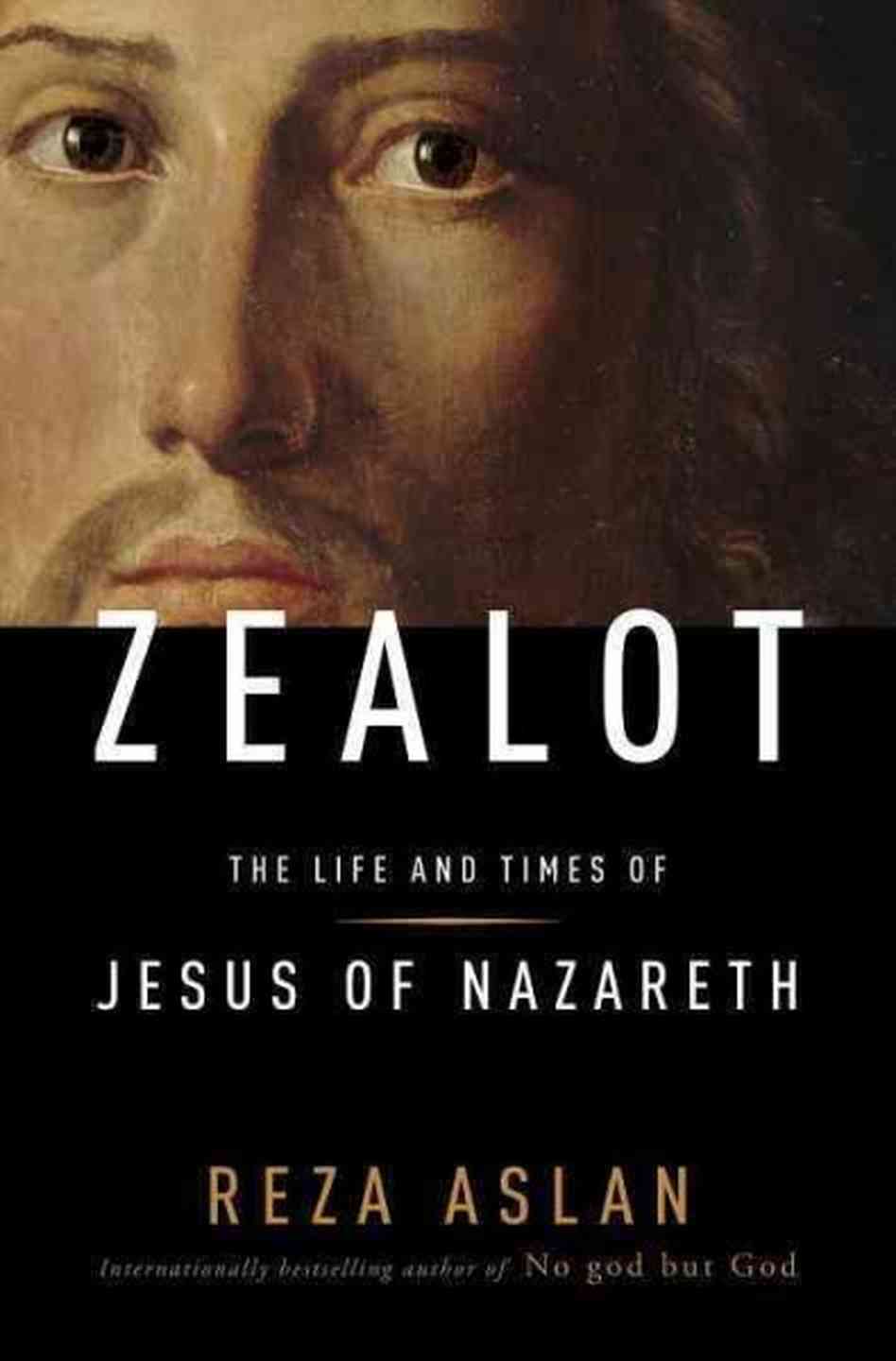
9781400069224_custom-74c1fad03aa8c72c92cb923ce65325c75dd15ea0-s6-c30I’m actually writing this Sunday night for Tuesday morning; I don’t think I’ll have time to get to a post until late, what with it being the first official teacher work day (hah!) and Parent Night happening and all that, and I want to make sure some sort of post happens.  So  have a book review, combined with some fun nostalgia.

(EDIT:  Whoops!  Shit, posted it immediately.  Oh well.  I’ll come up with something else for Tuesday, I guess.)

As many of you already know, Alternate Universe Me has a Ph.D by now and is a Hebrew Bible scholar at some terribly prestigious university with an insanely high tuition rather than a math teacher at a high-poverty public school.  I managed three majors and two minors in college; two of the majors were Religious Studies and Jewish Studies and one of the minors was Near Eastern Languages and Cultures; one of my two Master’s degrees is from the University of Chicago’s Divinity School.  One of my tattoos is in Hebrew.  (And yes, I can read it; my cardinal rule of tattooing is that you never, ever, ever tattoo yourself in a language you can’t read– I’m looking at all of you idiots with Chinese characters that you think mean “Strength” and actually mean “Dim Sum” or “Stupid Cracker” tattooed on your arms or the small of your backs.)

I washed out when I realized that not only was a Ph.D in Religious Studies one of the longest doctoral programs known to the human race, but that I really wasn’t actually all that interested in trying to do independent research in a subject that people had been studying intensively for two and a half millennia.  Dissertations in Biblical studies tend to be… slightly more specific than I’m interested in.  And, I reasoned to myself, since what I was interested in was learning about this stuff, well, there wasn’t really much of a reason to keep paying beaucoup tuition for that.  I can read on my own, right?

Fast forward (checks date on diploma) thirteen years, and I’ve barely read a single thing on the topic of religion since then.  Maybe a half-dozen books.  Something like that.  So that’s how well that plan went.  If you’re one of my friends who actually has a Ph.D in some branch of religious studies, keep in mind that I’ve been out of the game for over a decade, so my recollection of the bleeding edge of scholarship isn’t exactly precise.  I’m reviewing this as a relatively well-informed amateur, for whatever that’s worth.


All that said: Reza Aslan is a goddamned genius.  I’m of the school of thought that he knew exactly what the hell he was doing when he went on Fox News and absolutely bewildered the interviewer with the unbelievable, does-not-compute mindfuck that an honest-to-God-Moozlim actually done wrote sumpin’ ’bout Jeebus. Note that I haven’t watched the interview; I lost enough IQ points just reading about it, but if you like stupid go ahead and click.  Aslan’s book may be the shortest “historical Jesus” work I’ve ever seen, actually, and doesn’t even actually spend all of its pagecount on Jesus himself– there are several chapters exploring the revolutionary/political environment he grew up in at the beginning and several chapters on Paul and James at the end, so really only about the middle 50% or so of the book is specifically about Jesus’ life.  That said, he manages to pack quite a lot of stuff into those pages, and does so without lapsing into the sort of impossible specificity and detail that these sorts of books are known for.  I can’t vouch for the rightness of his claims, necessarily, but I didn’t find much that I disagreed with– he certainly isn’t terribly interested in getting into details of translation very often (there is very little Greek, Aramaic, or Hebrew in the book, and everything is transliterated into Latin characters) and all of the footnotes and endnotes are in the back, not interrupting the text.  This is a book for the type of people who watch Fox News or react to stupid things that happen on Fox News, not people who are already in “the biz,” so to speak.

Best thing I can say about it?  It made me remember why I enjoyed being in a field that consumed most of my intellectual space for most of my twenties; it’s been a while since I regretted leaving grad school.  That’s the best thing I can say about it.  If you’re interested in the historical Jesus, this isn’t a bad place to start; I can move you onto other titles afterwards.  Thumbs up.