#REVIEW: The Raven Scholar, by Antonia Hodgson

I got a second copy of Antonia Hodgson’s The Raven Scholar on the day I started reading it. And it wasn’t quite on purpose– the copy on top there showed up on release day, since I’d preordered it after it caught my attention somewhere at some point in the last few months, and then Illumicrate sent me another copy as part of their monthly box. This is the first time that’s happened; the unofficial rule for Illumicrate books seems to be that they only send me books I’ve never heard of, and this is the first time they’ve sent me one I already owned, although I have bought a couple after reading them so that the series were sure to match. One way or another, though, the Illumicrate edition is fucking gorgeous, one of the prettiest books they’ve sent me, so I’m not pressed about it.

… and suddenly I want to change the title of this post and take the word “review” out of it, because the more I think about it the less interested I am in writing even a traditional-by-my-standards book review. This book is weird; I enjoyed reading it, and I’ll pick up the sequel– which may be, in and of itself, enough of a review for anyone who cares at all about my opinion– but there’s a lot about it that makes me reluctant to star-rate it. For one, it’s a Magical Tournament book, and I am tired of books that can be boiled down to the name of a trope. On top of that it’s a People Are Sorted Into Categories book, although it’s not the entire society, at least, but nearly all of the main characters in this book represent the devotees of one of the eight animal gods (creatively named “the Eight,” although it’s fun seeing the word “eight” used as a swear word) and some of the ones who don’t used to. Which leads me into another gripe, which is that every character effectively has three names, since sometimes they’re referred to by their first names, sometimes by their last names, and sometimes just by their faction, so you might see someone talking about “the Hound” and you have to remember who that is. Spread that out over the eight people involved in the tournament (which is how they pick their emperor, who appears to be a king, and I wish people would learn the difference) and keeping track of everyone can be a little more complicated than maybe it should be.

But! There’s a murder mystery at the heart of this book, and the murder mystery is wrapped around the succession tournament and the eight-faction worldbuilding thoroughly enough that it’s hard to extricate from it– this story only works in this world– and main character Neema, the titular Raven Scholar, is tasked with untangling the mystery as well as trying to become emperor on the side, a job she’s not even interested in, because the outgoing Emperor has ordered her to try to become his successor, which makes more sense in context than it might sound. Only Neema’s not much of a scholar– she’s more of an autistic nerd, which isn’t quite the same thing– and occasionally she gets really good at physical combat because she has to.

Oh, and there’s a Shoehorned Enemies-To-Lovers Romance, because everything has a name nowadays.

I dunno. I liked this book, as I said, but every ten pages or so something jumped out and kind of annoyed me? But not enough that I didn’t five-star it, although right now I’m not sure why? Because maybe I don’t know what a five-star is, and of course I’m writing this, when I could have just not talked about the book.

Maybe I should just go back to bed.(*)

(*) It is 6:18 PM.
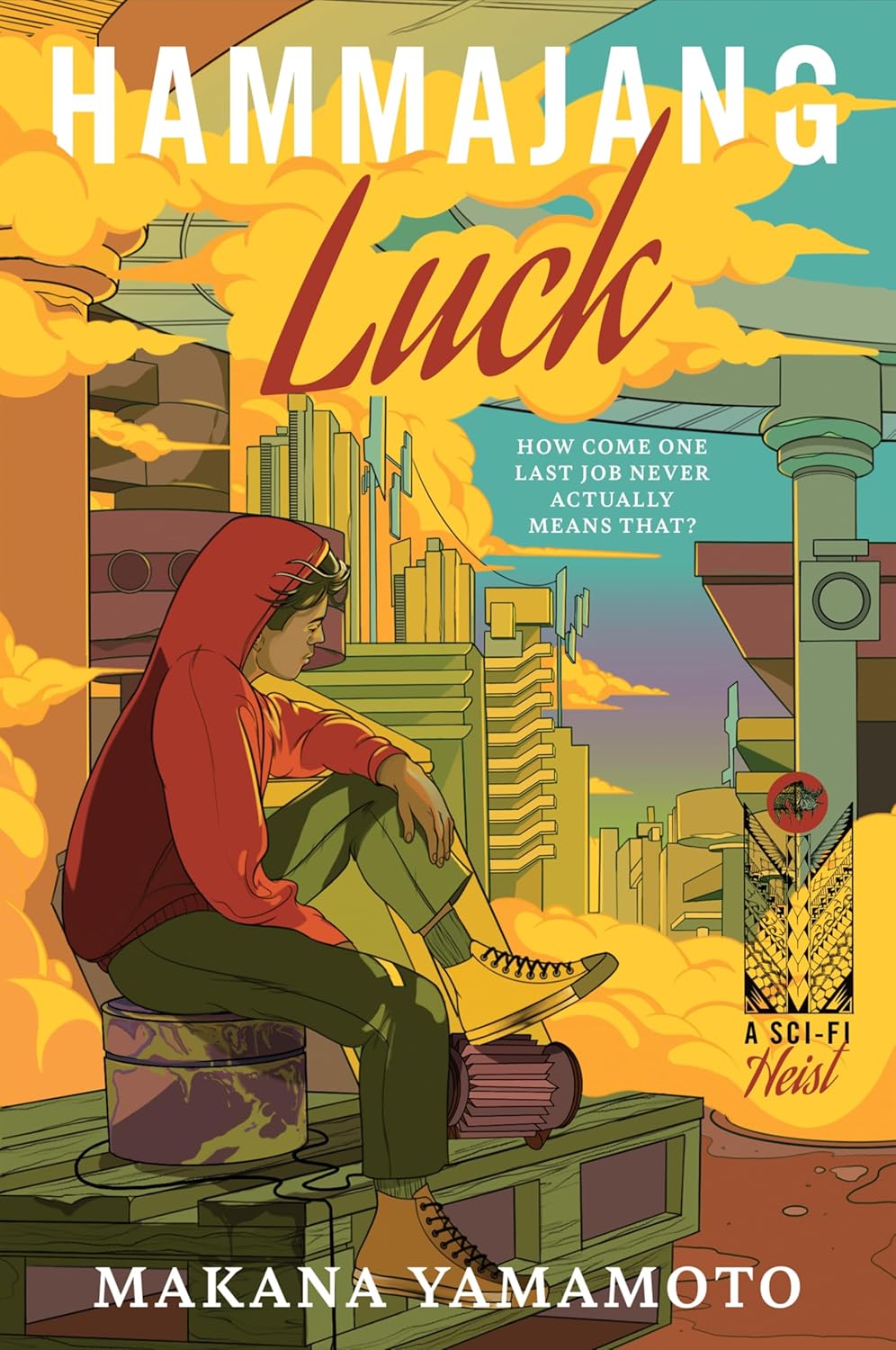
#REVIEW: Hammajang Luck, by Makana Yamamoto

This was a hell of a lot of fun.

My Illumicrate subscription has been kinda hit or miss, if I’m being honest, and I keep almost cancelling it. I think their version of this book is the best-looking of any of their books that I’ve yet received, but upon seeing what the cover of the paperback looks like, I may have to order that too. One way or another, though, the books are always pretty, but it’s only about 50/50 whether I’m going to like the book, and so far I think I’ve only gotten one book from them that I’d heard of prior to it showing up in my mailbox.

Hammajang appears to be Hawaiian Pidgin for cattywampus, and if you’re not white enough to know that word then we’ll go with “messy” or “chaotic.” The book is sort of an outer space Hawaiian diaspora Ocean’s 11 mixed with cyberpunk and lesbians(*) and a dash of The Fast and the Furious. That sentence has either sold you the book or caused you to keep scrolling, and I would encourage you to follow that impulse either way. It’s directly up my alley, though, and it gave me everything I might want from such a book– a great, character-centered heist story with a whole bunch of personal betrayal and criss-crossing loyalties and an ending that genuinely took me by surprise. Let me just say that I’ve read a whole lot of heist books and there is a certain way that they never, ever end, and if you’ve also read enough heist books that that counts as a spoiler, trust me, you’ll enjoy the hell out of this book. It’s on the short side; 340 pages in the Illumicrate edition with big print, and I think it took me maybe 3-4 hours in two sittings to get through, but I’m absolutely in for more of this world and more of these characters. (I haven’t mentioned Edie, the MC, by name yet; there is no reason this book has to have a sequel and it’s written as a one-shot, but I want more Edie, and I want it soon.).

(*) I have also seen this book compared by official publicity people to Gideon the Ninth, and the presence of lesbians is the only similarity to Gideon. Do not go into this book thinking you’re getting Gideon beyond the very, very loose plot descriptor of “lesbians in space.”(**)

(**) Actually, okay, this is another similarity, as there isn’t a lot of space in either book. Hammajang doesn’t take place on Earth, and to be quite honest I can’t quite describe how Kepler works. I think it’s a space station somewhere Out There but the book doesn’t dwell on it much other than one part involving a less-than-optimal oxygen supply. This is, effectively, urban sci-fi, which is not a bad thing.)

#REVIEW: The Phoenix Keeper, by S.A. MacLean

It’s possible that by the time I go to sleep tonight I will have finished five books this weekend, and two of them I did not like very much. One of them may have been my fault, as it demanded a more careful reader than I’ve had the energy to be lately, and one, to my dismay, turned out to be something called extreme horror, which is code for “mentions things being crusted in pubic hair four times in the first fifty pages,” at which point I noped out.

We had an afternoon wedding in Indianapolis today, and I read S.A. MacLean’s The Phoenix Keeper cover-to-cover on the drive, closing the book with perhaps a minute of driving to go until we got home, and it was wonderful. Pay no attention to the tagline on the cover, which is referring to the phoenixes, not the people; dating is one of the many things on the main character’s mind, and she goes out with two people over the course of the book, but this is very much not a romantasy, a genre that I’m growing a trifle tired of at the moment. It’s a subplot and while it works out delightfully (there’s that word again) it’s very much not what the book is about. Also, the blurb appears on the back of my lovely Illumicrate edition of the book, and not on the front, which is nice.

One subgenre I’m not tired of yet, though, is the cozy fantasy, and … oh, man, this book is a hoodie and a warm blanket and maybe a sleeping cat in your lap to go with it. The titular character, Aila, is a 28-year old zookeeper with an anxiety disorder and maybe a touch of the ’tism to go with it,(*) and the entire book takes place at the zoo, with only a couple of brief interludes to her apartment and one (1) date at a restaurant. The problem driving the narrative is getting a second phoenix for her zoo so that she can have a breeding pair (the author explicitly references how zoos brought the California condor back to viability in a foreword, and the parallels are not subtle) and then how she manages to convince these complicated animals to accept each other and mate.

There are complications. There’s another zookeeper she doesn’t get along with. It’ll all be fine.

Turns out I like books set in zoos, and while I’m normally a stickler for worldbuilding, “this isn’t set on Earth, there are magical animals, fuckin’ roll with it” is more or less all the worldbuilding you’re gonna get, and it’s really all the book needs. I mean, there’s drama; there are poachers to worry about, and there’s the relationship stuff, but a big part of being cozy fantasy is relatively low stakes, and again, you know it’s all gonna work out fine and it does. I really enjoyed reading this, and I’ll definitely check out whatever S.A. MacLean comes up with next.

(Also: this book does queernormative societies quite well; Aila goes out with a guy, and then goes out with a girl, and it’s all good, and there’s a trans character and her transness is revealed in the most natural and easy and clean way I think I’ve ever seen in a book before. I’ve talked about this before, but trans side characters can be tricky, and there’s no Sekrit Penis moment in this book and the reveal, such as it is, comes in what felt like perfectly natural dialogue. Extra points for all of that.)

(*) I can imagine a reader who feels like Aila is kind of A Lot. I am not that reader.)

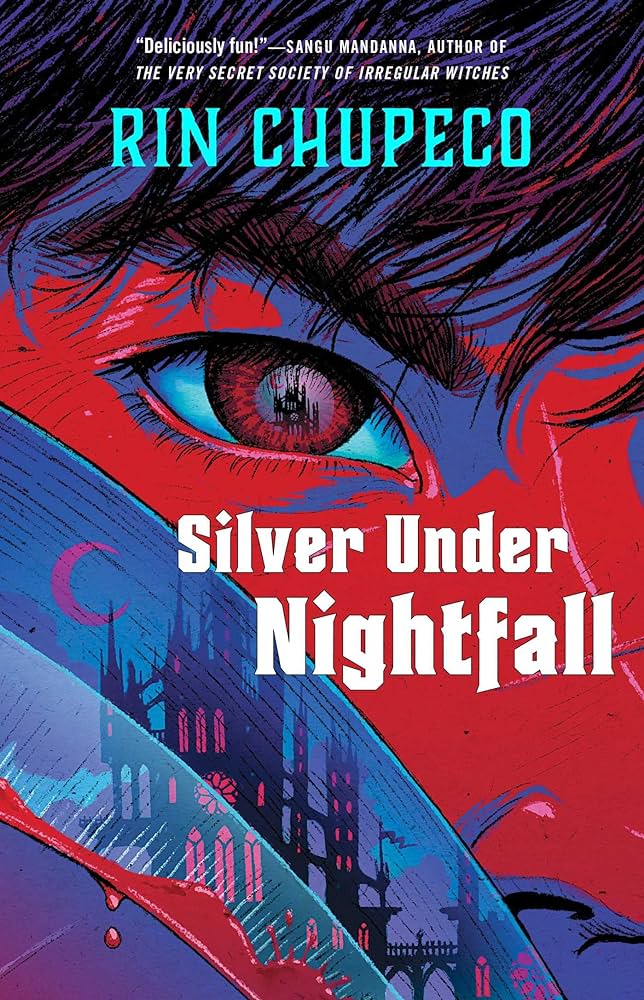
#REVIEW: Silver Under Nightfall, by Rin Chupeco

Yes, that’s right, three book reviews in three days, although this one is going to be shorter. Rin Chupeco is kind of a known quantity around here; this is the … sixth? of their books that I’ve read, and I’ve enjoyed all of them and at least one or two have made my end-of-year list. And, honestly, Silver Under Nightfall sat on my unread shelf for long enough that by the time I picked it up to read it I’d forgotten what the hell it was about.

And, honestly, I may never have known what it was about– it’s possible that I just ordered the damn thing on reflex because of 1) that cover (my god, that cover) and 2) Rin Chupeco. Again, known quantity. I buy Rin Chupeco books. It’s a thing I do.

It’s, uh, about vampires? And a bisexual vampire hunter who falls in love with both members of an engaged outwardly-cishet vampire couple? And there is so, so much sex that I promise you is nowhere to be found in the Bible, and that’s three super queer books in a row now. And I’m sorry, but “vampire hunter who falls in love with some vampires” should absolutely have led to me putting this book down, never looking at it again, and quietly looking down on anyone who said good things about it. I’m tired of vampires. I’m tired of vampire books. I’m definitely tired of vampire books where the vampires are irresistible and fuck everything. At least there are no werewolves, I suppose? Yet?

Finished the fucker in a day. Reflected on just how different Chupeco’s writing style is in this book compared to everything else they’ve written. Looked up the sequel. Got mad that the sequel wasn’t available in paperback yet, since my copy of Silver is in paperback. Spent ninety fucking dollars on the absolutely fucking breathtaking Illumicrate editions, which will probably take so long to get here that the paperback will be out by then anyway.

I’m mad at myself. Go read it.

#REVIEW: To Cage a God, by Elizabeth May

“I don’t understand reviews sometimes,” he said, as the first sentence of his book review.

I have received two books through my new Illumicrate subscription– one, Fathomfolk, was already on my radar, but Elizabeth May’s To Cage a God was a book I’d never heard of by an author I’d never heard of. Which sounds like snark, but I hope it’s obvious that it isn’t– there are lots and lots of books, as it turns out! Anyway, I looked it up on Goodreads when I was ready to start it, and … well, it didn’t look hopeful. Generally anything under a 3.5 is going to be a rocky road, and this is at 3.3 right now. Sometimes that happens solely because a book is written by a woman or a person of color, though, or– God forbid– features women or people of color, or The Gays, so it’s not always a useful metric, but it’s usually a fair bet that an aggregate score under 3.5 is going to be a mixed read at best.

I’m happy to say, having read the book, that I don’t have any idea what the hell the reviewers are on about on this one. This book is indeed written by a woman, and does feature The Gays, but scanning through the reviews didn’t immediately produce any reviews that appeared to be the result of a pile-on or a Neanderthal eruption, so I just stopped looking and stopped worrying about it.

To Cage a God is a political thriller wrapped up in an intriguing magic system with a dollop of romantasy on top, and at its best moments it reminded me of something that Lisbeth Campbell might have written. And, honestly, this book and The Vanished Queen have a lot in common, and although To Cage a God has the romantasy aspect and tilts just a bit more toward YA than Queen does, if you enjoy one you’ll likely enjoy the other.

I want to talk about that magic system for a bit, though, because it’s super cool. All of the POV characters are part of a conspiracy against the Evil Empress (not actually her name, but it’s more fun to call her that) and all of them have different motivations and abilities that they bring to the revolution. Magic abilities in this world are granted by literally– and, it’s implied at least, physically, take a close look at the cover– imprisoning a dragon inside your body, and dragons are gods. The book uses the words pretty interchangeably, but the gods have teeth and claws and move around and are not remotely beyond inflicting pain on their hosts if they feel like it. In fact, one character’s god hates her and she has to more or less practice blood magic in order to convince it to do anything. The gods also have opinions about each other, and at least one relationship in the book is driven by mutual attraction of the gods as much as the humans involved. It’s really cool, and I’m looking forward to more exploration of the idea in the conclusion to the series, which I believe is currently planned as a duology but stands really well by itself. All of this stands against the background of a war with another nation that is talked about but never appears on the page, so I assume the sequel will delve into figuring out what to do with the new political status quo at the end of the book.

I have some minor gripes– the Evil Empress is a bit much, but in a sort of delightful way– one can imagine Glenn Close or Angelina Jolie just devouring scenery by the handful while playing this character, and the book as a whole is a little tropey, but tropes become tropes because when they’re well done they’re effective, and they are. It’s always nice to pick a book effectively at random and be rewarded by it, and I didn’t even pick this one, so it’s a genuine pleasure to be able to recommend it. I’ve ordered the non-Illumicrate hardback so that I have something to match the sequel on the shelf when it comes out. You don’t need to buy two copies, but definitely check it out.