In which I started with Pong

I’ve been playing Ghost of Yotei during my scant free time lately— it’s kind of nuts how busy the last couple of weeks have been, now that I think of it– and so far, about ten hours in, it’s at least the equal of Ghost of Tsushima, its predecessor, one of the best games I’ve ever played. If you go look at my review of Tsushima, you’ll notice I keep harping on how amazing the facial animation is– and, yes, I used the same line about Pong, which will keep being relevant until I stop playing video games.

I hit a moment last night that absolutely floored me, to the point where I decided I needed to be done playing for the night because there was no way anything else I was going to do in that session was going to top it. I’m going to dance around some spoilers, but I’ll do my best to be as ambiguous as possible.

There is a moment in the game where a character encounters another character who they believed was dead. And there is a good three or four seconds where you realize what is going on before either of the characters speak, just from the look in the eyes of the character realizing what is going on. Their eyes moisten, just a little bit, and the look that crawls across their face is this amazing and perfectly readable mix of disbelief, joy, relief and shame, and it is quite simply the most complex emotional moment I have ever seen a digital character convey in my entire life.

(To be clear, that’s a random screenshot above. I found some online that were from right around the moment I’m talking about and decided not to use them to avoid even that much of a spoiler.)

And this is just ten hours in. I’m sure there is more to come. That said, Sucker Punch, if you fuckers kill my horse again after what you did to me in Tsushima, we’re gonna have a problem.

#REVIEW: Making Enemies: Monster Design Inspiration for Tabletop Roleplaying Games, by Keith Ammann

We’ll begin with my absolute favorite thing for book reviews: Disclaimers! First, that I got a copy of this book for free (it comes out on Tuesday) and second, that I’ve known the author for a vaguely shocking twenty-two years, and not in the usual parasocial Internet way that I know a fair number of authors but in a “he’s been in my apartment and we’ve worked on grad school projects together” sort of way. There’s a review of his book The Monsters Know What They’re Doing here; this is actually his fifth book, technically part of a series but, given that they’re all roleplaying sourcebooks dedicated to helping game masters for TTRPGs do their jobs better, there’s no reason to feel like you need to read them in order. I admit it; I have not read the books in between, although I intend to.

Here’s the thing about Keith, guys: Keith is one of the smartest motherfuckers guys I’ve ever met. He’s ludicrously well-read and he’s got a mind like a steel trap. If he had been born seven hundred years ago he would have been a monk and would have discovered something that we all take for granted by now; if he’d been born in the 1810s instead of the 1970s you would never have heard of Gregor Mendel. However, he was born in the 1970s, so instead of more or less inventing genetics as we know it, he writes about roleplaying games.

Making Enemies is, ostensibly, about creating home-brew monsters for your TTRPG campaign. He doesn’t limit himself to Dungeons & Dragons with this one; attention is paid to Pathfinder, Shadowdark and Call of Cthulhu, along with another system that I have to admit I’ve never heard of called the Cypher System. Each section of the book begins with a more generic introduction to/discussion of the aspect of monster design being discussed, such as morphology, abilities, size and number, quirks and weaknesses, etc; and then there will be sections afterward dedicated to the differences you’d see among each of the specific systems. I felt like Call of Cthulhu got a little shorted, as it doesn’t quite work the same way as the rest of the systems (You Are Fucking Doomed is more or less Call of Cthulhu’s entire thing, and this book is about making good enemies for your players, not killing them in seconds) and of course D&D gets a bit more attention than the others, but there’s good stuff here for everybody who plays TTRPGs.

Nothing I’ve just said is sufficient to prepare you for just how deep this book gets, over and over and over again. The chapter called Weird Nature, about monster type and morphology, could be copied and pasted into a biology textbook with barely a sentence changed. The book interrogates the entire concept of “monster” over and over again in a way that is completely fascinating and yet in some ways entirely unnecessary to a book about TTRPGs, which are generally much more lowbrow than this. There are interviews scattered throughout the book with professional game designers, and it’s stunning how high-level, no pun intended, some of these discussions get. I would love to know how much actual research went into this book that had no direct relationship to TTRPGs. My guess is: lots.

(Memo to Keith: go whole-hog on your next book. I want four hundred pages on your theory of game design. Do it.)

But seriously. I feel like I should have been taking notes and adding Post-Its into the book while I was reading it, and the reader of this book should be prepared to see the occasional quotes from genuine academic works of philosophy and then less than a page later an anecdote about The Muppet Show. That’s not to say that this book doesn’t have a ton of good old-fashioned in-the-weeds nerd math, because it does. Witness:

I’ve talked about this before: I love enthusiasm. My favorite thing about TikTok is how great of a vehicle it is for people to share activities they love with other people. And the reason I feel so comfortable recommending what by rights ought to be a very niche book to literally everyone I know who reads is that Keith’s incredible enthusiasm for game design and TTRPGs shines through every page of this book. I enjoyed The Monsters Know What They’re Doing quite a bit and recommended it, but I was clear (and so was the book!) that it was a book for people who ran TTRPG games. I think there are people out there who would enjoy this regardless of what they’ve done in the TTRPG space; if you consider yourself an autodidact and an intellectual (dare I say “polymath”?) you may find yourself skipping the weedier sections here and there that get into specifics about the systems, but the interviews and the beginnings of every chapter and the relentless attention to careful thinking throughout are going to bring a smile to your face.

Making Enemies comes out October 7th. Check it out.

#REVIEW: Wuchang: Fallen Feathers (Xbox Series X, 2025)

The tl;dr: this was so close to perfect, but probably needed another month or so to cook before getting released.

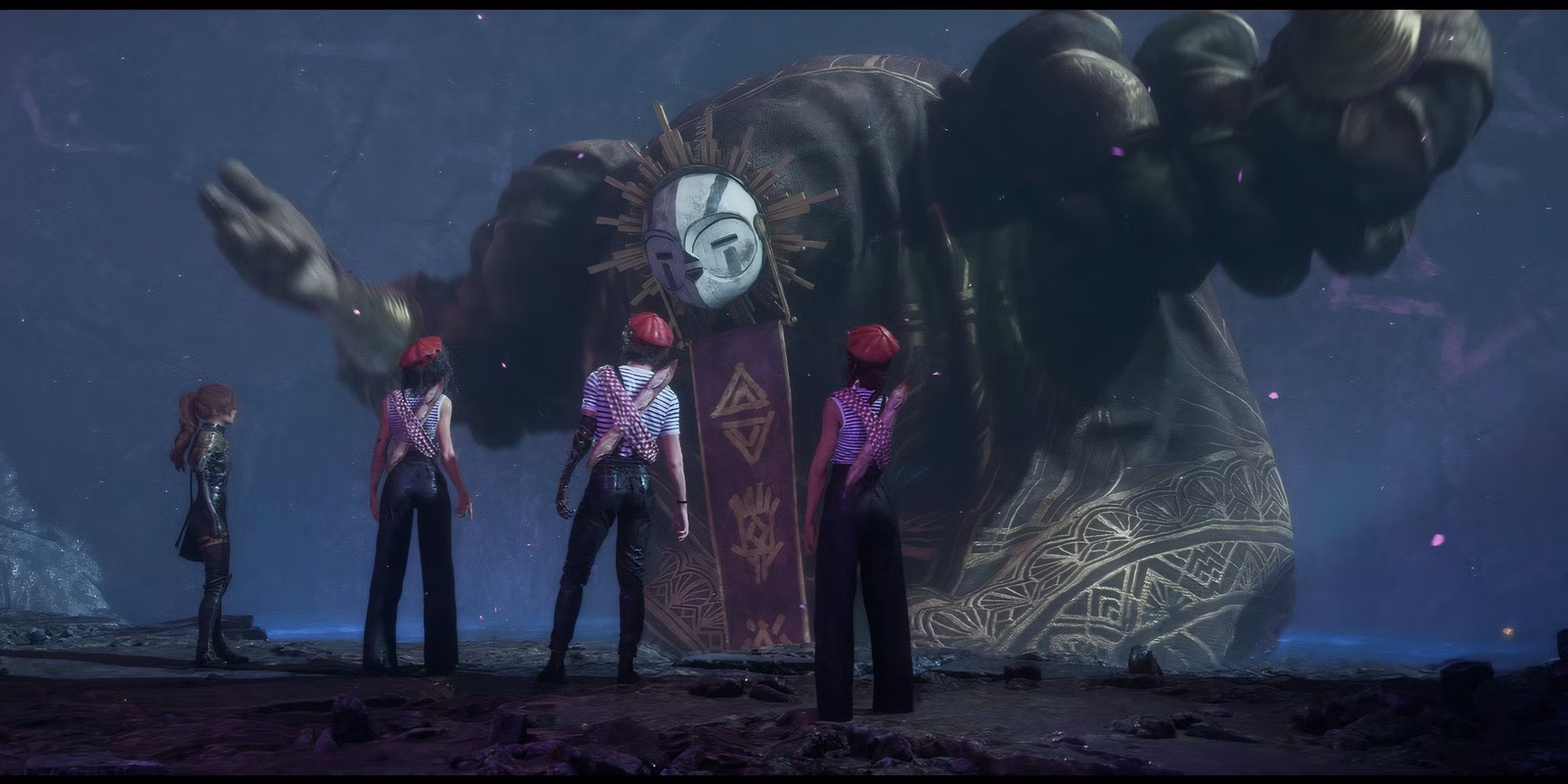
I beat Wuchang: Fallen Feathers last night after 60 or so hours of gameplay, and for the most part, I was really, really happy with it. Most of my gripes are technical, and the things this game does right, it does very right. This is a Soulslike through and through, which is currently my favorite kind of game, and it hits all the buttons: deep combat, wildly variant weapon builds, obscure quest lines, difficult boss combat, and an emphasis on exploration. The exploration is the best part; Wuchang may have the best interconnected world map I’ve ever played, and it’s incredibly rare that you’ll see a path fork off and one of them end a little bit later in a dead end with a treasure in it. Everything loops around and leaves you somewhere, and it was harder to keep a mental map going (note: this is a good thing) than I’ve seen in a game like this in a long time.

There’s three different major things that this game does that distinguish it from a run-of-the-mill Soulslike. First, what the call the Skyborn Might system. All of your spells and some of your combat abilities are based on how many stacks of Skyborn Might you have at any given time. You can have up to five, and spells will cost from one to all five stacks and weapon abilities generally cost between one and three. Skyborn Might is earned mostly by perfectly-timed dodges, although most weapons have at least one other way you can earn it and there are different items that can add to Skyborn Might as well. One that I kept equipped for most of the game automatically generated Skyborn Might on kills, which came in really handy. Skyborn Might deteriorates over time if you don’t use it, which was good and bad– it encourages you to use your abilities, on one hand, but on the other I felt like it deteriorated too fast, and I’d have liked some way to slow down that deterioration, whether it was a more permanent item or a consumable.

The second is the Madness system. Killing human enemies and dying both generate Madness, and killing nonhuman enemies and various items and locations can decrease it. Increasing your Madness has two major effects: it increases your damage noticeably the higher it is, and it at least supposedly increases how much damage you take, although I went through the whole game without ever feeling like that had caused a death. I never really even noticed it.

On top of that, if you die, you lose a percentage of your currency (Red Mercury as opposed to souls, or blood echoes, or whatever) and that percentage is based on how high your Madness is. If your Madness is less than 100% you can pick your resources up from wherever you died. If it’s at 100%, though? You’re gonna generate a Madness Demon when you go back to get it, and if that Madness Demon kills you, your shit is gone. On the other hand, if you kill the Madness Demon, you get a bunch of other stuff on top of your lost materials, and Madness Demons can be baited into attacking anything, so there are places where generating one on purpose (there are items that raise Madness as well) can be a sound strategic maneuver against an enemy that you can’t find a way to beat. This won’t work on bosses– you can’t generate demons inside a boss arena– but there are occasional more powerful red-eye enemies scattered around, and letting one kill me, generating a demon, then triggering her and running away to watch the two of them fight was fun.

The third is the upgrade system, which runs off of an upgrade tree. Each weapon style (Spear, Greatsword, Axe, Dual Blades, and Longsword, and I spent most of the game in Greatsword) has its own tree but you can go anywhere you want on the tree and you can respec any time at will. Weapon upgrades are also built into the skill tree, and the awesome thing is that 1) any weapon upgrade affects every weapon of that type, even if you get a new one later, and 2) you can respec your weapon upgrades just as easily as your own abilities. So unlike, say, Elden Ring, where if you make a change to your preferred weapon late in the game you’d better hope you have enough upgrade mats available to level that weapon up, if you had a +9 axe and you want to switch to greatsword your greatsword will automatically be +9. In fact, all five of the greatswords you’ve found will be +9, and if you find a sixth that’ll be +9 when you pick it up. In every other Soulslike I’ve played, just because you leveled up Longsword A doesn’t mean Longsword B is improved as well. This is a huge improvement.

The problem is the performance. This game, at least on Xbox (I picked it up here because it’s currently free on Game Pass) is very poorly optimized, and while you can lock the framerate at 60, you’re going to see constant blurriness and focus issues as the game struggles to keep up with itself. I played without the frame rate locked for a little while and the frame drops were so bad I had to switch back. This is on the Series X, mind you, which is supposed to be the beefy one; I can’t imagine what this would play like on the less powerful Series S. There are some balance issues– there’s a huge difficulty spike with a boss about a third of the way through the game, and the game really expects you to use a certain mechanic to beat that boss, only all weapon types don’t have access to that mechanic. As it turned out, I’d started with a Spear build, and the Spear build is the one least capable of managing this boss. I had to respec, and once I did I sailed past her. Now, again, the game encourages painless experimentation, and I could have switched back afterwards, but it left a sour taste in my mouth. I don’t object to the idea that certain bosses are weak to certain styles and stronger against others; that’s a staple of the genre– but “you need this type of ability to win here, and this weapon doesn’t have that at all” is a problem.

There’s a few other things; it’s way too easy to fall off of ledges, which is partially a skill issue, and until very recently the icon that shows where you dropped your resources was really hard to see against some level backgrounds and invisible if you were unfortunate enough to die in shallow water, but they’ve patched that problem out in the last couple of weeks. I know Soulslikes aren’t for everybody, and if they aren’t your thing you’ll want to stay away from this, but if they do, and especially if they do and you’re on Game Pass? Hooooooly shit. And it’s only $50 at full price, and it’s a good enough game that I’m considering picking it up for the PS5 anyway. Check it out.

#REVIEW: Crypt Custodian (2025, Xbox Series X)

For the record, I did see Fantastic Four: First Steps today, and it was magnificent. Full review coming, probably tomorrow.

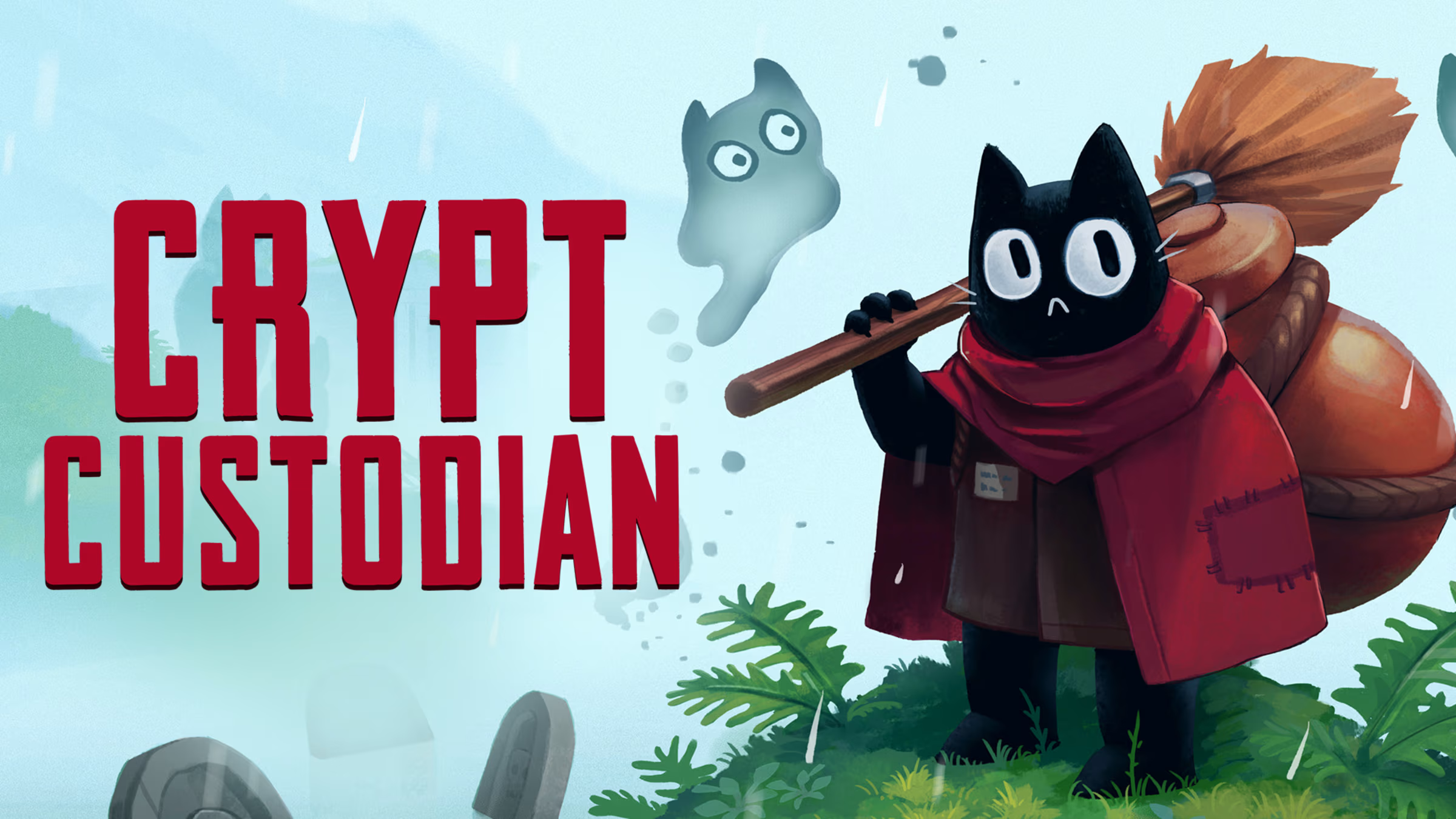
I finished Crypt Custodian yesterday, hitting 100% after about fifteen hours of play, although there’s a boss rush mode I’ll need to dip into if I want to get all the trophies, and I’m probably not going to. It’s one of the nicer surprises of the year, because I basically just grabbed it for free from Game Pass based on the image you see up there.

It’s a Metroidvania. You play a cat. You’re dead and a ghost. You’re prevented from entering paradise by a really bossy dead frog (that’s not a joke) and you spend the entire game cleaning up trash with your broom and whacking monsters with it. In classic Metroidvania fashion, you unlock a bunch of abilities over the course of the game that let you go back and get into areas you couldn’t reach before, and while I have no intention of spoiling the ending, it revolves around making 10 friends so that you can invade Paradise and visit your still-living loved ones, and the ending will make you cry a little bit.

I play these games for the exploration, right? This is the map:

Or, if you prefer a slightly more abstract, right-click-for-much-larger version, you can have this one:

Don’t worry about the Chinese, the words don’t matter. The point is the map is ridiculously large, and the different areas are wildly different, some with environmental challenges (one area reverses its polarity every time you dash, making walls and floors either appear or reappear along with roughly half of the enemies at any time) and some that just look cool. There’s rainy forests and castles and tombs and enormous retail backrooms and an amusement park. You can teleport to save spots at any time and there’s no penalty for dying, and you can even unlock a power-up late in the game that prevents missed jumps from hurting you, so there’s a strong incentive to just pick a direction and go. Your power-ups can be equipped using little upgrade spheres that can be found or purchased, so there’s an element of switching back and forth between them depending on what you need to do– I found myself with an exploration build and a boss fight build after a while, for example– although by the end of the game you can find enough of the spheres that you can equip nearly everything you need, and you might be able to buy as many spheres as you want; the one vendor doesn’t seem to run out of them.

So, yeah. Games like this are why Game Pass is worth the money; this game is delightful and everyone should play it, whether they have to pay for it or not, but if you can get it for free then you really have no excuse. Give it a shot.

#REVIEW: Clair Obscur: Expedition 33 (2025, Xbox Series X)

You should play this game, regardless of how much time I spend dwelling on its mistakes in this review. Despite the … uh … let’s go with unwieldy name (“Clair Obscur” just means “light dark” in French, which is not better) this is a smart, tremendously well put-together game with a great story and impressive game mechanics that stumbles in an equally impressive fashion at the end. It’s turn-based, which is normally a sign for me to stay far away from a game, but it manages to throw in a few mechanics that depend on timing and skill anyway– your characters can parry or dodge attacks and there are a couple of other special attacks that you can avoid in specific ways as well. Dodge everything and you won’t take any damage; parrying successfully can lead to automatic counter-attacks. If people haven’t started doing no-damage or even no-attack runs on this game yet, they will be soon.

But the most impressive thing about Expedition 33 is its story, and I’m not telling you a damn thing about it other than the game is set in a vaguely post-apocalyptic France, except it’s not, and even the reason it’s not really set in post-apocalyptic France is a whopper of a spoiler, so I’m not going to say anything about it. Usually when a game is set specifically in a non-English-speaking culture I’ll do the audio in that language, but there are a couple of big names in the English voice acting team and I’d recommend you stick with that.

There were at least two times in this game where story developments knocked me flat on my ass. Prior to playing this, the most jaw-dropping moment I’d ever encountered in a video game’s story was the “would you kindly” moment in Bioshock, which came out in 2007. (If you don’t know what I’m talking about, find something that can play Bioshock and get on that. Right now.)

At any rate, the Bioshock moment held a record for 18 years. The first moment in Expedition 33 held its record until the second moment. The game’s story is going to rip your heart out and stomp on it, more than once. Be prepared for that.

On a technical level, it’s one of the best-looking games I’ve ever played, particularly in its renditions of the game’s people. Everyone looks great, and the facial expressions especially are masterfully done. There’s a moment in the final battle where I think the game really wants you to notice someone having second thoughts without drawing direct attention to it, and it’s just incredibly well-done. The characters are memorable, and Esquie, who is a giant sentient balloon-thing who basically acts as transportation for your group, is probably the most adorable character I’ve ever seen in a video game before.

Here’s the problem, though: The game has three acts, and the story is effectively over at the end of Act 2. All you have to do at that point is go beat the main boss, and the game tells you exactly where to go to find that person. You are probably already leveled up enough to be able to get the job done, too. But there is a huge amount of content left– you’re no more than 50% of the way through the available locations and the handful of collection objectives the game has cannot be completed before the end of Act 2. The problem is, with no story left to get you to go anywhere, you’re either just grinding until you get bored or kind of flailing about because suddenly most of the “new” areas are way too tough for you. And that’s a damn shame. I ended up beating the game because I didn’t want to play anymore, and that’s not how this game should have ended. On top of that, because of the amount of extra stuff I’d done and some fiddling with optimizing my characters, when I finally got to the final boss I beat the shit out of him because he was scaled to be able to fight him right after completing Act 2. The climactic battle of this great game was over in no time because I was so overpowered– and had I maxed out my character’s available levels (I wasn’t even close) it would have been so much worse. I hadn’t even found the best available weapons for two of my five, and the ones I had weren’t fully leveled up. I never even found the materials necessary to hit max level on weapons, and beating the boss before that happens is nuts.

The pacing in this game is really unforgivable, and it’s amazing to me that no one caught it in play testing. All they would have had to do is move some of the major story beats back a bit, or given Esquie the ability to fly earlier in the game– he gets it automatically at the end of Act 2, but again, if you want, the game is effectively over at that point. And it’s a damn shame to be thinking that a game is a shoo-in for Game of the Year for the first two acts and then beat it because you’re bored five or six hours later.

So yeah: mostly successful, and hugely successful at what it’s good at, but with that one huge caveat you should be aware of. Play it anyway.

#REVIEW: Crime Scene Cleaner (Xbox Series X, 2024)

I can’t believe I mean this: right now a game called Crime Scene Cleaner is somehow one of my favorite games of 2025. That sentence is true. I have spent twelve hours or so mopping up blood, moving bodies, and picking up broken glass in a video game, and it may be the most chill and genuinely relaxing game I’ve ever played.

The premise is real, real simple: you’re a janitor who gets hired by a mob boss to clean up after his people. You take the job because you need money to pay for your daughter’s hospital bills, which makes this the most American game of 2025. You accept jobs through your computer and the occasional phone call from “Big Jim,” the guy who signs your checks. You have a dog. There’s an achievement for petting the dog 15 times. The crime scenes range from a small apartment to an entire museum to a giant warehouse. At the end of each job you get paid based on how thorough a job you did; money can be used, not to pay for your daughter as you might think, but to upgrade your cleaning tools, accomplished through a skill tree, so you honest-to-God might pay for an upgrade to how much blood your mop can clean up before you have to wring it out in a bucket, and you can also upgrade how many detergents you can add to the bucket at once. By the end of the game you’re able to dual-wield sponges, which is not a phrase anyone had ever said or thought of before this game came out.

There is something primordially satisfying about walking into this:

and walking out an hour later with the floor and walls spotless, the broken tables whisked away, the bodies safely stored in your truck, and everything that wasn’t broken put back exactly where it belonged. There are some collectibles– every level has a few cassette tapes hidden away, and there are secret areas all over the place that you can uncover, and exploration is a lot of fun, especially once you unlock the– again, I’m not kidding– upgrade that lets you walk across blood without leaving footprints all over the goddamned place afterwards. You’ll need to find keys and the occasional key card, and oh, you’ll also rob everyone blind while you’re cleaning. The great thing about working for the mob is the people they send you after tend to have piles of cash and jewelry and stuff just sitting around! They’re all dead, they don’t need it any longer.

There’s no real point in talking about graphics or sound; they’re good enough and no better. The rag doll physics can occasionally be kinda ridiculous. You can jump or fall from any height and be fine; it’s impossible to die, so there were definitely times where I was moving a body and just chucked it off a balcony and then jumped after it rather than carrying it down the stairs. My only real gripe is that if you’re a completist, like me, and you want to 100% everything, every so often there’s a single bullet that you accidentally knocked somewhere with your mop that takes an hour to find, or a single spot of blood that you just missed that is too small for your UV lamps or your “Cleaner Vision” (no, seriously) to spot easily. Having to end a level at 99% blood cleanup because you just could not find that last spot is kinda annoying, especially when the game really does need about an hour to an hour and a half per level.

But yeah. This was a blast. Twelve hours or so was enough to 100% every level and get all but five of the achievements; I’m gonna jump back into finish those off just because I’m that guy. It’s on Game Pass right now, so if you have that, you don’t have to pay for it, but it’s worth the $20 or so you’d pay if you actually buy it.

Oh, and I vacuumed the whole house today, because I’d been cleaning in a video game for several days and felt kind of guilty about the condition of my actual house, which is a real place with cats in it that needs vacuuming way more often than I actually do it.

My day in two images

This is kind of an #iykyk image, I suppose, but I finally polished off The First Berserker: Khazan tonight after 78 hours, which is absolutely outlandish for an action game. This is a remarkable achievement in game design, even if it has a really stupid name(*), and everyone who likes video games should play it, but God damn is it difficult, to the point where I had to (not “decided to,” had to) turn down the difficulty for the final boss and even then it took a couple more hours. Got the true ending, though, so yay me. I’m actually planning on playing through it one more time to scoop up the couple of trophies I missed. Possibly not immediately, mind you, but it’s definitely happening.

(*) This game features no berserking and no berserkers, in case you were wondering, and in fact has no mention of berserkers in any way. I mean, Khazan’s pretty angry, but it’s a revenge story, so … he sorta has a reason for it? The really interesting thing is that this game is a combination of two of my other all-time favorites– it’s Nioh 2 with Sekiro: Shadows Die Twice‘s combat system bolted on to it, and Sekiro also has a deeply stupid-sounding name that does not match up to anything in the game. Weird, right?

My wife and I went to this local consignment place today, just for the sheer hell of it. The place was 90% junk with a few interesting items scattered here and there– nothing to get us to spend any money, mind you, but some interesting crap– and this caught my eye.

This is the ACABiest ACAB that ever ACABbed, and fuck the semiliterate person who created it (I can only assume that “congol” means “cajole,” which is exceptionally shit spelling), fuck the person who decided to put it up for sale, and fuck anybody who eventually buys it. This is a supremely fucked-up thing to decide to hang on your wall as decor, and thinking of the police this way and approving of it borders on mental illness.

Done-ish

The problem is that there are zombies at the end of the tunnel.

I have just completed my final exam notes for my 8th grade Math classes, which means that other than maybe creating some meaningless game-type worksheets– Sudokus and word finds and the like– I am done with any lesson planning for the 2024-25 school year. I’m certainly done with anything that matters. We’re doing final exam review through Wednesday, the final is Thursday. I’m going to do two hour long after-school sessions to do additional review for anyone who wants it on Tuesday and Wednesday. I expect them to be sparsely attended. The four days of school that remain are for nothing.

(Weird teacher pet peeve: occasionally people will hear things like that and say “Well, then they should make the year shorter, if you can be done early!” This would make sense except for the part where there would still be last days of the year. The point is that we have to get done before the kids go home, and there’s actually a ton of non-academic crap to happen at the end of the year!)

Anyway, I pretty much just have to get through the next four days without going to jail, which should be manageable. Should. We are probably going to have some students going to jail over the next few days, as the office has been pretty militant about the whole “start a fight and your ass is getting arrested” thing lately. But I should be able to manage. I hope.

In other news, I’m at the final boss for The First Berserker: Khazan, a game with a dumb name that I have put about 75 hours into over the last couple of months, and while I’ve enjoyed the game tremendously the thought of learning the moves for a three-phase final boss is proving to be so exhausting that I’m not sure I even want to do it. This game has been militant about the fact that there is never any way to cheese anything; you’re going to learn the bosses or you’re going to die. Most of the time the learning curve has actually been pretty fun, but three fucking health bars just feels like punishment and not fun. On the other hand, I can probably anticipate coming home wanting to blow off steam a lot in the next couple of weeks? I dunno, we’ll see. Maybe I’ll play something else and come back to it. There’s gotta be a fun game on the five to ten hours range out there somewhere, right? Anybody wanna recommend anything?