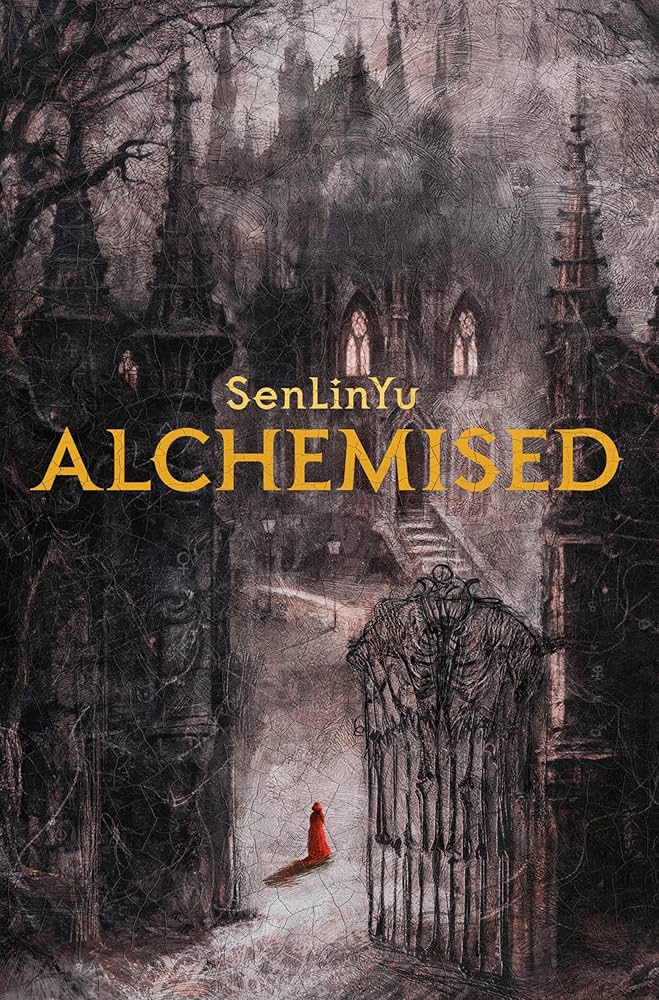
I’ll be halfway done with this beast of a book before I go to bed, and … it’s not terrible, but it’s kinda boring? And I was expecting any number of possible reactions to it, and “boring” was not one of them.
One indisputable good thing: there has not been, after about 430 pages, even a single trace of the source material to be found. I have no idea how SenLinYu managed to adapt this from a fanfic of any kind. I’m not going to go looking for the original to compare them or anything, but I think it’s reasonable to lay that worry to bed.
Anyway, off to — no, not reading, you silly goose, Ghost of Yotei is out. My PS5 is calling.
I think we all knew this already, but it’s official: I can be manipulated. Rather easily, in fact.
I don’t know if you live a lifestyle that allows you to not have heard of the above book. If you do, I envy you, because it has been everywhere on my everything for two solid weeks. I first became aware of it several months ago, and actually had it preordered for a while, a preorder I cancelled when the word Dramione first entered my vocabulary.
So why do I own it now, snagging it from my local Barnes and Noble for a surprisingly reasonable $21 and change?
Because the reviews this damn book has been getting have been ludicrously good, and while I don’t really think it’s going to be all that good, and I’ve been burned by BookTok fads approximately fourteen thousand times before, if this book is half as good as people have been claiming it’s going to be something I need to read. And the reviews don’t seem quite as dominated by young women as one might expect; TikTok is the world’s epicenter for the “book girly,” a category that I think is supposed to exclude grizzled and ancient penis-havers such as myself, but I’ve seen guys talking about it too, if perhaps not quite as glowingly.
It’s a thousand fucking pages long. I have far too many thousand-page books on my TBR, and seriously, y’all are never going to stop laughing when you see the state of my shelf tomorrow. I will get to it when I get to it, God damn it, and if I don’t love it I’m never trusting another TikTok book of the moment again.(*)
That was a lie, sadly. I knew it was a lie when I was typing it, and it’s a lie now.
The fucking book doesn’t even have pretty edges. I’m trying to save for a down payment on a car, damn it, what the hell am I doing?
(*) What am I reading right now? Book five of Dungeon Crawler Fucking Carl. Which is so much better than it has any right to be that there should be some kind of law that it’s breaking.
I’ve done not much but sleep this weekend, and at least one person in the house has Covid and at least two are sick, and I didn’t have a lot of grading to do today but what I had to do was immensely annoying.
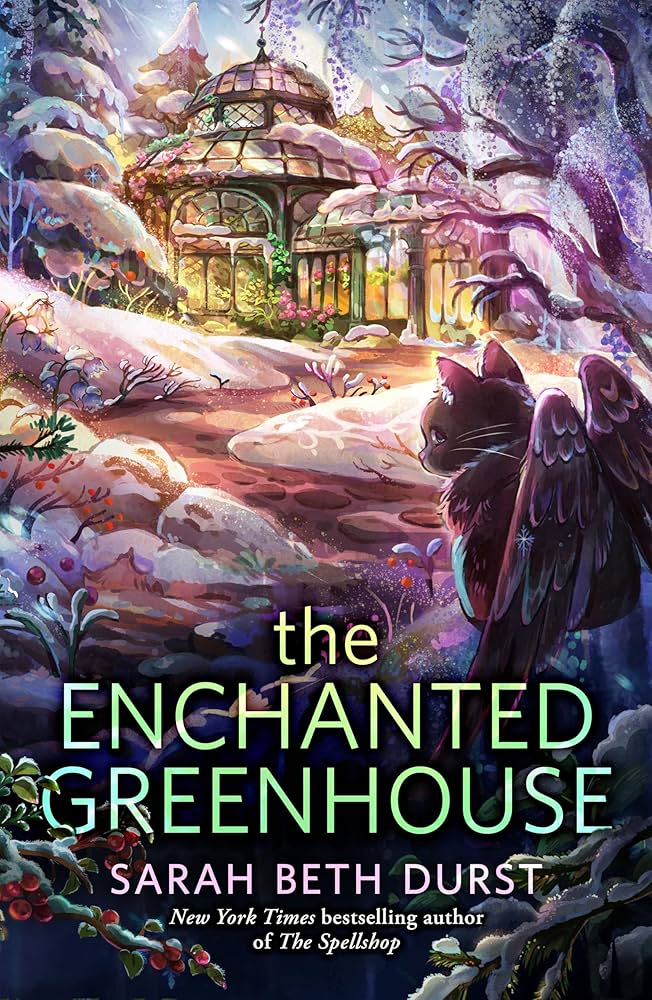
So, please, forgive me, when I write a very short review, less than it deserves: that The Enchanted Greenhouse is delightful, and it’s a sort-of sequel (same world, different characters) to The Spellshop, which I didn’t review when it came out last year but was also delightful, and it was absolutely the antidote to having read a bunch of books lately that I didn’t like all that much. It is short (I finished it in less than three hours, easy), low stakes (sure, “cottage core” or “cozy,” either works) and has a romance angle without ever descending into smut, and there are talking plants and a cat with wings.
I loved it, but I’m too tired to say much more, so just go read it, and enjoy peeling the pages apart, because something about the way they stained the edges kinda locks them together a little bit, and I’m not gonna sit here and pretend that the physical feeling of splitting the pages as I was reading didn’t add to my enjoyment of the book, because it totally did.
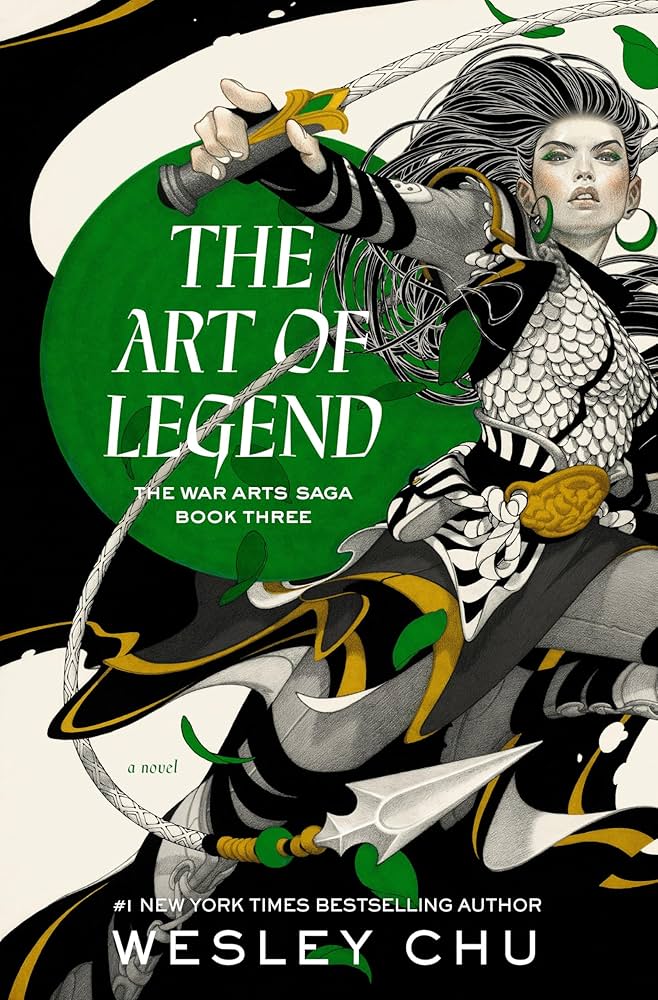
I write negative reviews infrequently enough that almost every time I do I start with a disclaimer like this. Under any circumstances other than “The publisher sent me the entire trilogy because I asked for it,” I would simply not review this book. It feels ungrateful to make other people go to trouble to send me books for free and then say bad things about them. But while I really liked the first book in Wesley Chu’s War Arts Trilogy, I was mixed on the second and unfortunately I have to report that the series’ ending really ends up unsatisfying.
The problem is writing this without massive spoilers. I mean, in one sense I don’t really have to worry about that, I can just say “Hey, spoiler alert,” and then go about my day, but I don’t want to do that either. So we’re going to go the “mild spoilers” route; a lot of what you will see in the next few paragraphs could have been reasonably guessed going into the book, but I’m not going to completely reveal the story.
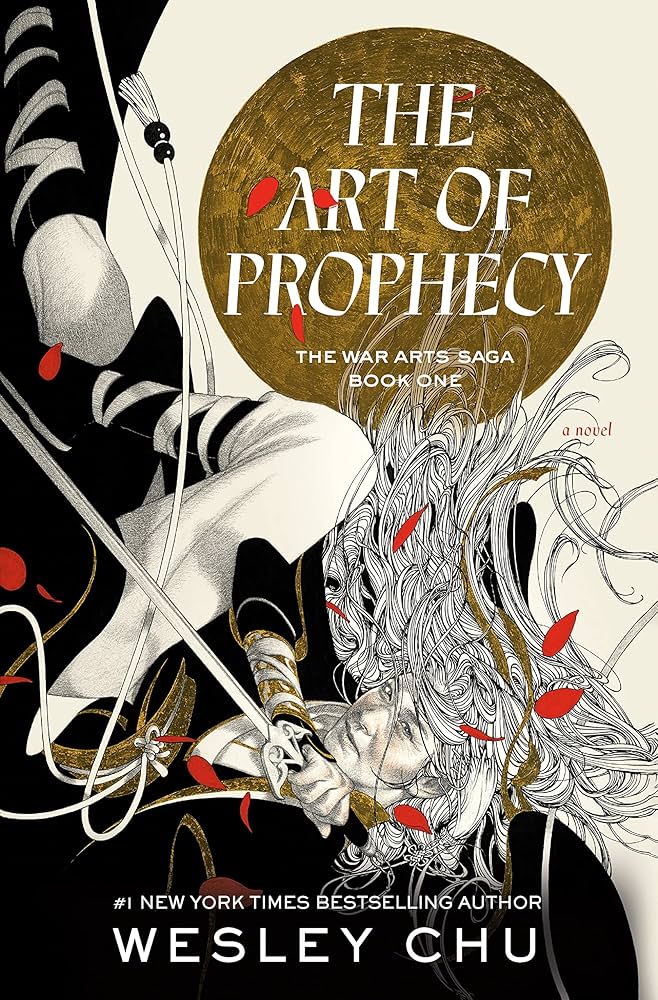
The Art of Prophecy begins with Jian, the Prophesied Hero of the Tiandi and the Champion of the Five Under Heaven. Jian has been prophesied since birth to be the one who kills the Eternal Khan, ending his dominion over the Tiandi people. And then the Khan goes and gets killed on his own, leaving Jian with no more destiny and setting the events of the whole trilogy in motion. In the second book, elements of the Tiandi decide that Jian is actually their betrayer, and he spends the entire series either running from capture or escaping it one way or another.
So, we all know that in Book Three the Khan is coming back, right? Of course we do. And he does. And then he confirms something that I had been wondering about since the first book: he was going to come back anyway. It’s even straight-up stated that even if Jian kills him he’s going to return in a decade or so. Now, one of the POV characters spends the whole first book trying to find out where the Khan has been resurrected and the second book trying to get a chunk of his soul peeled out of her body, so it’s clear that he’s “Eternal” because he keeps getting resurrected. But I had the idea that Jian killing him would be permanent, and … not so much? He’d have come back anyway? Really? What the hell was the point of making such a big deal about Jian, then?
Jian is a problem, honestly, and he’s at the middle of what I didn’t like about the book. The series can’t really decide if if he’s powerful or not– even during the inevitable final battle with the Khan the text itself bounces back and forth between “he’s ready, and this is a real fight” and “the Khan is obviously toying with him and the four other people he brought to the fight” and while Taishi talks about how much he has grown over the years she has known him, I kind of feel like the book doesn’t realize how annoying he is?
A brief diversion: did you watch Smallville or Buffy the Vampire Slayer? You know how Lana was actually really fucking annoying and Xander was kind of a creep, or to use another example, Barney Stinson was a predator and Ted Mosby was a huge loser in How I Met Your Mother, but the TV shows didn’t seem to realize that? That’s Jian. He started off as a pampered, callow youth, and for me, at least, he never improved– he actually faints when he is told the Khan is back. And this is as close as I’m going to come to a huge spoiler, but for a whole series about a prophecy about a dude, that dude has much less to do with the ending of the series than you might expect.
Some of my other gripes are artifacts of having read the trilogy more or less back-to-back-to-back; the bit where Qisami talks like an overenthusiastic memelord and her speech doesn’t remotely match anyone else in the book, or the fact that every insult in the series is inexplicably egg-based, wouldn’t have annoyed me as much had I not devoured 1600 pages of it over a few weeks. Seeing “Let them cook” in dialogue would still have been distracting as hell, though, or the way people keep “eating” punches and kicks.
I dunno, guys. I still stand by enjoying Prophecy, but given where it ends up I can’t really recommend the whole trilogy. I wouldn’t go so far as to call it bad— I three-starred it on Goodreads and Storygraph, and I feel like that’s about right– but it’s not something I’d have talked about had I not been sent the books, and I’d likely have DNFed the final book. I feel bad about it, but there you have it.
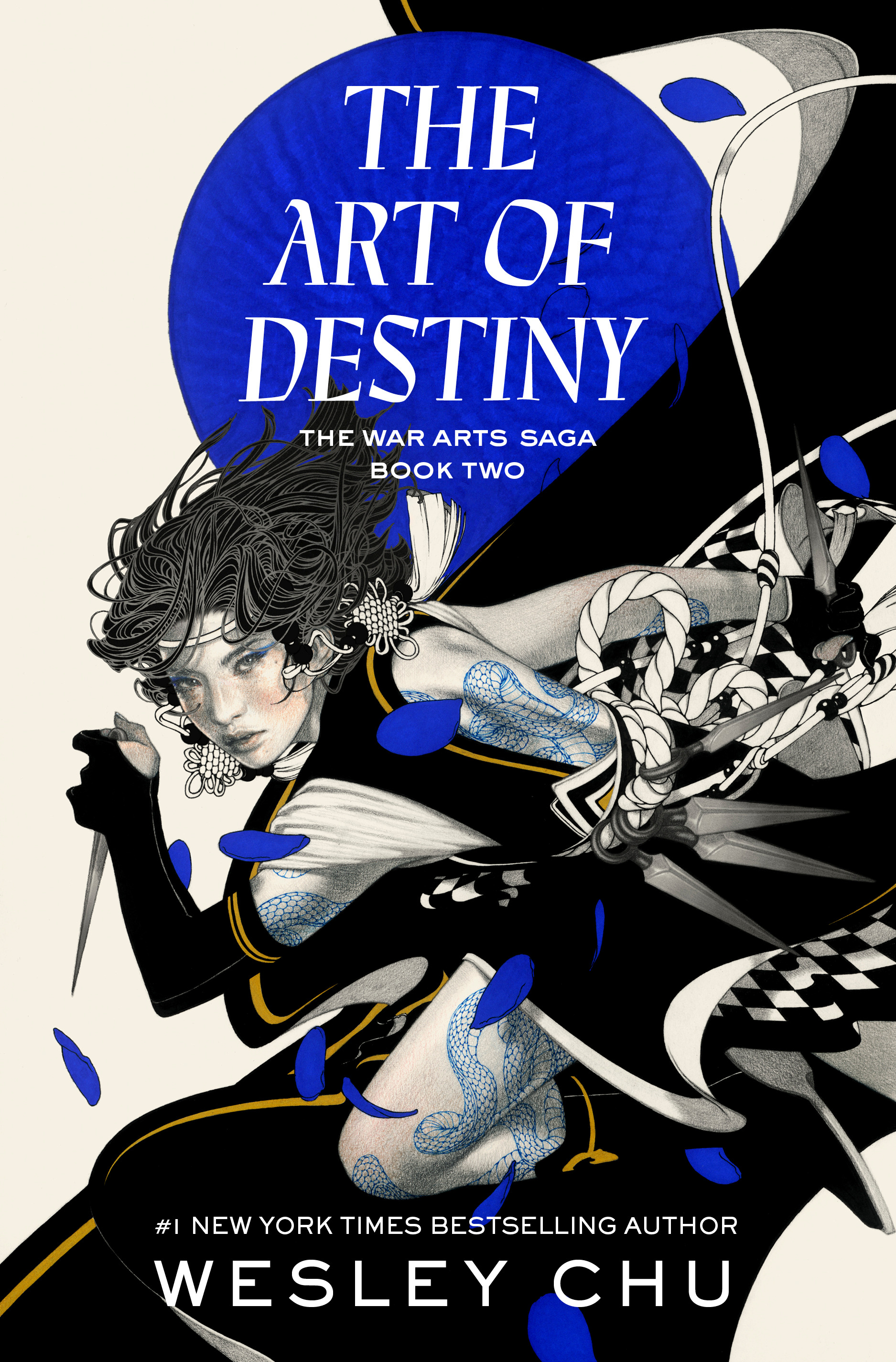
A quick recap: I got asked if I was interested in reviewing Book Three of Wesley Chu’s War Arts Saga, and replied that I’d love to, but I hadn’t read the first two books yet, and somehow that led to me getting sent review copies of the entire trilogy. My review of the first book, The Art of Prophecy, is here, and while I’m not going to go directly into Book Three like I thought, there’s only going to be one book in between, so I’ll probably have a review of that next week sometime.
But yeah. I enjoyed the book, but it definitely has a case of Middle Book Syndrome, where it sort of feels like they’re moving pieces around in preparation for finishing it off in Book Three. Destiny sticks with its same crew of players as the first book; Jian and Taishi are in training, Qisami spends most of the book on a job, and Sali spends the book trying to get the fragment of the Khan’s soul out of her body. Qisami feels like the main character of this one, which is a little odd, as I felt like she was the least important of the leads in the first book, to the point where I don’t think I mentioned her in the review. She has some interesting character development that is almost entirely tied up in spoilers, and Sali has a major status quo change and a clear direction going into the last book. The characters don’t interact as much in this one, either; they all end up in the same place for the last third of the book, but even then nobody really runs into each other; they’re all just doing their thing in the same city.
Jian and Taishi … feel kinda wheel-spinny. Taishi was easily my favorite character of the first book and she’s not got nearly as much time on-page in this book, and Jian gets captured again and it just sort of feels like a retread of a lot of what happened in the first book. There are some interesting developments in the religion around Jian; I was thinking as I was reading Prophecy that it’s super rare in the real world for a prophecy to be proven wrong and its supporters to just shrug and give up, and … well, turns out they didn’t, but I won’t say much more about it than that. But Jian still kind of feels like an immature kid for the majority of the book. There are some signs of maturation toward the very end of the book, so hopefully I won’t feel this way about him in the conclusion to the trilogy.
Don’t misunderstand me; even if I had bought these, this certainly wouldn’t put me off the third book, as a lot of my gripes are just part and parcel of the way middle books in trilogies tend to be messy. It’s not like there was much of a risk of anyone trying to read this as a standalone.
I’ve got another book I was sent for review to read next, as it’s out on the 16th, and then I’ll be diving into the conclusion. Stay tuned!
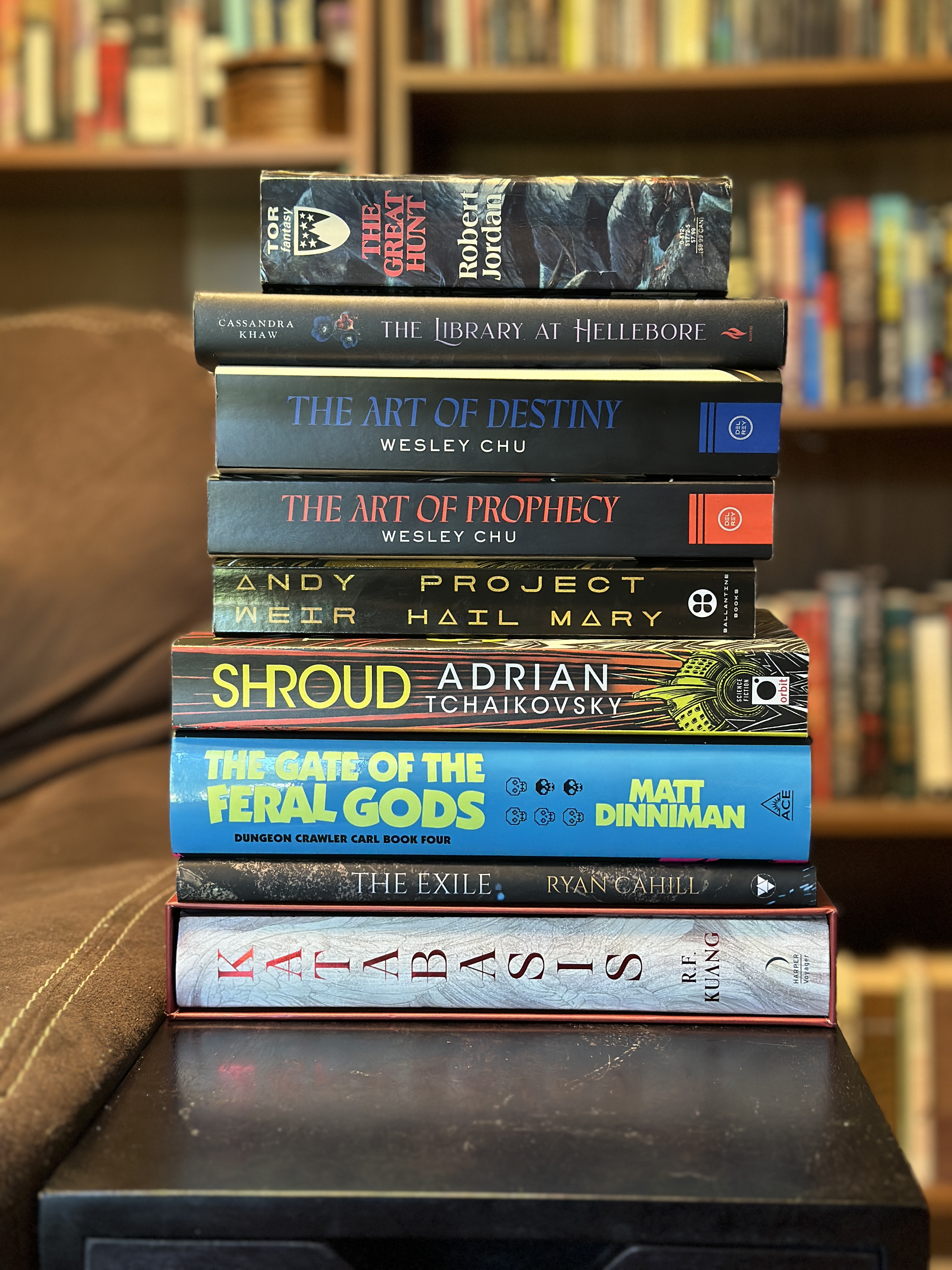
Depressing, I know, but remember I stared an 800-page history of London on July 31 and school started this month, so it’s not quite as depressing as it looks.
Book of the Month is Shroud, which I guess I should have reviewed.
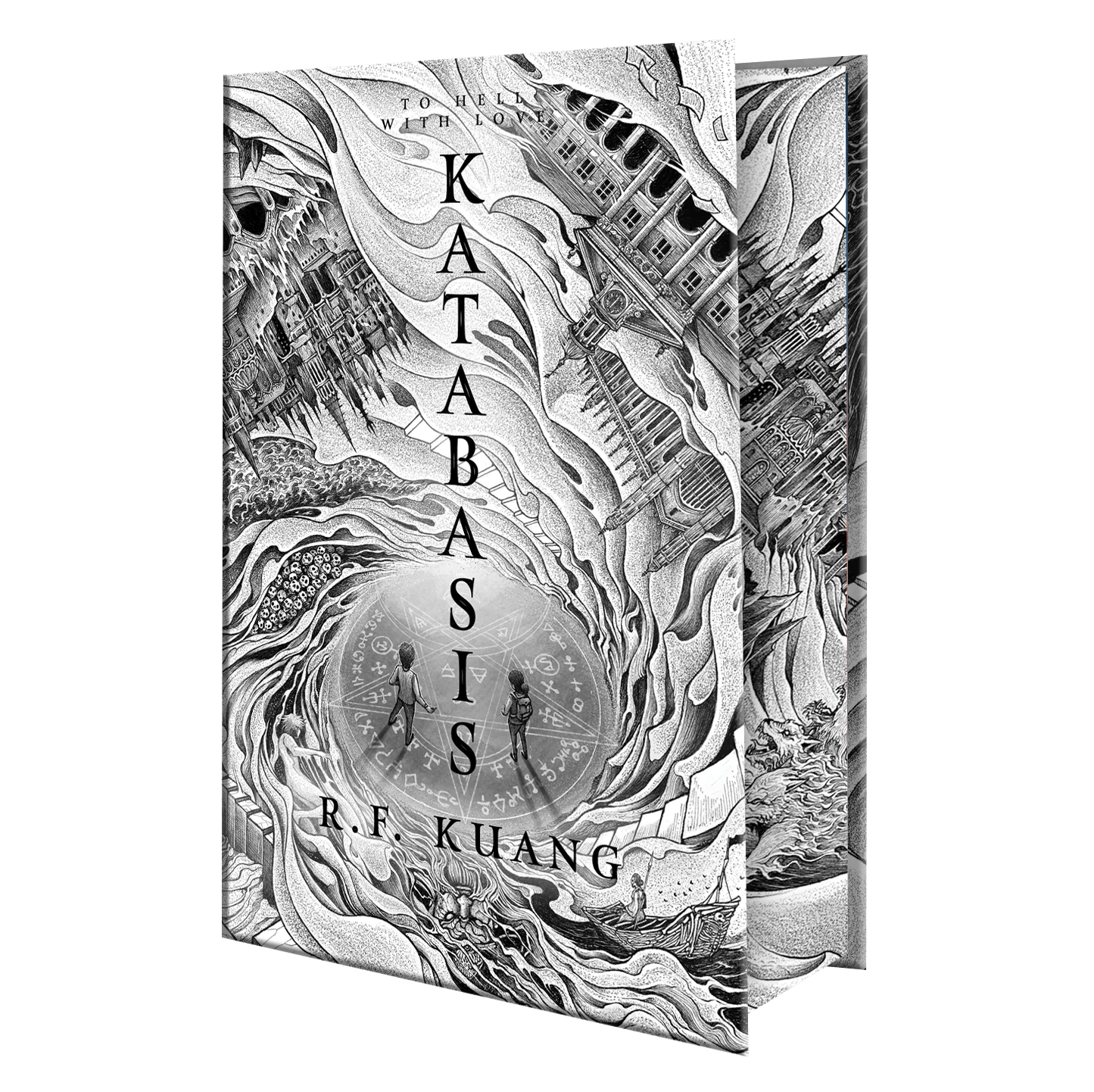
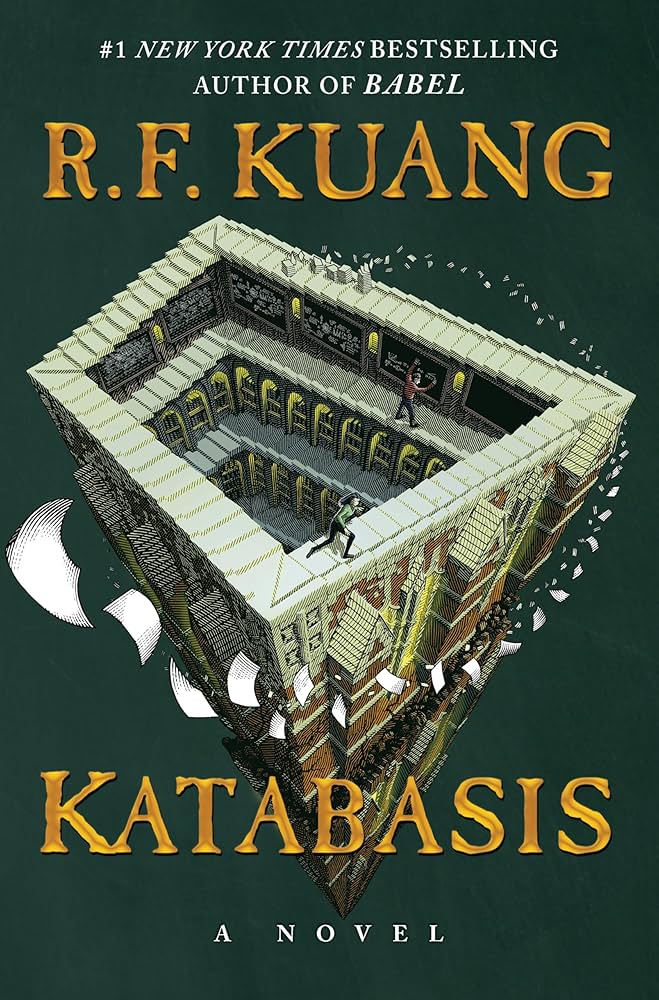
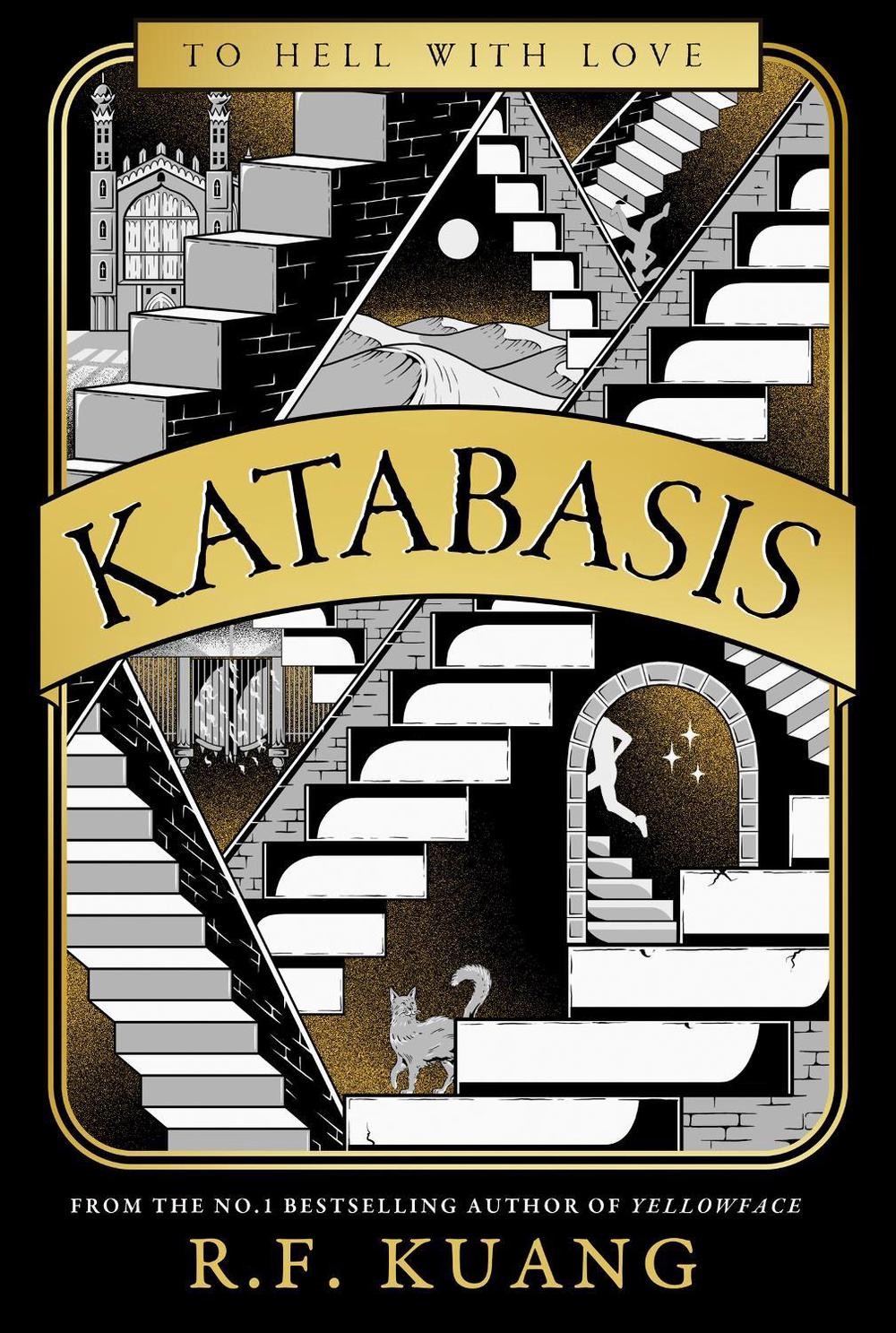
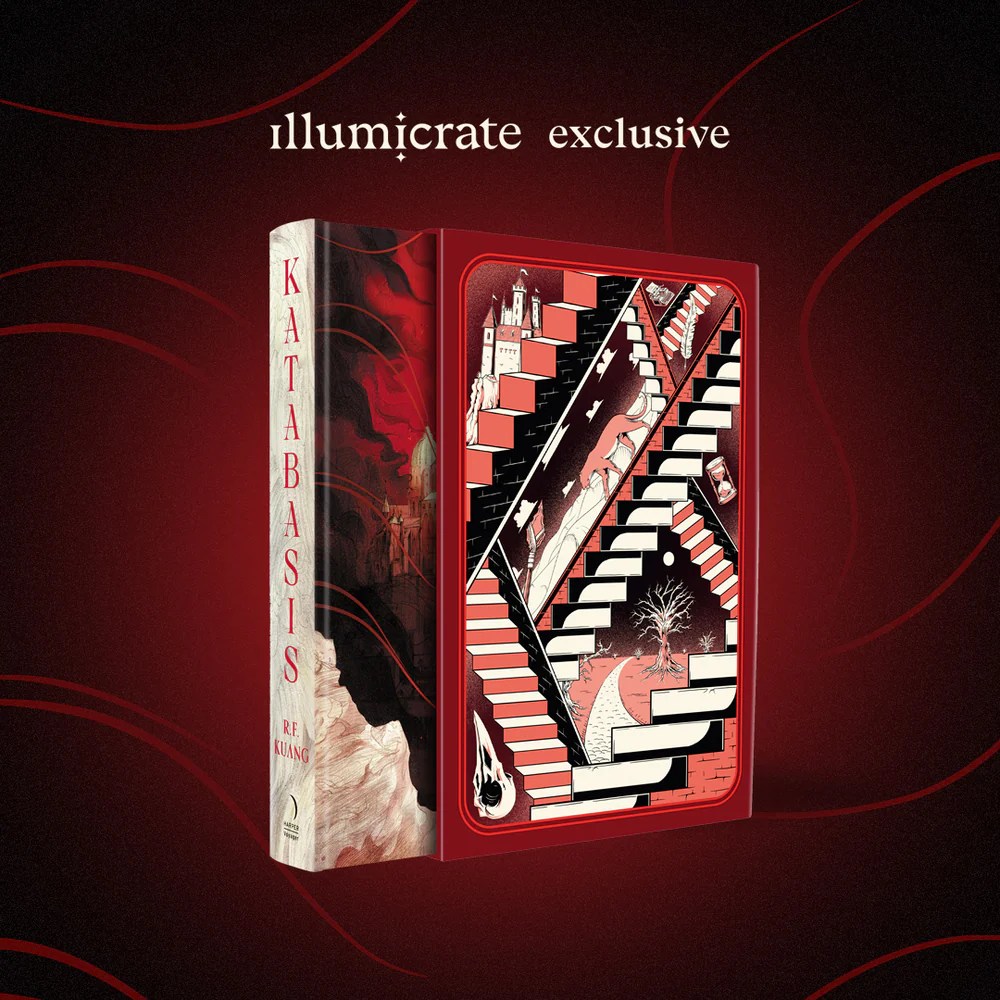
Up there are four of the seemingly unlimited Special Editions of R.F. Kuang’s new book Katabasis. I own three of them; two are currently in my house and I believe one is on the way. The fourth is the UK edition and despite everything I’m about to say it is still a maybe. Perhaps it wasn’t the wisest decision to order three expensive hardbacks of a book I hadn’t read yet, even if it was by one of my favorite authors! But as we’ve firmly established by now, I cannot be trusted with adult money.
Katabasis is the sixth book Kuang has written; I have read them all, and previously my least favorite of her books was one that was ranked third on my end of year Best Books list. My least favorite, mind you. Least. And part of me really thinks that I should sit with this for a minute and not write the review just yet, because part of the problem is that this book did not match the expectations I had set for it, and because I’ve enjoyed Kuang’s work so much in the past, I feel a need to be fair to it that I might maybe not feel with other authors. Then again, maybe not. Maybe, much like main character Alice Law about her mentor and Ph.D advisor Jacob Grimes, I’m making excuses so that I’m not disappointed.
Katabasis, somehow, has made Hell boring.
But let’s back up. Katabasis is the story of two graduate students (in theoretical Magick, of course) who travel to Hell to rescue the soul of their doctoral advisor, not because he doesn’t belong in Hell– he clearly does, and they’re both fully aware of this– but because their careers will be damaged by him being dead, and they need him for recommendation letters and such. I feel like this aspect of their motivation could perhaps have been explored a bit more; sadly, it was not. Katabasis (kuh-TAB-uh-sis, the word is Greek for “descent”) was supposed to be this dense, deeply literary work, heavily reliant on previous let’s-traipse-off-into-Hell books; there were pre-Katabasis reading lists floating around, and while I’m not actually completely certain Kuang was behind any of them, they were kinda intense!
And … well. Kuang is an academic writer; most of her books have at least partially involved schooling in some way and Babel was literally about a group of Oxford students who powered the world with magic based on translation, so this isn’t exactly a road untread for her. But this book is no more complicated than Babel was and no more academic; I was expecting a challenging read, and just didn’t get it. This is also the book that showed Kuang’s youth (she is still, somehow, not even 30) the most, I think; what she knows best is academia and grad school and I think that finally caught up to her with this book. And I get it! I’m not exactly a stranger to pretentious/prestigious graduate experiences; I hold an AM from the Divinity School at the University of Chicago, after all, which probably left me better prepared for going to Hell than most people’s educations, and I “hold” an “AM” rather than “have” an “MA” or a pedestrian “Master’s Degree” because, well, University of Chicago gotta University of Chicago. Those letters being reversed mean something. To somebody. I don’t know what, but they do.
Anyway, Alice (and is that name an accident, no, it is not) and her friend/fellow genius/academic rival Peter Murdoch head off to Hell to drag Grimes back into the world with them, and the book spirals (I see what you did there) back and forth between the past and the present as they argue about the map of Hell and, for the sake of argument, descend down to the final level to find him. They go in without much of a plan, and “no plan” really never gets better; they have a couple of never-ending water bottles and a sackful of, this is really what it’s called, Lembas bread with them so that they don’t starve to death or have to drink anything in Hell, and they mostly just wander around for five hundred pages, occasionally interacting with some of Hell’s shockingly small number of denizens. Most of Hell is an empty wasteland. They eventually arrive at the city of Dis, and I feel like if we’re going to start with a pre-reading list, maybe one of the New Crobuzon books, or Gormenghast, or the Shadow of the Torturer, or something like that should have been on there, because I have definitely read better infernal cities before.
It’s not … bad? Or at least I’m not willing to admit it was bad yet? And if you are someone who reads books for character development, this probably is right up your alley, as Alice Law and Peter Murdoch really are two of Kuang’s more completely drawn characters. But I don’t really read for character; I read for story and setting, and the story and setting here are both far too thin for my tastes. I probably owe this book a reread in a year or two regardless, just to let the expectations clear and to go into it with a better idea of what I’m about to read. But right now I’m deeply disappointed in it. The extra copies are still going to look great on my shelf, and Kuang is still an insta-buy author, but this one really didn’t do it for me.
You know this; I have somehow acquired enough pull as an Important Book Reviewer that sometimes publicists contact me to see if I want review copies of things. I almost always say yes; the only time I can think of that I declined a read was when the publicist made it clear that she was offering me a pure romance novel. I don’t mind romance, but I need it mixed with something, and I didn’t want to accept a book that I was already probably not going to enjoy.
At any rate, I got an email a few weeks ago about Wesley Chu’s new book, The Art of Legend, out today at finer retail establishments across the globe. Would I like a review copy? Absolutely, I said, except there’s one problem. It’s book 3 of 3, and I haven’t read the first two. I’ve enjoyed Chu’s work in the past but reading book 3 on its own kinda feels like a heavy lift.
No problem, the publicist said … and sent me the entire trilogy. Not even ARCs! Actual official copies! So I finished Book One today, and my intent is to read Katabasis and then read the next two back-to-back. I plan to review all three of them.
This plan would backfire quickly if I hadn’t liked the first book! So it’s lucky that I didn’t; The Art of Prophecy shares the strengths of the two Chu books I’ve read in the past, with great action, interesting characters, and a quick-moving plot that would have had the book read overnight if school hadn’t just started.
The premise, as you might have guessed, involves a prophecy: a young man named Jian, the Champion of the Five Under Heaven, has been groomed since birth to be the one who defeats the Eternal Khan, saving his kingdom from the forces of evil in the process. Jian has been trained by the finest teachers in the martial arts, but is still young; only fifteen or so, if I remember correctly.
A master named Taishi arrives to evaluate Jian and his training, and she finds both severely lacking. Jian is indolent and callow, his trainers little more than grifters, and his training has been more for show. The boy is more of a professional wrestler than a prophesied warrior.
So we already have a problem.
And then the Khan goes and gets himself killed in a drunken stupor, without Jian’s help in any way, and … all hell kinda breaks loose.
This was a lot of fun, y’all, and I apparently have a thing for impatient, irascible old one-armed women, because Taishi is one of the best characters I’ve encountered in quite a while. The fact that she’s a supreme badass who more or less melts her way through damn near any adversary she encounters for the entire book doesn’t hurt at all, and her completelack of patience with Jian’s crap is breathtaking. I loved it. As I said, the wuxia-flavored action is great, and Chu avoids the trap of only describing battles using complicated names of moves. Sure, sometimes he’ll let you know that someone has deflected a Monkey Saves the Circus by using Monkey Ruins Christmas Dinner, but he’ll also describe what that means, which is my problem with the handful of wuxia books I’ve read. You’re also going to see this world from more than one perspective, as at least a couple of the POV characters are out to get both Jian and Taishi, and one of them carries a fragment of the Great Khan’s soul with her. Surprisingly, she doesn’t think her people are the evil empire.
I’m not going to spoil a whole lot of details about what happens next, but there are a lot of assassins, and Jian has to go into hiding in a martial arts school and masquerade as a novice and an orphan … which after years of wealth and pampering, doesn’t go quite as well as everyone might have hoped. Not everything gets wrapped up, as this was clearly written with a trilogy in mind from the start, but since Book Three is already out, the only thing making you wait is how fast you can read. I’m particularly interested in finding out more about a particular side character who starts having panic attacks during battles partway through the book; we’ll see how much of him we see in Book Two.
Definitely check it out. I’ve got a three-day weekend coming, so hopefully I can have my review of The Art of Destiny up within a week or so.

 Welcome to infinitefreetime dot com