It may be that there’s no cliché less true than “You can’t judge a book by its cover.” You not only absolutely can judge a book by its cover, you are supposed to. That’s what the cover is for! It’s to attract peoples’ attention, particularly those kind of people who are likely to enjoy the book.
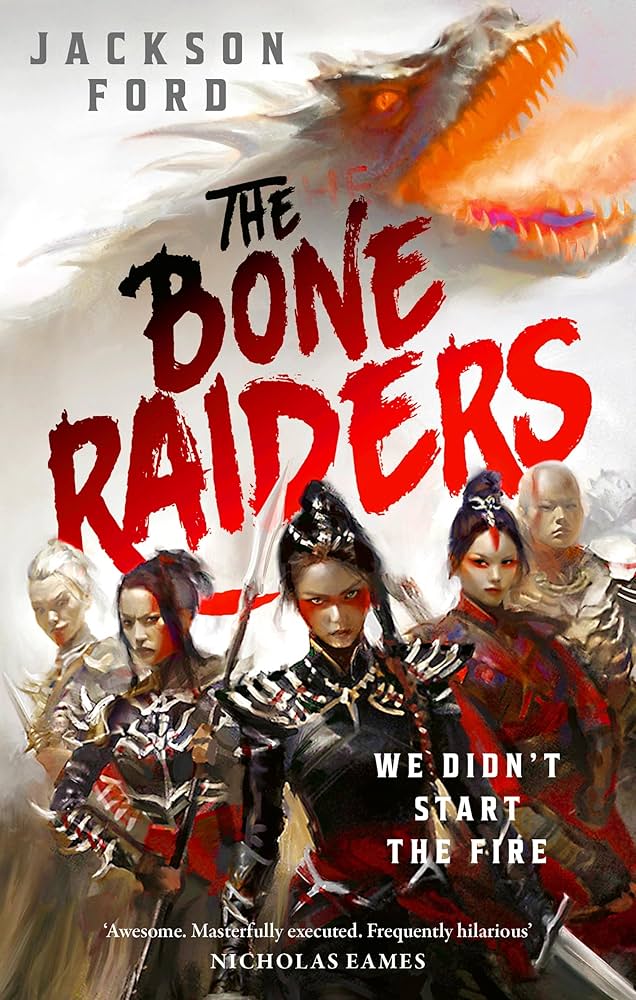
And let me tell you something: I absolutely encourage you to judge Jackson Ford’s The Bone Raiders by its cover. Five badass-looking women of color holding weapons and a fire-breathing technically-not-a-dragon in the background? Sold. Gimme. We’re done. I don’t quite get why they decided to put the Billy Joel quote on the cover, but that’s not just my biggest gripe about the cover, it’s my biggest gripe about the book. Because this book is everything that you think it is upon looking at that cover, except maybe a little smarter than you’re expecting. I’m super psyched that it’s a trilogy, because I want more of these characters and more of this world, which can be fairly boiled down to “Mongols during the time of Genghis Khan, but dragons and feminism,” and that’s really all I need.
(Every POV character is a woman except for the first and last chapters; the first chapter is an okey-doke and the last chapter is a tease for the next book. There are hardly any men with dialogue. I can’t believe a guy wrote this, to be honest.)
But yeah. This is one of those reviews where I don’t need to belabor the point at all. Violence and humor and violence and world building and violence and lesbians and violence and rebellions and violence and family drama and violence and … animal husbandry. If you’re remotely interested in a book with that cover, go grab it right now. You will be well rewarded. I want the sequel, and I want it tomorrow.
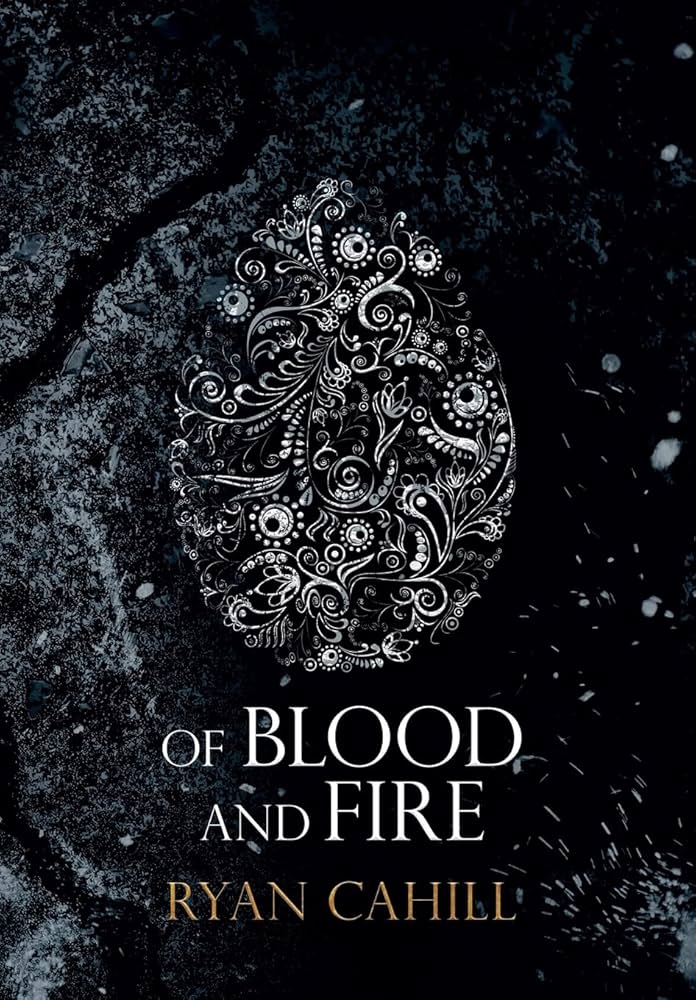
Let’sbe clear here, and not bury the lede on this review: You have read Ryan Cahill’s Of Blood and Fire before. No, really, I promise you have. If you’ve read Lord of the Rings, or Dragonlance, or The Sword of Shannara, or the first book of The Wheel of Time, or John Gwynne’s The Faithful and the Fallen series, or especially if you’ve read– gag– Eragon, you’ve read Of Blood and Fire. The book’s biggest weakness is that in its nearly five hundred pages there is not a single original idea. It adheres to the dictates of classic fantasy with near-perfect fidelity, from the main characters hailing from a small town suddenly infringed upon by the evil of the outer world to suddenly dead parents to one of the three main characters being The Chosen One to parents and authority figures with a Secret Past to dragon riding to elves and dwarves and orcs, here called Uraks, to a distinct lack of female characters. Hell, all it needs is “A Noun” at the beginning of the title and even that feels ripped off.
There is a human king named Arthur and an elf named Ellisar, for God’s sake. I’m not going to bother to tell you what the book’s about. You already know. Again, you’ve read this book before.
And yet this is not going to be a negative review, because originality isn’t everything– hell, this book manages to rip off two or three books that were themselves massive ripoffs of earlier, better books– although I would neither blame you nor be particularly surprised if that first paragraph keeps you from picking it up. Somehow, despite being an utter pastiche of a ton of stuff that came before it, it’s a competent pastiche, and frankly it’s a pastiche of a genre of book that I have been a big fan of for my entire life. It’s a cheeseburger and fries. You know what a cheeseburger and fries is going to taste like before you pick it up, and you don’t necessarily need anyone trying to get super creative with a cheeseburger and fries, right? It can taste like three thousand other burgers so long as it does being a burger correctly, and, well, this does being a burger mostly pretty well.
(Why mostly? This is self-published, to boot, and there are signs of occasionally needing maybe one more editorial pass. The book begins with someone telling someone else they’re going to ask them Four Questions, and it’s said like that where you want to add capital letters, and then they ask them at least seven questions. Shit like that.)
I dunno. I four-starred this, and at least one of those stars was for the exceptional quality of the hardback– this book is an absolute pleasure to hold in the hand, with a pleasant heft and exceptionally smooth, creamy paper, and if you buy books for their qualities as physical objects you definitely want to own it– and I’m looking forward to reading the sequels, but it is absolutely McDonald’s fantasy fiction, to be even more specific with the “cheeseburger” metaphor. You’ve had this before, and sometimes you get a Double Quarter Pounder with Cheese that was just made perfectly, but it’s still a DQP with for all that. That’s what this is. I’m in for more, but maybe you don’t like fast food, and that’s okay.
“I don’t understand reviews sometimes,” he said, as the first sentence of his book review.
I have received two books through my new Illumicrate subscription– one, Fathomfolk, was already on my radar, but Elizabeth May’s To Cage a God was a book I’d never heard of by an author I’d never heard of. Which sounds like snark, but I hope it’s obvious that it isn’t– there are lots and lots of books, as it turns out! Anyway, I looked it up on Goodreads when I was ready to start it, and … well, it didn’t look hopeful. Generally anything under a 3.5 is going to be a rocky road, and this is at 3.3 right now. Sometimes that happens solely because a book is written by a woman or a person of color, though, or– God forbid– features women or people of color, or The Gays, so it’s not always a useful metric, but it’s usually a fair bet that an aggregate score under 3.5 is going to be a mixed read at best.
I’m happy to say, having read the book, that I don’t have any idea what the hell the reviewers are on about on this one. This book is indeed written by a woman, and does feature The Gays, but scanning through the reviews didn’t immediately produce any reviews that appeared to be the result of a pile-on or a Neanderthal eruption, so I just stopped looking and stopped worrying about it.
To Cage a God is a political thriller wrapped up in an intriguing magic system with a dollop of romantasy on top, and at its best moments it reminded me of something that Lisbeth Campbell might have written. And, honestly, this book and The Vanished Queen have a lot in common, and although To Cage a God has the romantasy aspect and tilts just a bit more toward YA than Queen does, if you enjoy one you’ll likely enjoy the other.
I want to talk about that magic system for a bit, though, because it’s super cool. All of the POV characters are part of a conspiracy against the Evil Empress (not actually her name, but it’s more fun to call her that) and all of them have different motivations and abilities that they bring to the revolution. Magic abilities in this world are granted by literally– and, it’s implied at least, physically, take a close look at the cover– imprisoning a dragon inside your body, and dragons are gods. The book uses the words pretty interchangeably, but the gods have teeth and claws and move around and are not remotely beyond inflicting pain on their hosts if they feel like it. In fact, one character’s god hates her and she has to more or less practice blood magic in order to convince it to do anything. The gods also have opinions about each other, and at least one relationship in the book is driven by mutual attraction of the gods as much as the humans involved. It’s really cool, and I’m looking forward to more exploration of the idea in the conclusion to the series, which I believe is currently planned as a duology but stands really well by itself. All of this stands against the background of a war with another nation that is talked about but never appears on the page, so I assume the sequel will delve into figuring out what to do with the new political status quo at the end of the book.
I have some minor gripes– the Evil Empress is a bit much, but in a sort of delightful way– one can imagine Glenn Close or Angelina Jolie just devouring scenery by the handful while playing this character, and the book as a whole is a little tropey, but tropes become tropes because when they’re well done they’re effective, and they are. It’s always nice to pick a book effectively at random and be rewarded by it, and I didn’t even pick this one, so it’s a genuine pleasure to be able to recommend it. I’ve ordered the non-Illumicrate hardback so that I have something to match the sequel on the shelf when it comes out. You don’t need to buy two copies, but definitely check it out.


 Welcome to infinitefreetime dot com