
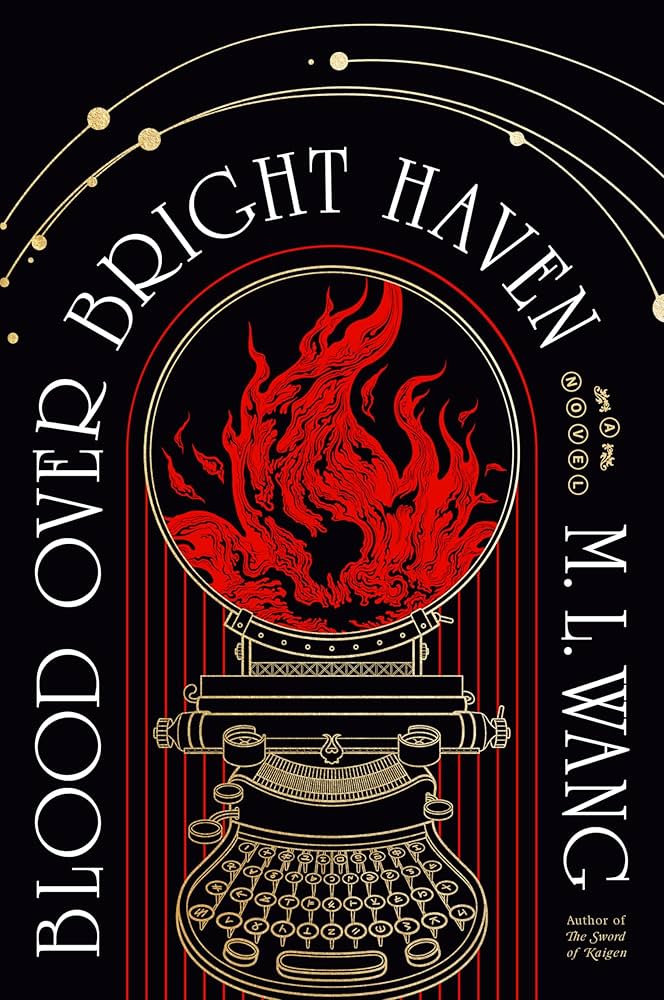
I discovered the work of M.L. Wang through BookTok, which is, by and large, convinced that her The Sword of Kaigen is one of the best books ever written. I read that one first, and … it’s not one of the best books ever written, not by a long shot, but it was good enough to get me to pick Blood over Bright Haven up and then take several months to get around to reading it. I didn’t start off well with this book either; by pure coincidence it shares a lot of plot points with Ava Reid’s A Study in Drowning, which I read immediately before it, and starting a second book in a row where the main character was a trailblazing female academic in a field where no one wanted her around and who cried all the time was a bit jarring even before it turned out that, somehow, in both books the fact that said main character was a huge fucking racist was a big plot point. Now, this is fantasy racism, which doesn’t make it a lot better,(*) mind you, but it’s a big theme of both books, so be prepared for that. Also, while we’re talking about things that might be in a content warning, Drowning has a character who is a rape survivor (although, creepily, the act in question comes off as consensual the first time it’s described) and there’s a rape attempt in Blood.
A Study in Drowning was not a great book– serviceable, but not much more– and it kind of poisoned me against Blood over Bright Haven for the first third or so. I nearly put it down. I’m glad I didn’t.
For starters, and I don’t want to get too deep into spoilers, because you deserve to experience this at the book’s pace, Sciona is very much not the main character of Blood over Bright Haven, even though it will seem like she is for most of the book.
Second, Blood over Bright Haven is one of the angriest books I’ve ever read, up there with Yellowface and Iron Widow,(**) although, again, you spend enough time in Sciona’s head that you might not realize how angry the book is at first. This is a deliberate misdirect on the part of the author and in retrospect it’s tremendously effective at prepping you for the big twist midway through the book. A bit of background: Sciona starts the book off by being named a Highmage of her home city-state of Tiran, an office that no woman has ever held before. This happens quickly; another weird similarity it has to Drowning, come to think of it; you get yourself mentally ready for her to take half the book to become a highmage and it’s, like, a chapter. Magic in this book is fascinatingly mathematical and complicated and meaty, it’s more like writing equations or geometric proofs than what for lack of a better word I’ll call “traditional” spell casting, although it’s not as explicitly mathematical as, say, To Shape a Dragon’s Breath.
Anyway, for our purposes the salient part of writing a spell is that you have to determine where the spell gets its energy from, and how much energy it might take to pull off any given magical effect. If you pull too little you’ll get partial results and if you pull too much, something is probably going to explode. Sciona is a prodigy at mapping, which is the process of figuring out where magical energy sources are and how to pull from them, and she gets put on a huge project involving pushing back the magical wall that surrounds the city, a huge … public works project, which isn’t quite what you might expect from a fantasy book but that really is what’s going on here.
Also, spells are written on magical typewriters, which is just super fucking cool.
Anyway, blah blah blah class conflict blah blah blah sexism blah blah blah plot development and then she figures out where the sources of her magic are really being pulled from, and I’m not telling you anything else, because you deserve to experience this on your own, and probably by this point if you’re like me you’ve decided you don’t like Sciona all that much. Unlikable MCs are tricky, right? First of all, you often can’t be sure if the author realizes they’ve written an unlikable main character, or if it’s just your reaction to that person (I call this “Lana Lang syndrome”) and also because the author wants you to keep reading, which can be a hard sell if you don’t like living in the head of the person you’re reading about.
I’m just going to say that it was clear quickly that M.L. Wang knew exactly what she was doing here, and that Sciona’s personality flaws are clearly intentional and are also pretty essential to the book unfolding the way it does. She has a great conversation (well, fight) with a relative late in the book where the relative just rips her to shreds and every word she says about her is true and I just kind of read it in awe of how fully in control of her characters Wang was.
Also, and I’m not going to go into details because, again, I want as few spoilers as possible, but reading this book on Thanksgiving lent the whole book a really interesting synchronicity with actual life. You’ll understand when you read it.
And, yeah, I’m about to end the second review in a row with the phrase “one of the best books of the year,” and a wish that M.L. Wang’s many fans on BookTok and elsewhere would realize which of her tradpubbed books (she has several that she published herself, and this and Kaigen were both originally indie titles) is clearly the superior one, because this book deserves the press and attention that The Sword of Kaigen has gotten. Go read it.
(*) The sole physical characteristic that the Kwen characters are given is “copper hair,” and I’m still unclear what precisely the difference between copper and red hair is, but you could take this as evidence that the despised minority in this book are white people, which is an interesting choice that ultimately doesn’t end up mattering very much since this is very much a Not Earth book.
(**) The fact that all three of the authors here are Asian women is a coincidence. It’s an interesting coincidence, but a coincidence nonetheless.
 Welcome to infinitefreetime dot com