#REVIEW: Advocate, by Daniel M. Ford

The standard disclaimers apply: Dan and I are Internet Mutuals, the origin of which is lost to time but almost certainly involves Twitter somehow. I spend a fair amount of time hanging out in his Discord server, which is, in fact, the only Discord server I spend any time in. And while I reviewed The Warden, the first book in this series, I somehow did not review Necrobane, the second book. My vague recollection is that I had kind of complicated feelings about it and the review just kind of got away from me; I didn’t dislike it, although I do have to talk about it in order to talk about Advocate.

Which, by the way, I’m gonna screw this up: the name of the book is Advocate, not The Advocate. I keep wanting to put that The in there.

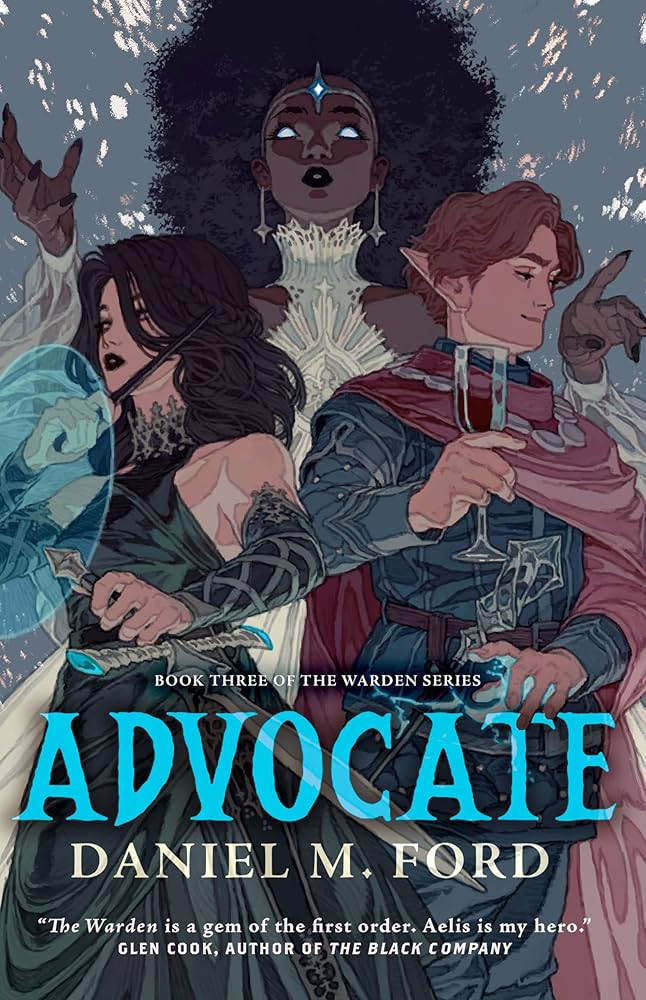
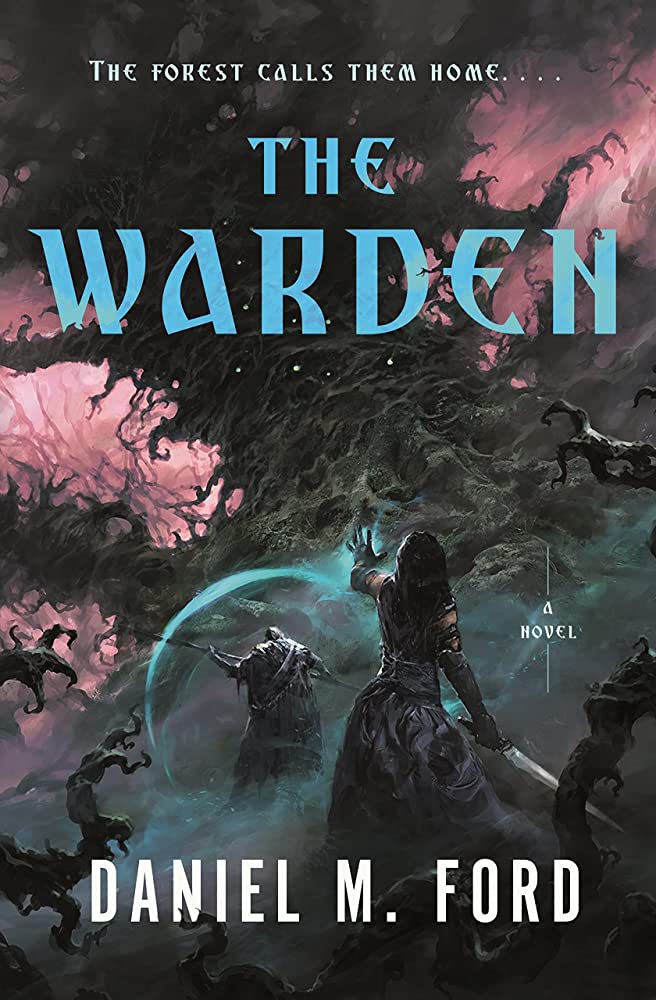
So let’s rip the Band-aid off here: viewed on its own, I really enjoyed Advocate, for much the same reasons I enjoyed Warden, and the rest of Dan’s work. Aelis is a fabulous asshole, of a type I enjoy reading about, and a couple of the new characters, particularly an alcoholic gnome named Mihil and a fellow Warden (and ex-girlfriend) of Aelis’ named Miralla, are also a lot of fun. That’s Miralla in the back on the cover, although the elf on the right is not Mihil, even though he should be.

(I get why he isn’t; that’s Amadin, another Warden, and he’s a fairly important character, but I suspect the real reason Mihil isn’t on the cover is that including a gnome in the composition would make placing the cover text tricky.)

The bulk of Advocate unfolds like a mystery, although we know who committed the crime from the first pages of the book, and Aelis’ job is less to prove her former mentor innocent than to convince the court that no crime was committed in the first place. The story is satisfyingly twisty-turny and Aelis gets plenty of time to show off her two best character traits: her utter confidence in her own ability to outwit literally anyone and her tendency to make a snap decision, get in over her head, and then somehow come out on top anyway. There’s lots of swordplay and quite a bit more actual necromancy than what we saw in the last couple of books.

Advocate‘s biggest problem is that, while the cover calls it “Book Three of the Warden Series,” it is, for now at least, the final book of the Warden series, and it’s structured much more like Book Three of Six than Book Three of Three. But let’s back up a little bit and talk about Warden and Necrobane.

Warden ended with Aelis screwing up in a fairly spectacular way, potentially unleashing a continent-wide zombie plague. I was expecting the rest of the series to be focused on that not-minor problem, and the book went an entirely different way than I expected, dealing with what I thought was going to be a two-book problem in about a hundred pages or so and then pivoting into something else. At the end of Necrobane, Aelis’ love interest is magically bound to a particular plot of land in the midst of a wild forest a fair distance away from Lone Pine, and Aelis is unable to figure out how to free her. Then, at the end of the book, she is summoned to the city of Lascenise, a major (and wealthy) metropolitan area, to serve as an Advocate for her old mentor, who has been accused of murder. An Advocate is basically a Warden lawyer; Bardun Jacques has a lawyer but is entitled to a Warden defending him (and investigating his case) as well. He has asked for her specifically. She has no real choice but to go.

This was another left turn, and I was concerned with what it meant; that Book Three would be taking place in an entirely different place and with, importantly, an entirely new cast— Maurenia being magically stuck on a couple acres of land a week or two away, and half-orc werebear Tun being entirely unsuited to life in a city. And, in fact, that’s exactly what happened. The two stories do end up knitting themselves together, but Tun’s presence in the story is minimal and Maurenia’s role is basically to be something else that Aelis has to worry about in addition to the rather significant number of new problems the story is dumping on her head. It’s probably important to point out that Aelis was going to have to head toward civilization anyway, as she was going to need access to libraries to figure out how to release Maurenia, but she’s more or less stuck there until her Advocate duties are discharged. Making things worse, in her last scene with Maurenia before leaving it’s made clear that there’s a time limit on how long she has to break the spell before Maurenia is, effectively, taken over by the forest.

(Side note: Necrobane also features a fight with one of the creepiest monsters I’ve seen on-page. The book contains a tooth golem, which is every bit as awful as you might think, and maybe worse.)

So your appreciation of Advocate is going to be contingent on how much you like Aelis, and how willing you are to lose the supporting cast we’ve grown to like over the last two books. This is what I mean by it being a better “book three of six” than an end to a trilogy; there’s lots of expansion to the worldbuilding and lots of character development for Aelis (we meet her family!) and all of that is cool but if you were really vibing with her and Maurenia’s relationship, or her mentor/mentee relationship with the little girl she’s teaching to read at the end of Necrobane, you’re gonna have a hard time. And this would be much easier to bear if we knew there was Book Four on the way out there, but Tor has really screwed this series over(*) and right now there isn’t one. I decided to star-rate it on its own merits, mostly because no one can stop me, but I can imagine other readers being less happy.

I want more books in this series, in other words, not only because the world is fascinating and I want more but because I think the story and the characters deserve it.

(*) Not my story to tell, unfortunately, but I feel like they owe Dan another trilogy to make up for how they treated this one. Even if I didn’t know him, the simple fact that somehow I have bought five copies of the three books in this trilogy and still don’t have a matching set to put on my shelf would have me deeply pissed.
Blergh

It was a crazily busy weekend, at least by my current middle-aged standards; one of my oldest friends was in town with two of her kids all weekend because her son had a travel hockey tournament in town, and there was an all-day thing at my son’s school yesterday that both he and my wife got roped into, and all three of us spent the whole weekend peopling and pretending we are social human beings and so all everyone did today was lie around the house and moan. I took a nap and my son is taking one now; I cannot confirm that my wife took a nap too but who knows. I have my lesson plans done for tomorrow and I have done my various Things That Must Be Done Every Day, or at least I will have as soon as I finish this post, so it’s video games until bedtime for me as soon as I hit Publish.

A quick note before I do that: the sequel to Dan Ford’s The Warden came out last week. It’s called Necrobane, and I read it this week, and I haven’t reviewed it yet because a lot of my feelings about the book are tied up in spoilers and I’m not sure how to write a good spoiler-free review of it. The short version is that I like it a hell of a lot but it didn’t go in any direction that I thought it was going to go, and it’s going to be real real interesting to see what happens with Book 3.

… which I guess is a spoiler-free review, but it’s only a paragraph, and I feel like the book deserves a little more of that.

#REVIEW: THE WARDEN, by Daniel M. Ford

First, the standard disclaimer whenever I review one of Dan Ford’s books: while we’ve never met in person, Dan and I are interweb mutuals and have been for years at this point, and I’m a member of his private Discord server, and if you would like to take that information as a reason to perhaps toss a pinch of salt on my opinion on his latest book, I would not look askance upon you. That said, the rule I’ve always followed when reviewing books written by people I know is that if I can’t write an honestly positive review I’m just not going to write a review at all. I owe my readers honesty in my reviews but that doesn’t mean I can’t keep my mouth shut, right?

At any rate, I think this is probably his best book, and I’ve read and reviewed all of them, as far as I know. So let’s just start with that: this is his best book, and it’s part one of a trilogy, and I need Book Two, damn it. This is not going to be a spoiler review but let me just say that I think that the next book will begin quickly after the end of this one and I need to know what happens next.

The premise: Aelis de Lenti is a necromancer and a (supremely talented) recent graduate of the prestigious Magister’s Lyceum. The Lyceum trains Wardens, which are basically a mix of a town sheriff, a local ombudsman, and if necessary the magical equivalent of a Navy SEAL. Aelis, a city girl and the scion an extremely wealthy family, finds herself posted to Lone Pine, a tiny farming village at the edge of nowhere with absolutely nothing of the comforts she is used to. The townspeople don’t trust her very much at first, she’s not especially fond of them either, the second floor of her wizard’s tower on the edge of town basically doesn’t exist, and her home keeps being invaded by a goat.

Shenanigans ensue. Like I said, this isn’t a spoiler review, so I don’t intend to describe the shenanigans, but one way or another by the end of the book you’re going to have a decent idea of why the Lyceum “wasted” her by posting her to Lone Pine, and you’ll have met enough characters from Lone Pine itself that you’ll be invested in what ends up happening with them.

One of the things I really liked about Ford’s Paladin trilogy was his choice of main character. Religion generally doesn’t have much of a role in high fantasy, or at least doesn’t have much of a role among the main characters, so seeing a paladin as the central character of the trilogy was great. This book is about a wizard, and while my first thought was “Well, there are tons of books about wizards,” … are there, really? Because I don’t know that I’ve seen a character like Aelis as the MC of a series. Can I come up with some characters who fit her role? Sure, but they’re all side characters. I’m gonna come up with a counterexample as soon as I hit Publish, but Dan’s got a great knack for choosing protagonists that feel new and different.

Which is interesting, because the overall feel of the book is very old-school and very D&D influenced, and it’s been interesting to look at other reviews of the book and see how people feel about that. What do I mean? Well, all of Aelis’ spells have names, and they have “Orders,” which are functionally equivalent to spell levels as far as I can tell. Most wizards, or at least most Wardens specialize in a single school of magic, and the most powerful might have a handful. If you’re a D&D player, you can list them off right now, and let’s see how many I can do from memory: Necromancy, Divination, Abjuration, Conjuration, Evocation, Illusion, Alteration, and … dammit … Enchantment! The eighth is enchantment. Aelis specializes in Necromancy, Abjuration, and Enchantment, more or less in that order, although most of what she does throughout the book is cast wards. You don’t really see her lean into the necromancy until the end of the book, and the townspeople of Lone Pine have serious aversions to it.

Now, this is not so much up my alley as it is the actual alley itself, so it worked for me across the board. Aelis does have her spells memorized, and definitely runs low on magic the more casting she does, but I don’t think she’s actually forgetting spells or getting up and consulting her spell books like a D&D wizard might be. I can see why a reader might roll their eyes a touch, perhaps, at Aelis literally deciding to cast Moogerdook’s Hornswoggling Goat-Inconveniencer at someone. I am not one of those people.

A word about Aelis herself, so long as we’re discussing mileages and how they might vary. Aelis is … well, she’s a lot, to be honest. Someone asked Dan in the Discord if he thought she was arrogant the other day, and his response was something along the lines of that she is likely to think that of all the people in a room she is the most capable of solving a problem and probably also the smartest and most talented. She is also likely to be right. She reminds me– and I doubt this is intentional– of Aloy from the Horizon games, because Aloy is a supreme asshole when she’s surrounded by people who aren’t as competent as she is, and there are plainly and simply not that many people who are as competent as she is. Aloy has no patience for anyone’s bullshit, and neither does Aelis. She’s bossy and curt but she’s also literally in charge most of the time due to her role as a Warden, and one way or another there are going to be people who are turned off by her.

I was not one of those people. I’m kind of sneering at them right now, too. A lot of the book is inside Aelis’ head, and the trick is she has doubts and recriminations and anxieties and such but she is not about to let anyone see them. It’s going to be interesting to see if she cracks under the pressure in future books, because she rather abruptly becomes responsible for a lot toward the end of the book.

She’s also delightfully gay, by the way, and the romance subplot is a highlight. I won’t spoil anything about it but I’m looking forward to seeing more of her love interest.

I haven’t talked about the worldbuilding, which is typically great, especially since the book is literally set in a tiny village where nothing ever happens. Ford does a great job of giving you an idea of what the outside world is like, via letters from family (that Aelis reads to the recipients, who are frequently unable to read) and the occasional adventuring group from outside of town showing up. I want to see more, of course, because I always want more worldbuilding, but this was a highlight as well.

Ultimately, of course, it doesn’t surprise me that I enjoyed this book as much as I did; I was all in based on the description, and knowing the author obviously doesn’t hurt. But you want to check this one out. It’s Dan’s sixth book, but it’s also his first with Tor, and I’m kinda personally invested (emotionally, not financially) in it doing well. Give it a look. You’ll like it.

Go buy THE WARDEN

My buddy Dan’s book is out today and it is very important that everyone who loves me or loves things that are good go buy it immediately. I pre-ordered my copy last June, and I was super excited to see it show up today. I need to finish the other book I’m reading before I can get to it but expect a review on the sooner side of soon.

In other news, I once went like two years without missing a day of posting on this blog and I have no idea what the hell is going on with me lately.

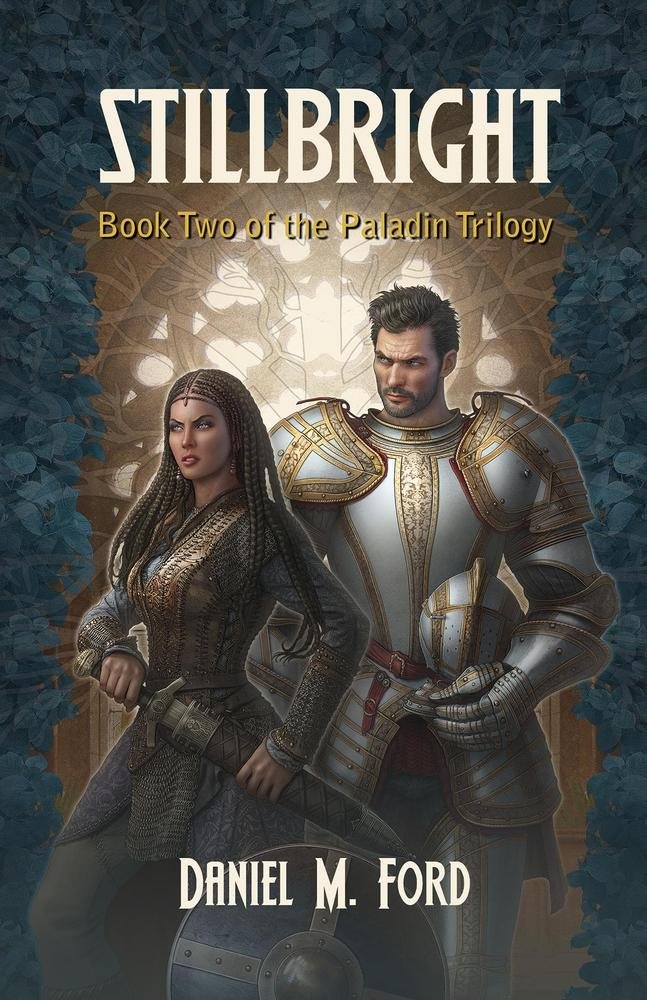
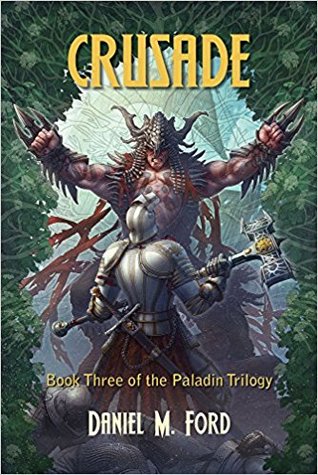
#REVIEW: The Paladin Trilogy, by Daniel M. Ford

I have reviewed a couple of Daniel M. Ford’s books in this space before, and they always have to start with a disclaimer: Dan and I are friends, or at least are whatever parasocial, mutual-followers-on-social-media, never-met-before sort of friends that stand in for most of my adult social relationships nowadays. He’s a Cool Guy, is what I should be saying, and if you stopped right now and followed him on Twitter and didn’t read the rest of the post you’d actually come off pretty well anyway. That said (and the second sentence in the disclaimer always starts with “that said,”) authors are really really good at reading each others’ work and just quietly never saying anything when we don’t like it. I don’t know if I would have bought any of these books if I didn’t know Dan through Twitter; I am absolutely certain I would have liked them just as much once I encountered them.

Anyway, I’ve worked my way through his Paladin Trilogy over the last who-knows-how-long, finishing up with the massive, 800-page doorstop Crusade, which absorbed a good chunk of my February, and while for some reason I didn’t review the first two (although I think I mentioned them here and there,) I’m reviewing the series as a whole now that it’s concluded: this is really good epic fantasy, and most excitingly, it’s epic fantasy of a style that I really don’t think I’ve seen before: it’s about religion. The main character, as you might guess, is a Paladin, the first convert of a new religion, and while the series is mostly Allystaire’s story, it’s also very much the story of how the religion of the followers of the Mother begins to gain traction in the collection of baronies that the story is set in. The book is second-world fantasy and manages to be both low fantasy and high fantasy at the same time; the Mother ends up with five main apostles, four humans and a dwarf, and all of them end up with various powers of one sort or another, and there are some really magically powerful enemies, but the world itself is not heavily magic-imbued. The bad guys would not feel out of place in a Robert Jordan Conan book, if you’re looking for a vague analog to the style.

The apostles are known as the Arm (that’s Allystaire,) the Wit, the Voice, the Will and the Shadow, and all of the characters have their own roles to play in the Mother’s religion. The first book is mostly dedicated to pulling the team together, for lack of a better phrase, the second to establishing the Mother’s religion as a threat to the status quo, and the books end as all fantasy trilogies should, with a big war. It’s delicious work from start to finish, and I’ve praised Dan’s exceptional character work in my other reviews and it’s on full display here. I really liked reading about Allystaire in a way that isn’t terribly common for me(*) and the way he balances his innate sense of justice with his (admittedly bad) temper and his responsibilities to his deity and to the people he’s supposed to protect are fascinating. You don’t see a whole lot of discussion of moral behavior in fantasy, and Allystaire is fascinating in that he’s more or less constantly worried about doing what is right and just but still never comes off as, well, as obnoxious as you think a paladin character could very easily be. Of the other characters, the Shadow, Idgen Marte, and the Wit, a dwarf named Torvul, are the standouts. I particularly wish I could learn more about Torvul. I spent the entire third book worrying about something bad happening to Torvul.

In a lot of ways, these books are what I’ve been looking for this year. I’ve been doing Big Reading Projects for the last several years, and this year I mostly wanted to kind of pull back and take refuge in genre, and this big honkin’ fantasy trilogy with a unique angle on the genre, great worldbuilding, interesting politics and character work and cool magic has been a great way to start off the year. I’ve told my wife to check them out, which is not a sentence you see around here all that often. Definitely definitely check them out, y’all, you won’t regret it.

(*) To vastly oversimplify things, some people read for language, some for character, and some for story. I have majored in Story with a minor in Worldbuilding, so those things are what I look to first, and a book that tells a cool story but maybe has boring or annoying characters will win out for me over a book with intricately developed characters but a boring story.

#Review: CHEAP HEAT, by Daniel M. Ford

Dan Ford and I have been mutual followers on Twitter for some time now, and I finally ordered one of his books a few months ago. That led to me immediately buying the first book of his epic fantasy series The Paladin Trilogy and pre-ordering Cheap Heat, his second Jack Dixon novel, the sequel to Body Broker. It is fair to take my reviews of his work with a small amount of salt, as I do quite like the guy, but as I said in the linked review there authors do tend to be pretty good at just going radio silent when we don’t like each others’ work, and he would never have asked one way or another. (That said, I don’t seem to have reviewed Ordination, the first Paladin book– rest assured, I liked it as well.)

Cheap Heat picks up more or less right where Body Broker left off, with our hero Dixon continuing to live on his houseboat and eat his almond butter and act as a PI on the side. Ford’s character work continues to be the shining star of his writing; I feel like I know Jack Dixon, and he feels like a real, if a bit charmingly quirky, character. Dixon is contacted by a former wrestling teammate who has made the jump from collegiate-level wrestling to a mid-sized pro circuit. His character is based on Ulysses S Grant, and seeing as how the circuit takes place mostly in the mid-Atlantic and the South, his character is actually a bad guy— and he’s been receiving death threats. Dixon has to embed himself inside the wrestling company as they go on tour while he attempts to figure out who is threatening to kill his friend, and so the back 2/3 of the book is on tour with this touring professional wrestling crew, which is not something I’ve ever seen in a novel before and definitely made the book memorable.

This is the second of Ford’s novels I’ve read at effectively one sitting (Ordination is a bit too long for that to have been an option;) I started it before bed last night, put it down to sleep, then got up in the morning and finished it. If I have a gripe about the book, it’s that it’s a little too short– about the same length as Body Broker at 238 pages, so I’m sure the length is a deliberate decision, but I’d have liked another 20 pages or so to let some of the subplots and the relationships between the characters breathe a little bit more. Dixon’s relationship with his newfound girlfriend Gen feels a little bit shorted, especially since he’s on the road for the majority of the book and so they aren’t actually together– I’ll admit that there were a couple of places in the book where I was mentally shouting Call your girlfriend! at him. But I would like more of this please is not really that strong of a criticism, as they go.

The ending, I think, deserves some particular praise, as the main plot of the story and a simmering subplot carried forward from the first book knit themselves together in a way that frankly took me completely by surprise, and there is a twist in the very last sentence that has me seriously curious about where Ford plans to go with Jack Dixon next. The third book is already planned– it’s called Doctor’s Note according to that final page– but as of right now I don’t believe it has a release date. I was lucky to read Body Broker when Cheap Heat wasn’t that far off from release; I’m going to have to wait for this next one, unfortunately.

The good news is, every time I catch Dan on Twitter I can yell at him to get back to work. 🙂


12:53 PM, Tuesday, May 19: 1,510,988 confirmed cases and 90,432 American deaths.

In which I finished two books yesterday

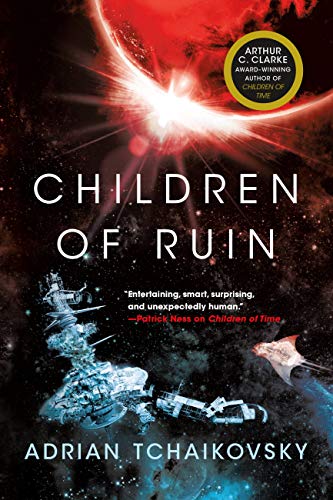
I never got around to writing a post yesterday, at least partially because I spent damn near the entire day with a book in my hand. First off: Adrian Tchaikovsky’s Children of Ruin, which I started a few days ago and finished the last 200 pages or so of yesterday. I’ve already reviewed the first book in this series (I don’t know if there are more planned; they are stand-alone enough that there doesn’t have to be, but sci-fi and fantasy writers tend to think in terms of trilogies or longer, so…) and Children of Ruin is every bit as strong of an effort as the first book. I read a lot, y’all know that, as this year the blog has really morphed into a book review site, and if there is another author out there who writes genuinely alien cultures better than Adrian Tchaikovsky does I’m going to need you to let me know who they are right now. As it is, the guy’s got another book on my shelf and a ten-book series that I’ve never read and another trilogy, so I’ve got enough books by him out there to last me a while, and believe me, I’ll be getting to them. This book adds two different alien species, one an octopus-based intelligence and the other … well, there’s another, and I feel like discussing it is a spoiler, to the human and spider cultures from Children of Time, and it’s amazing how differently each of them feel. He’s got a great knack for the little stuff, and I’m glad that I sort of cheat with my end-of-year list and put sequels and main books on the same spot on the list, because otherwise that job would be even harder than it’s going to be already.

(An example: at one point one of the octopodes makes reference to 6/8 as a fraction. At first the math teacher in me was mildly annoyed by the fact that he didn’t reduce the fraction, and then it hit me– the damn things have eight legs, so of course they use base-8 mathematics. He could have just used percentages and left this out, but he didn’t. That kind of thing.)

Anyway, if for some reason you haven’t read this series yet, get on it.


Meanwhile, don’t ever tell me that Twitter doesn’t sell books. I don’t know off the top of my head how long Daniel M. Ford and I have been mutual follows, but it’s been a while, and for some reason one of his tweets caught me at the exact right moment a few weeks ago and I ordered one of his books. Now, this is always a tricky thing for authors, and I think most of us have learned that even if we find out that a fellow writer has ordered one of our books, you never, ever ask if they’ve read it yet or what they thought. I absolutely hate it when I don’t like the books of writers I know, particularly indie writers (Dan writes for an independent publishing house, but I don’t know that he’d style himself an “indie author,” at least not the same way I do) and there’s always some trepidation whenever I start to read the book because of that, especially since I record everything I read on Goodreads and people tend to notice. Another issue in this case was that the book is a detective/procedural mystery, a genre I dabble in from time to time but am not generally a huge fan of.

I, uh, read the book in a single sitting, starting it around 8:30 last night and finishing it just after midnight, and I’ve already preordered the sequel and ordered a copy of the first book of his fantasy Paladin trilogy. So, yeah, I guess I liked it. The real victory here is the main character himself, Jack Dixon, who lives on a houseboat and thinks apples and protein-infused peanut butter measured precisely by the tablespoon counts as a meal, and yet who somehow felt like a real person who I knew within a chapter or two of the start of the book. I am typically more story-focused than character-focused as a reader, but Jack’s persona is compelling and clearly-drawn enough that I want to know more about him. Ford’s lean-and-clean, no-frills prose is perfectly suited to writing a detective novel, too; it’ll be really interesting to see how he handles a fantasy novel, which tend a bit more toward the flowery. My only gripe is that the ending felt a bit abrupt to me– the actual mystery is solved around the 80% mark and the end of the book is more like a coda and setup for the next book than anything else, but as there is another book coming it’s not as big of a weakness as it might be as a pure standalone.

So, yeah. ‘Twas a good day for reading yesterday.