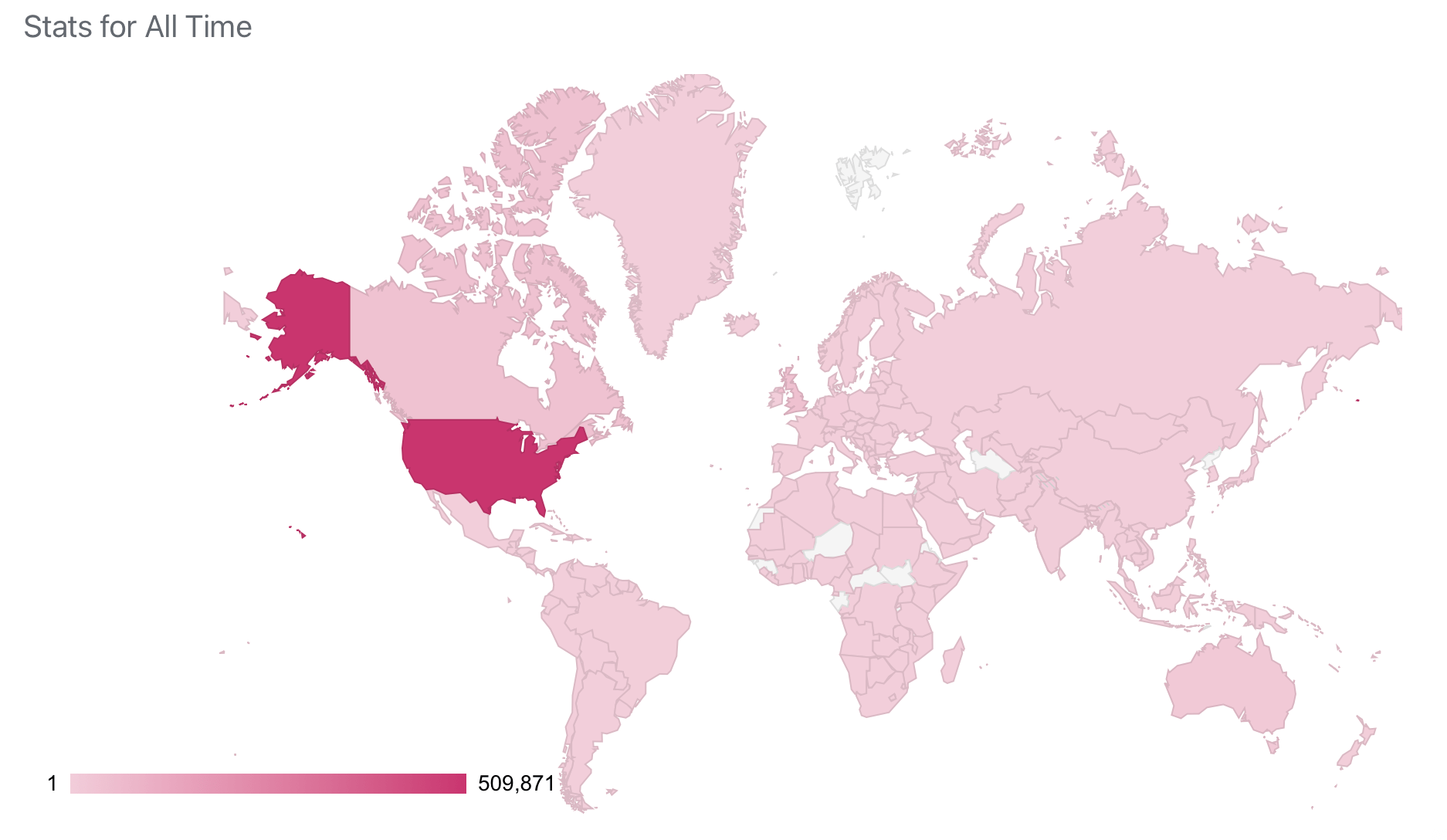
I keep almost writing a 2021 blogwanking post or a sort of round-up of last year, and then finding excuses not to do it. Not that the bathroom renovation isn’t more interesting (I hope, at least) than endless navel-gazing, but I can only put this off for so long before I just can’t write it any more. So, long story short: traffic last year was way way way down, which doesn’t matter because it’s still plenty high for a personal blog site of a non-famous person in 2021, and y’all are stuck with me here anyway for the foreseeable future. Two things are pretty cool. This is the lifetime map of countries that I’ve had hits from:
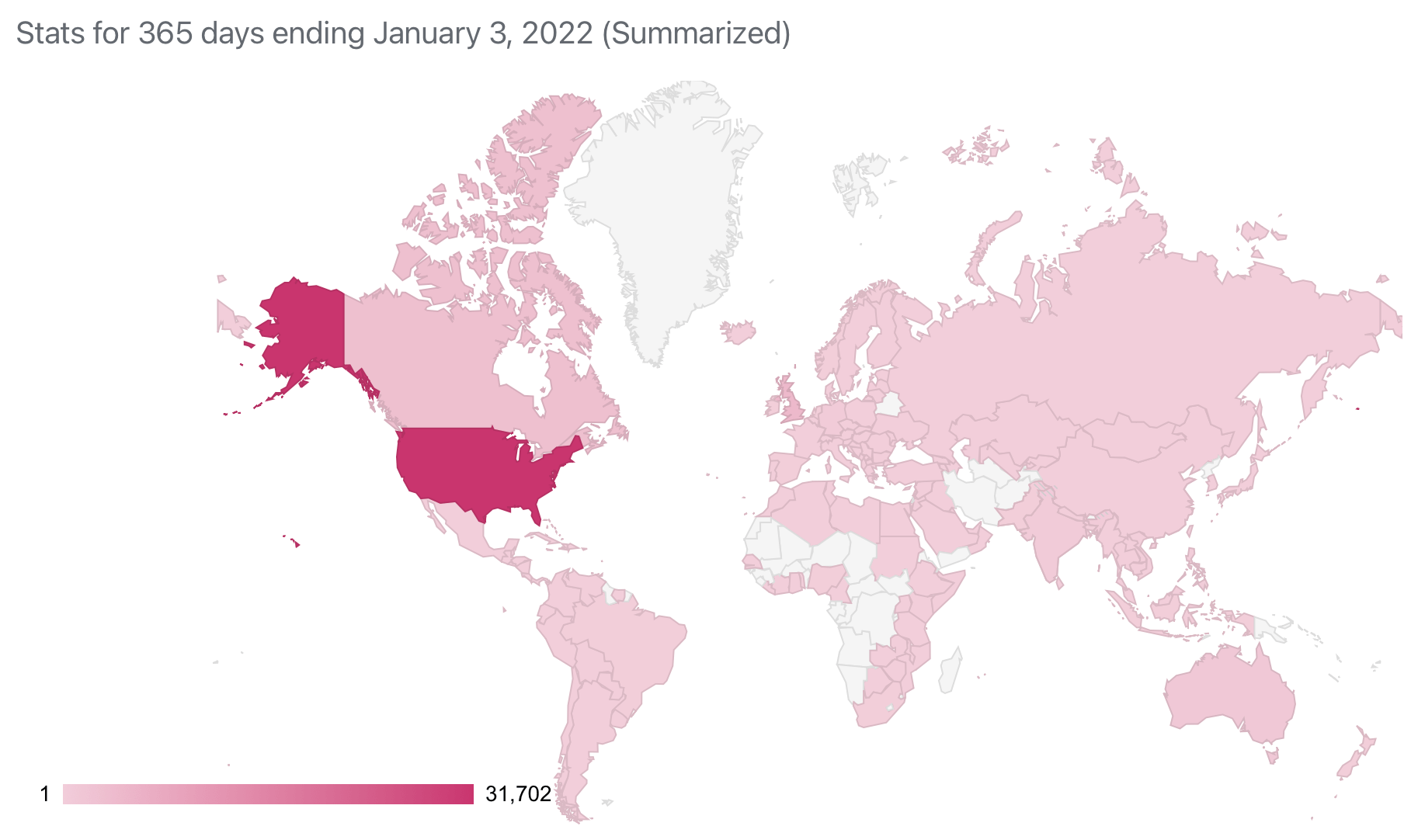
That’s … everywhere, basically; that island up at the top is Svalbard island, where less than fifty people live, most of whom are climate researchers, and it’s part of Norway anyway. North Korea. South Sudan. Tajikistan, I think? (EDIT: Nope, that’s Turkmenistan.) These are not heavily populated countries with a lot of infrastructure, in other words. And despite the low numbers of actual hits (down over 20K in hits and about 12K in unique visitors) the geography from last year is pretty gratifying all by itself:
One way or another, the notion that people from literally all over the world have at least popped in over here, if not actually stuck around and hung out, is pretty amazing.
I have to admit something that is, if not a Hot Take, at least not an especially popular opinion: for me personally, and my immediate family, I don’t think last year was that bad of a year. Now, you have to take this in context, where I am pretty sure that I have described every year since 2016 as the worst year of my life, and I remain of the belief that yes, my life really did spiral south for five straight years, culminating in the loss of my mother on January 11, 2020. 2021 was the first year in a long fucking time where I have a few good things to think about when I look back on it. My brother and his wife had their first child. My dad’s doing okay. We’ve done a lot of work on the house. I made more money last year than I’ve ever made before, a feat I should be able to repeat this year, and because I’ve paid off my credit cards, leaving me with no credit card debt for the first time since college, I’ve been able to keep more of that money and use it for more than just paying off interest. My son is happy and healthy and thriving at school. My wife got a promotion and a raise. I, who a few years ago was convinced I’d never see the inside of a classroom again, got nominated for Teacher of the Year again. By the time this school year ends, I’ll not only have paid off my car, but my student loans might be gone.
All in all, on a strictly personal basis, I can actually see some light again. I have reason for at least a guarded level of optimism, which has not been true for quite some time. I mean, the rest of the world is still going to hell, don’t get me wrong. But at least not everything is going to shit.
My one big personal regret right now is that my writing career is, at the least, on a significant pause, and very well might be done. I haven’t written a word of fiction in at least a couple of years, and I’m not missing it much. I mean, it’s not like I was changing the world or anything like that, as much as I tried to take everything seriously, I never managed to make any money at it– every single con I attended lost me money, so it was more of an expensive hobby than anything else. I’m not saying I’ll never release another book, but I’m not in a hurry to.
You never know. Most of my creative energy lately is going here and to the YouTube channel, and maybe eventually that’ll blow up. If not, well, we’ll see what comes next.
It is December 30, and Adrian Tchaikovsky is just going to have to wait until next year if I happen to really love the book of his that I’m starting today. This is an interesting list to me for several reasons; several of these books are very much of the “I loved this but you really might not” type, as holy shit that was weird and awesome seems to have been a common thread for a lot of the books I really liked this year. Also, a handful of them weren’t on my shortlist, meaning that after I did my first pass on that I thought “Hey, where was book X?” and realized that at the time I read it I didn’t think it was going to be good enough to make the list at the end of the year and then it did a really good job of sticking around in my head. I read so many books that books I read early in the year are at a serious disadvantage, so it’s always neat when one creeps up on me.
Also, as I’m writing this right now I still don’t know what the #1 book is going to be, which is a sign of just how much I loved both of them. Don’t pay a ton of attention to the specific rankings until the top five or so, as usual, because if I put the list together tomorrow they might shift around a little bit.
As always, “new” means “new to me,” so although there are a number of 2021 releases on here and none of them are really old books, being read in 2021 was the requirement for inclusion, not being released.
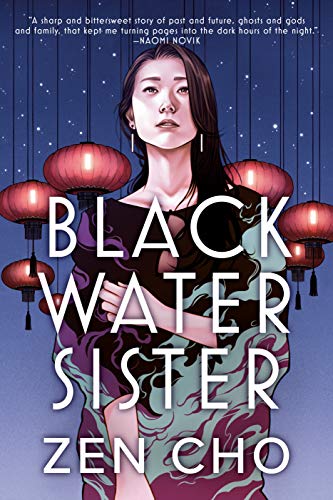
15. Black Water Sister, by Zen Cho. I have read several of Zen Cho’s books but I am pretty sure this is the first time she has appeared on this list; it’s the story of a Malaysian-American girl whose family returns to Malaysia after a series of financial setbacks and who immediately starts being visited by the ghost of her grandmother. While calling it autobiographical doesn’t really make any sense, as I’m pretty certain Zen Cho hasn’t experienced any ancestral hauntings, it’s clear that she’s drawing on her own experiences as a child of immigrants in this book, and as a result it feels more personal and intimate than a lot of her other work has. The supernatural influences don’t stop with the grandmother; Malaysian religion and Malaysian gods and an interesting (at least to me) take on Christianity are also a big part of the book, and there are enough twists and turns over the course of the narrative to keep the pages turning. Jess herself is a bit of an asshole, but having had some time to marinate on it I think it makes her feel more real. This is Cho’s best book by a decent margin, and she was already someone whose books were on my “buy automatically” list, so just start adding everything I talk about to your TBR right now.
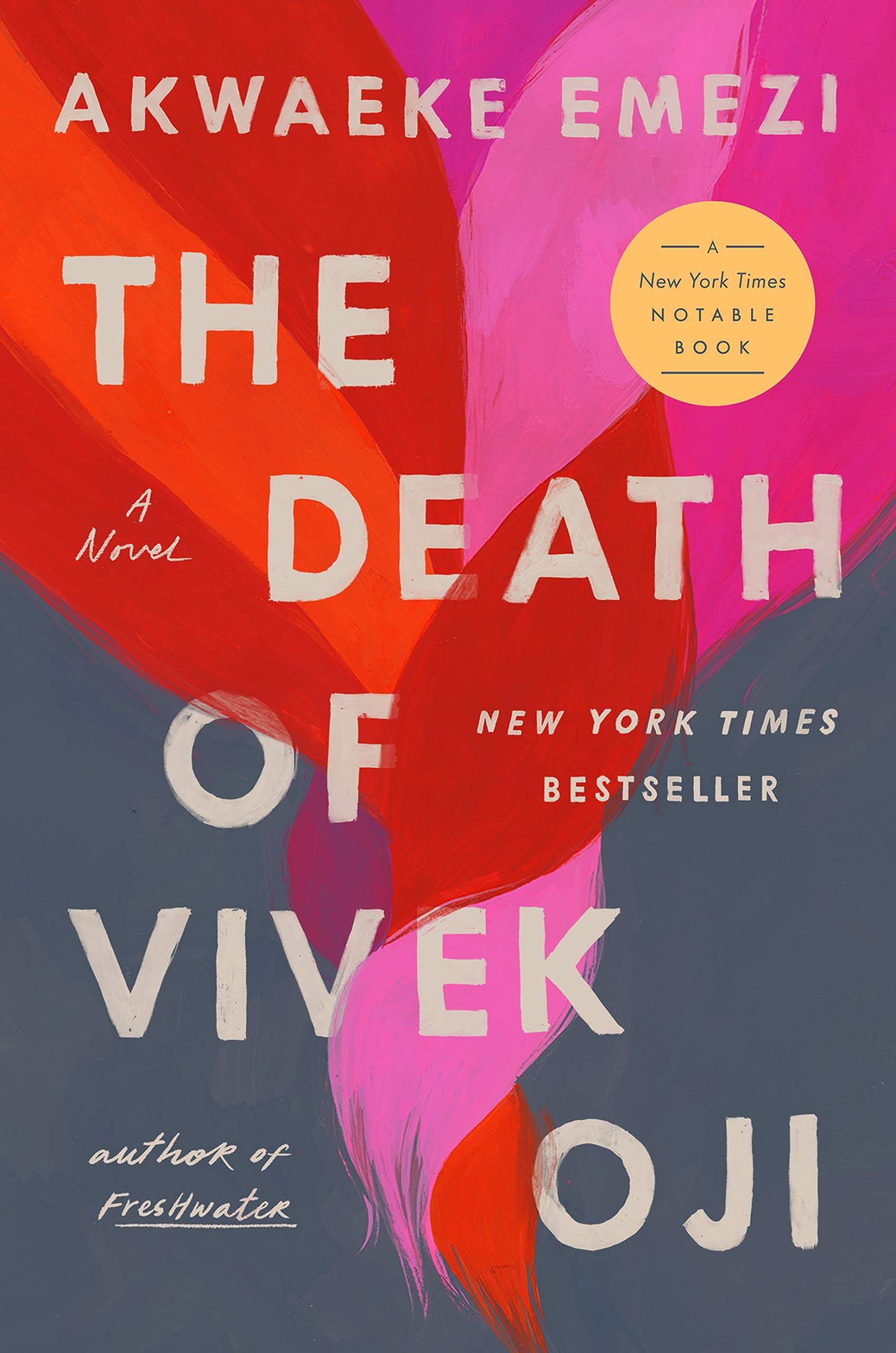
14. The Death of Vivek Oji, by Akwaeke Emezi. So, uh, spoiler alert: Vivek Oji dies in this book. The title? Not a joke.
Nigerian author Akwaeke Emezi is a superb talent, and Death is a title that is a little difficult to talk about without spoiling plot details, as, well, you kinda already know Vivek is gone at the beginning of the book and so learning about what happened is the whole point. I don’t know that this is quite a mystery story except in the broadest possible outlines; it’s more of a story about a tragedy that happens to a family than anything else, and of Emezi’s three books that I’ve read (the other two being Freshwater and Pet) this is the most assured and emotional their writing has ever been. The book jumps around in time, telling the story of Vivek’s life as well as his death, and it’s yet another piece of evidence for my oft-repeated statements that if you like to read and you’re not regularly picking up books by Nigerian authors you are seriously missing out.
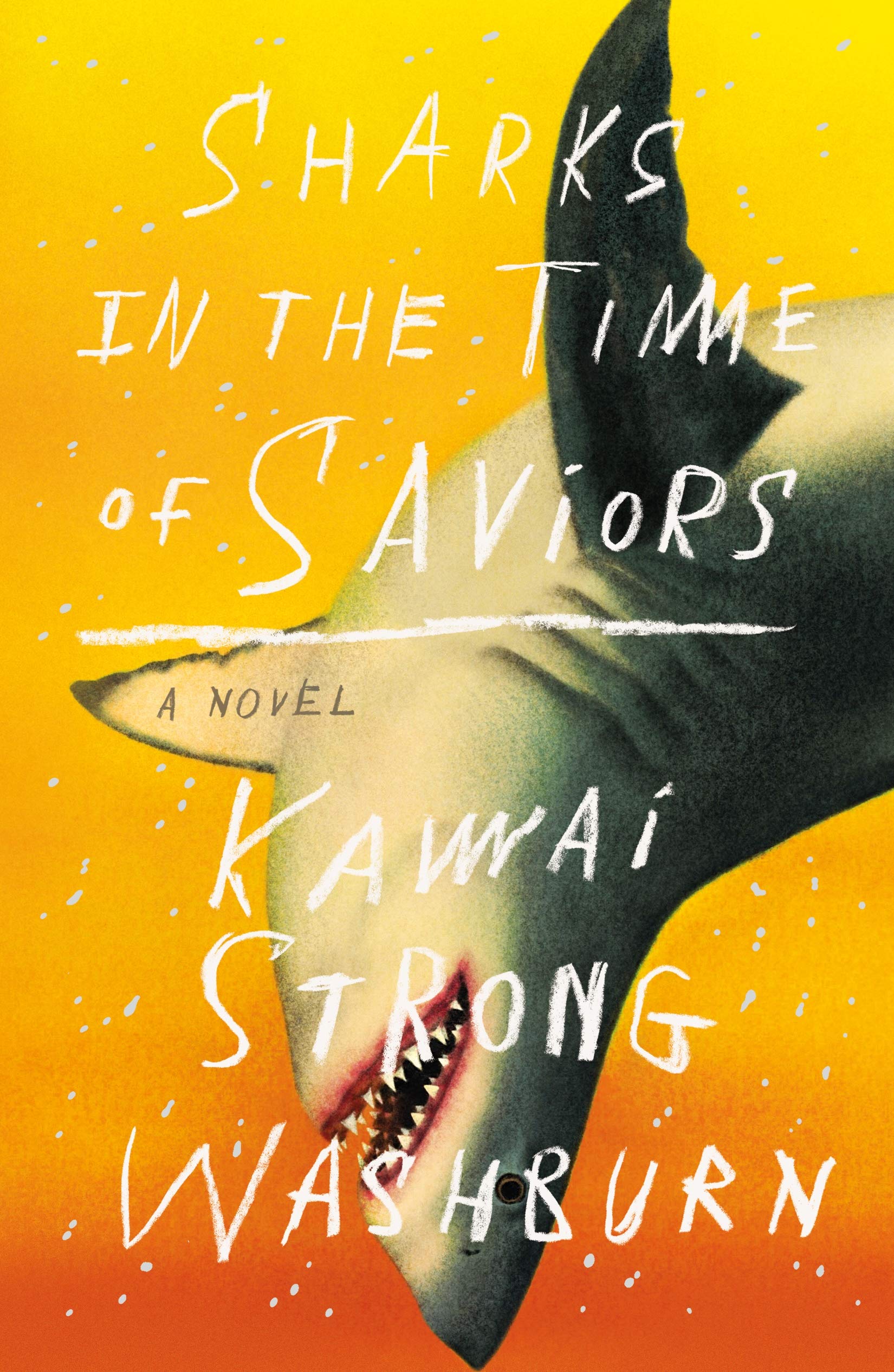
13. Sharks in the Time of Saviors, by Kawai Strong Washburn. This is the first book on the list that I would likely not have read were it not for #readaroundtheworld, and in fact I found it by sending a message to a friend of mine from high school who lives in Hawai’i now and asking her to recommend some books by native Hawaiian authors. This is another family story (another theme this year, as I look through the rest of the books) that starts when a seven year old boy falls off a boat and nearly drowns and is rescued by … sharks. Which, y’know, isn’t exactly typical. Then a friend blows part of his hand off with fireworks and the boy is able to heal him. Which, yeah, also not typical, and the narrative blasts off from there.
Most of the family members– three children and a mom, with Dad popping in for a chapter or two here and there– are point-of-view characters for some part of the narrative or another, as they go through their lives and move back and forth between the island and the mainland. This is a book about the weight of family expectations, and what happens to you when The Future is always something you thought you understood until it arrived differently than you expected.
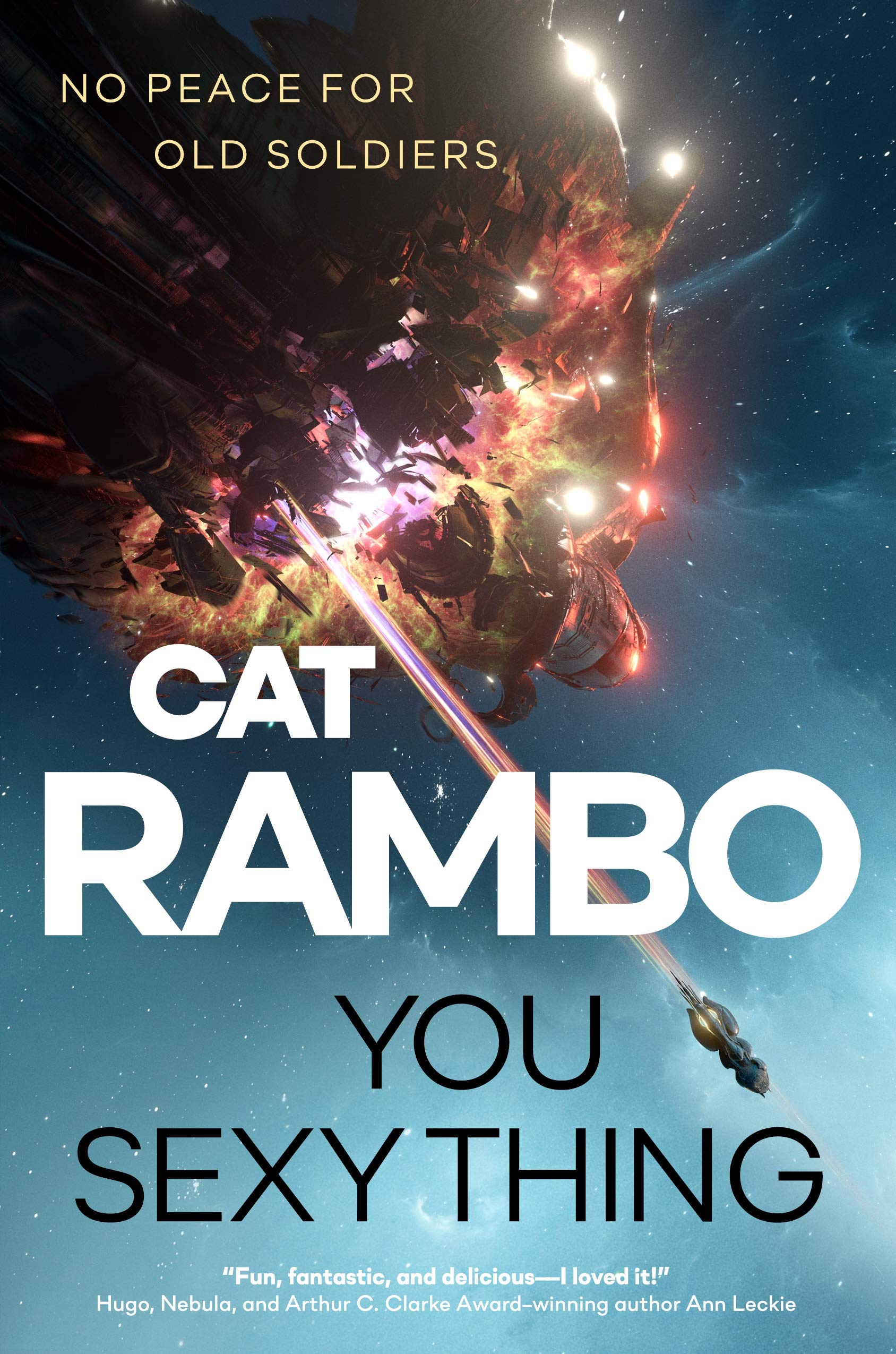
12. You Sexy Thing, by Cat Rambo. Getting sent books for review consideration has developed into a thing that happens four or five times a year now, and while I got sent early copies of two of the books on this list, I don’t know that this book would have gotten onto my radar had I not had it sent to me for free. So it’s great that it was, because the book is awesome.
This is a book where describing the setting, and assuring you that the book lives up to the setting, should be sufficient to get you to read it. The copy on the back cover describes the book as “Great British Baking Show meets Farscape,” and that is perfectly sufficient in and of itself to get me to hand over my money. The characters are all (well, mostly) members of a military unit who have retired and opened a restaurant, and as the book opens they are eagerly anticipating a visit from a food critic who has the power to award them something called a Nikkelin Orb, and … yeah, at that point I was already in, and that’s before it’s revealed that the title of the book is the name of an intelligent bioship that the characters (sort of) steal, or things like the team’s explosives expert being a chimpanzee who only communicates via sign language, or the four-armed, eight-foot-tall head chef, or the hypersexual floating squid who also makes up part of the crew. With a setting and characters like this you barely need a story, but Rambo succeeds there as well, and while I’m not a hundred percent certain there are more books coming in this series, I really really want more.
11. The Meaning of Names, by Karen Gettert Shoemaker. I said in my original review of this book that I had really liked it but I wasn’t sure I ever wanted to read it again, and while that is still true the book has really stuck around in my head– this is one of those that wasn’t originally on my shortlist for this post but forced itself onto the list anyway.
Names is set in Nebraska during World War I, in a small German immigrant community. You may already be raising an eyebrow; if you suspect that a book about German-Americans during World War I might in some way be about nativist prejudice against those immigrants, well, you’d be right, and do you happen to remember what else happened in 1918? Oh, right, a fucking global pandemic involving a respiratory disease.
This book was written well before Covid became a thing, but it has a number of really uncomfortable parallels to everything going on today, and I’d actually love to sit down with Karen Gettert Shoemaker and have a conversation with her about having written this book that was about one thing when she wrote it and now reads like a satire on American society. Because everything going on right now involving Covid happens in the book– well, no horse paste, but the rest of it is spot-on– and … yeah. It’s hard to read. But it’s damn well done for all of that, and I had to include it on the list.
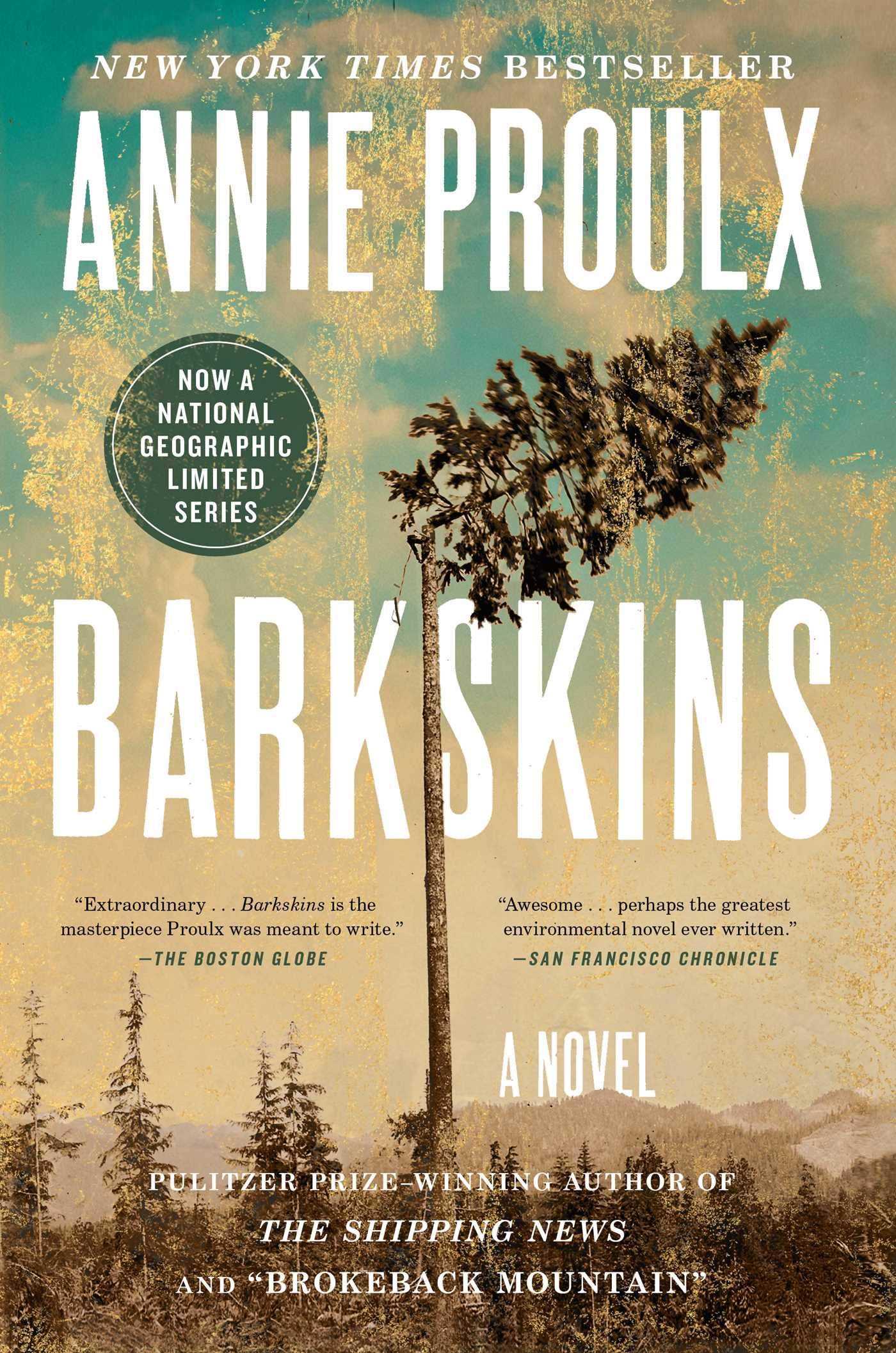
10. Barkskins, by Annie Proulx. Barkskins is another one that I originally didn’t intend to put on the list, and the third book so far that I wouldn’t have read were it not for the #readaroundtheworld project, this time for South Dakota. This is historical fiction, and insanely detailed and well-researched historical fiction, following the descendants of a seventeenth-century French indentured servant through over three hundred years of history. Part of it ends up being a history of colonialism, and part of it ends up being a (fictional) history of the logging company that the original character starts and one branch of the family keeps alive through the years. This is also very much a book about environmentalism; you can imagine that people who own a logging company might have a few ideas about what to do with trees, and the book addresses both the ideas of early white colonists that America’s forests were literally endless and inexhaustible and later attempts at conservation, and we end up with characters on both sides of that conversation. The conversation about conservation. The conservation conversation.
Oh, and because it’s a generational saga, Proulx doesn’t feel any need to be especially nice to her characters, because one way or another they’re gonna die, since the book has two hundred years and 500 pages left to go. So sometimes people have a nice interesting storyline going and then step on a nail and die of typhus a page later. God, I’m glad I live in an era with modern medicine.
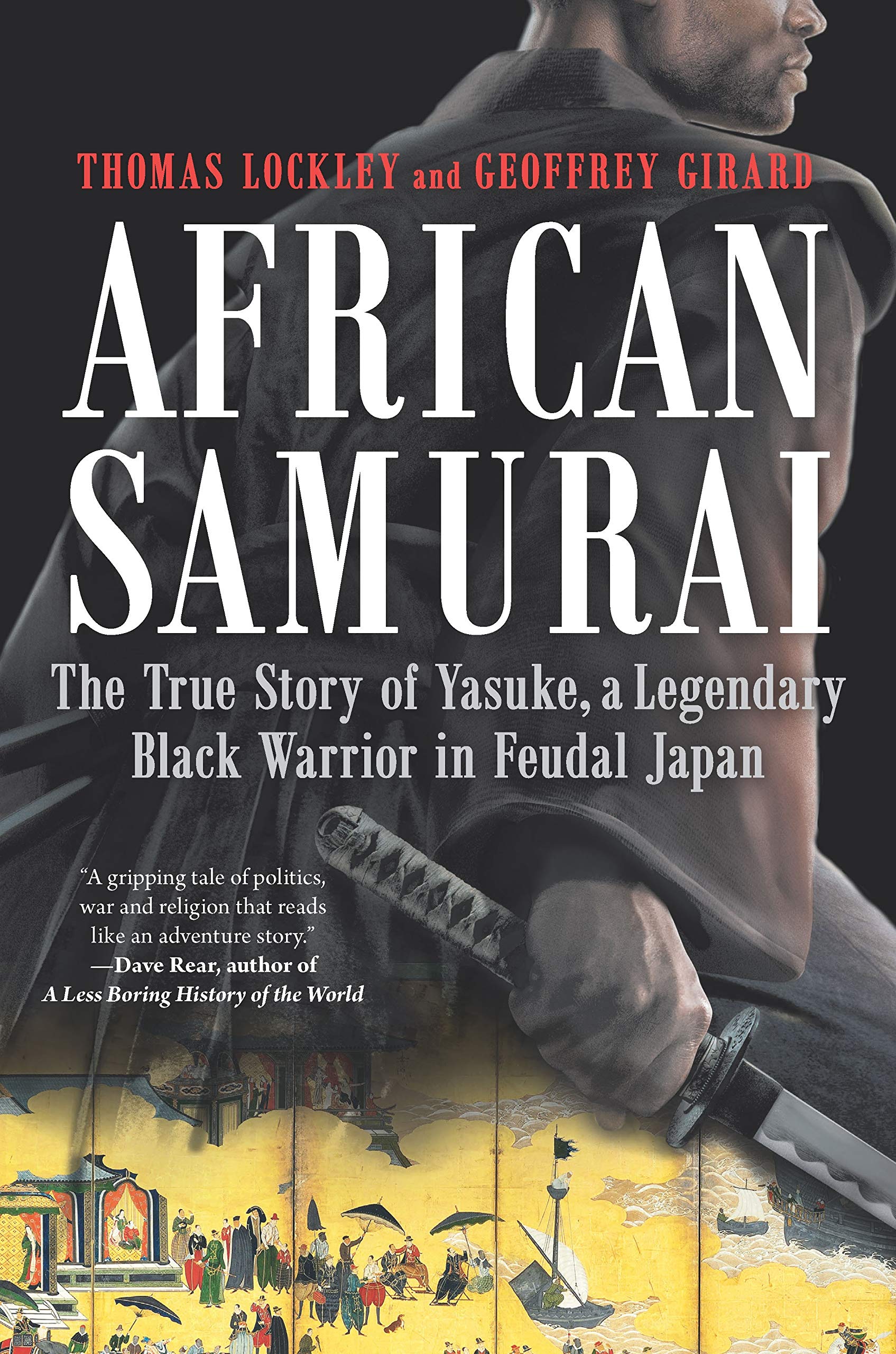
9. African Samurai: The True Story of Yasuke, a Legendary Black Warrior in Feudal Japan, byThomas Lockley and Geoffrey Girard. I read very little nonfiction this year compared to a typical year, and in fact as I’m sitting here I can’t come up with more than maybe one or two other nonfiction books from 2021. Even this one is lightly fictionalized, as Yasuke was definitely a real person and was, yes, an African samurai in sixteenth-century Japan, but the only way we know he existed is through some artwork and a series of letters from a Jesuit priest who lived in Japan at the time. Geoffrey Girard is a novelist and Thomas Lockley a historian, and I think the novelist might actually have written more of the book than the historian did, as we spend a lot of time inside Yasuke’s head and recounting day-to-day events in his life than the historical record might strictly be able to support. That said, this book also doubles as a biographical treatment of Oda Nobunaga, who was also real and also fascinating, and while it’s necessary to take specific claims with a grain of salt from time to time– we don’t know how Yasuke felt about discovering he was going to have servants in the house Nobunaga gave him, an anecdote that a couple of pages is devoted to– the book is truthy enough in the broad strokes, and it’s a fascinating read.
Just don’t expect Yasuke to have magical powers or to have his giant spirit bear attack you. That’s from video games, and it definitely didn’t really happen.
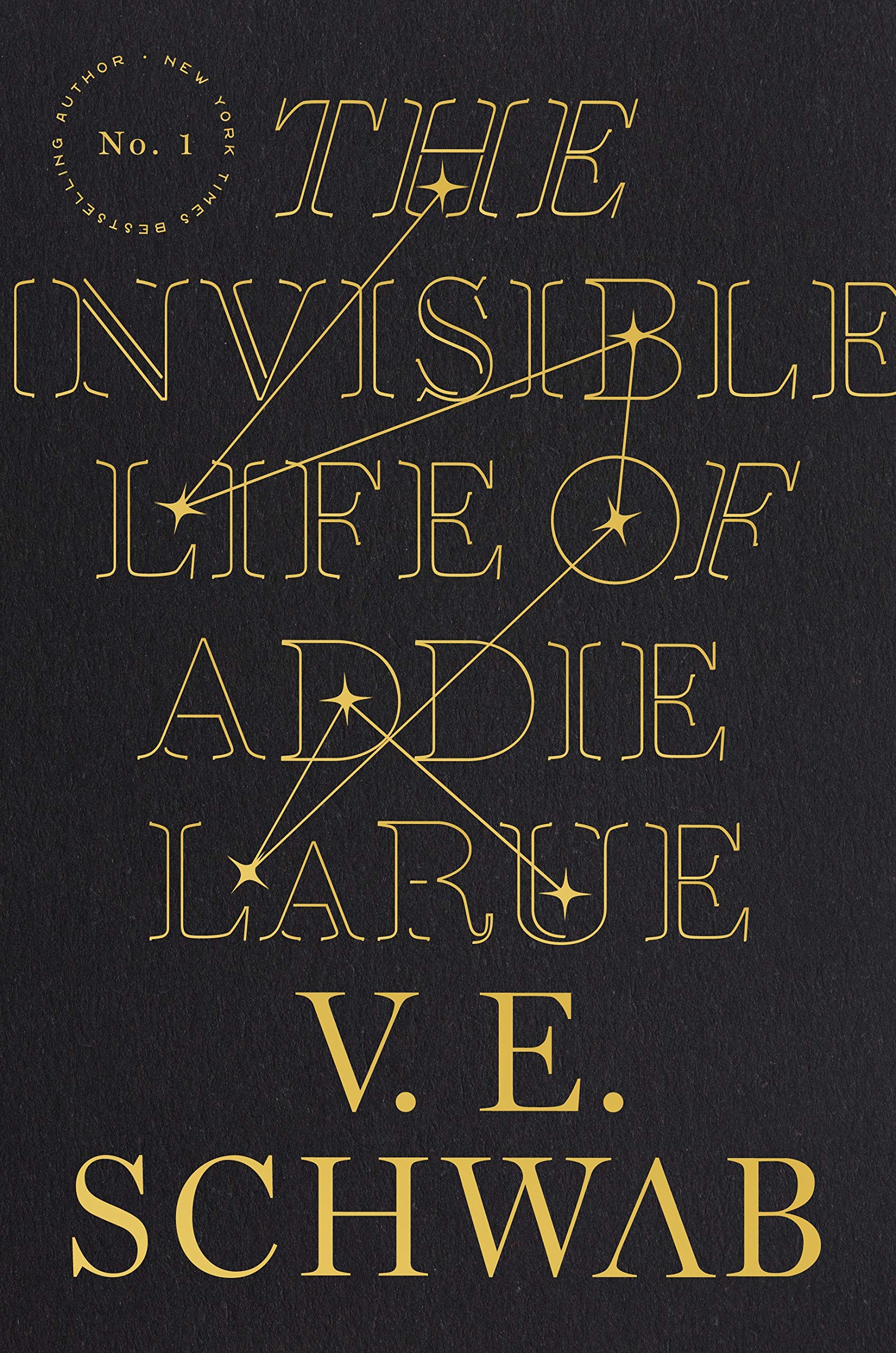
8. The Invisible Life of Addie LaRue, by V. E. Schwab. Another book that flirts with historical fiction without being historical fiction, Invisible Life starts several centuries ago in France and tells the story of Addie LaRue, an immortal woman who is cursed to not be remembered by anyone once they look away from her. While this type of lifestyle does have its advantages (it’s easy to steal from people if they literally don’t remember you exist once they lose sight of you) you can imagine that it also has massive drawbacks, and the occasional meal with the Actual Devil doesn’t do much to assuage the loneliness of being, effectively, unperceivable.
And then she meets someone who can remember seeing her, and everything changes, and the narrative takes off from there. This is, like Barkskins, a book that gets a lot of points for being something that I absolutely could never ever write, as the research alone for the book’s timeline must have been an immense amount of work, and Schwab handles it like someone who lived there. I want to take a particular moment to recommend this book to fans of Sandman, as LaRue’s story has certain commonalities with Hob Gadling’s, and he was one of my favorite Sandman characters, so chances are the similarities will hit others as well. I know book reviewers who have named this one their favorite book of all time, so expect it to make an impact.
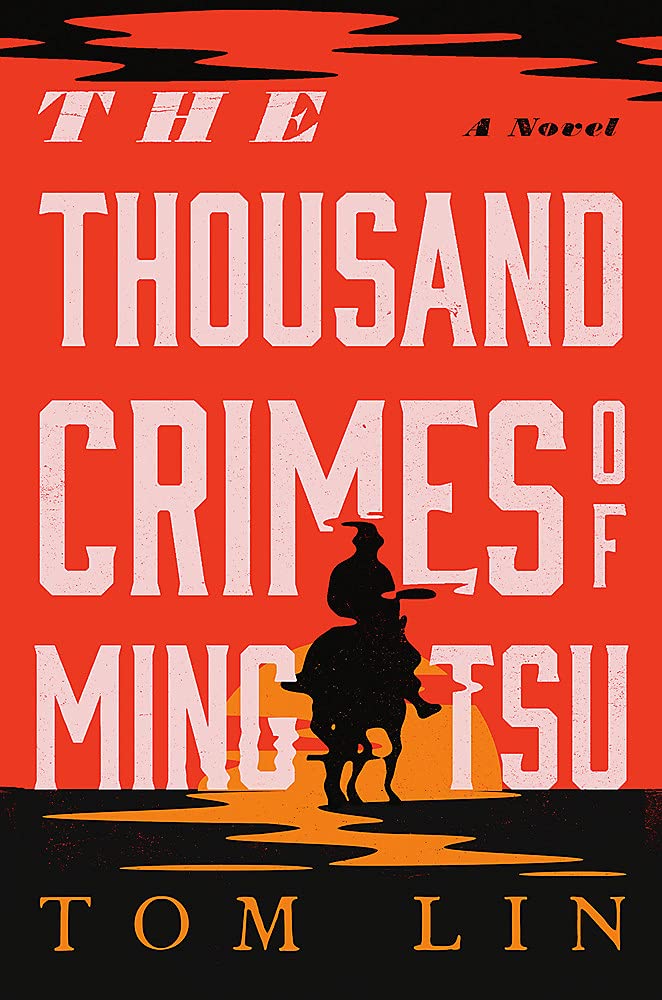
7. The Thousand Crimes of Ming Tsu, by Tom Lin. Did I say historical fiction? How about a Chinese cowboy in the American West? How about lots of shooting and killing and crime, and a prophecy and a seer thrown in just for the hell of it?
Like, I’m done talking there, because much like the premise of You Sexy Thing, you’ve already decided if you’re going to read this book, and if you’re a good person you’ve decided to read it, unless you already read it back when I originally reviewed it. And if you’ve decided to read it you are correct, and if you have not decided to read it you are wrong, so make sure you’re on the right side of history here. Westerns starring Chinese cowboys should have people reaching for their credit cards and slamming them on the table, dammit. You’ve all seen TikTok. Like that.
This is Tom Lin’s debut, and I’m pretty certain that it’s a one-off, so who knows where he’s going to head with his next book, but you can rest assured I’m going to be reading it.
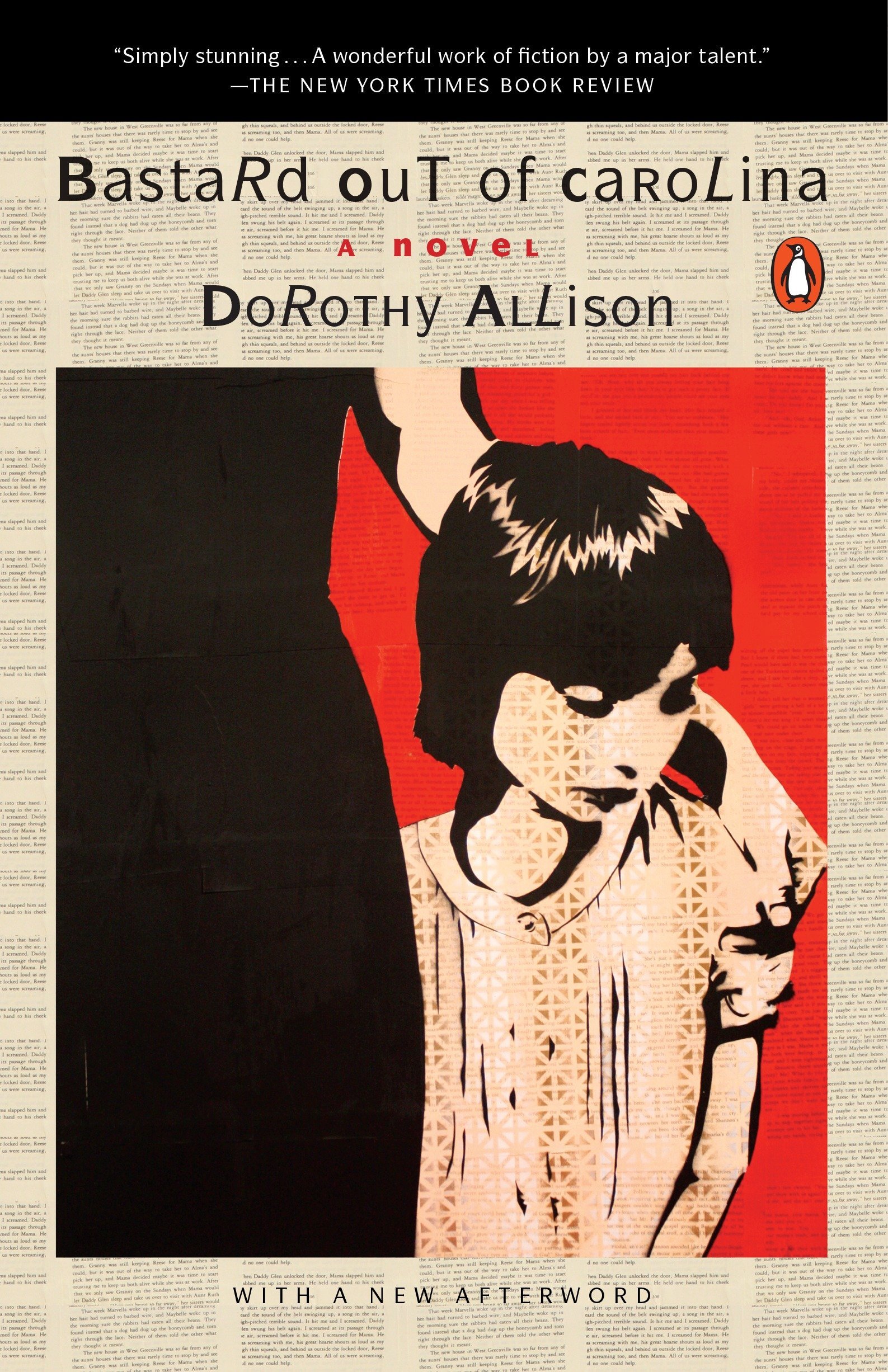
6. Bastard out of Carolina, by Dorothy Allison. This is the oldest book on the list, written in 1992, and was another book I read because of #readaroundtheworld, representing (see if you can guess) South Carolina. There’s a movie, too, which I haven’t seen, although my understanding is that it’s pretty good as well.
This is the only book on the list that I really feel needs a content warning if you’re going to read it; the main character, a young girl called Bone, is growing up fatherless and poor in a small town in South Carolina, and it is not an easy life, for her or any of her family members, particularly the women. Domestic violence and sexual assault are themes throughout the book, and there is at least one explicit rape scene.
It is a rough goddamn book to read, but it has well-earned its place in American literature and I’m really glad I read it. I can’t say I necessarily enjoyed the experience, but this is one of those books you should make sure to pick up anyway.
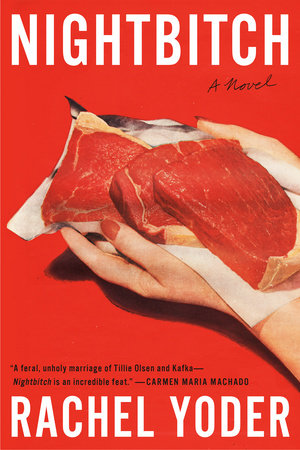
5. Nightbitch, by Rachel Yoder. This is a book where the main character abruptly turns into a dog halfway through and it’s not the weirdest book on the list. It’s definitely one of those “I loved this and you might not” books, though, and its deep and abiding strangeness is the best thing about it. The main character, referred to only as the Mother for half of the book and then as Nightbitch for the rest, is a suburban housewife, married to a man who spends most of his time out of town and is probably cheating, and she spends her day entertaining their toddler, a job that she does not respond to with joyous anticipation every day.
At all.
Frankly, she hates being a parent; hates the dead-eyed, joyless repetition of it all, hates the walks and the puréed food and the endless messes and the sleepless nights for both her and the child and the mindless fucking drudgery that any honest person will admit is part and parcel of raising, in particular, a toddler.
And then she, uh, turns into a dog for a while, and she convinces her kid to sleep without her at night by also being a doggy and sleeping in a kennel, and after that it gets kinda weird, and you should absolutely trust me and read it.
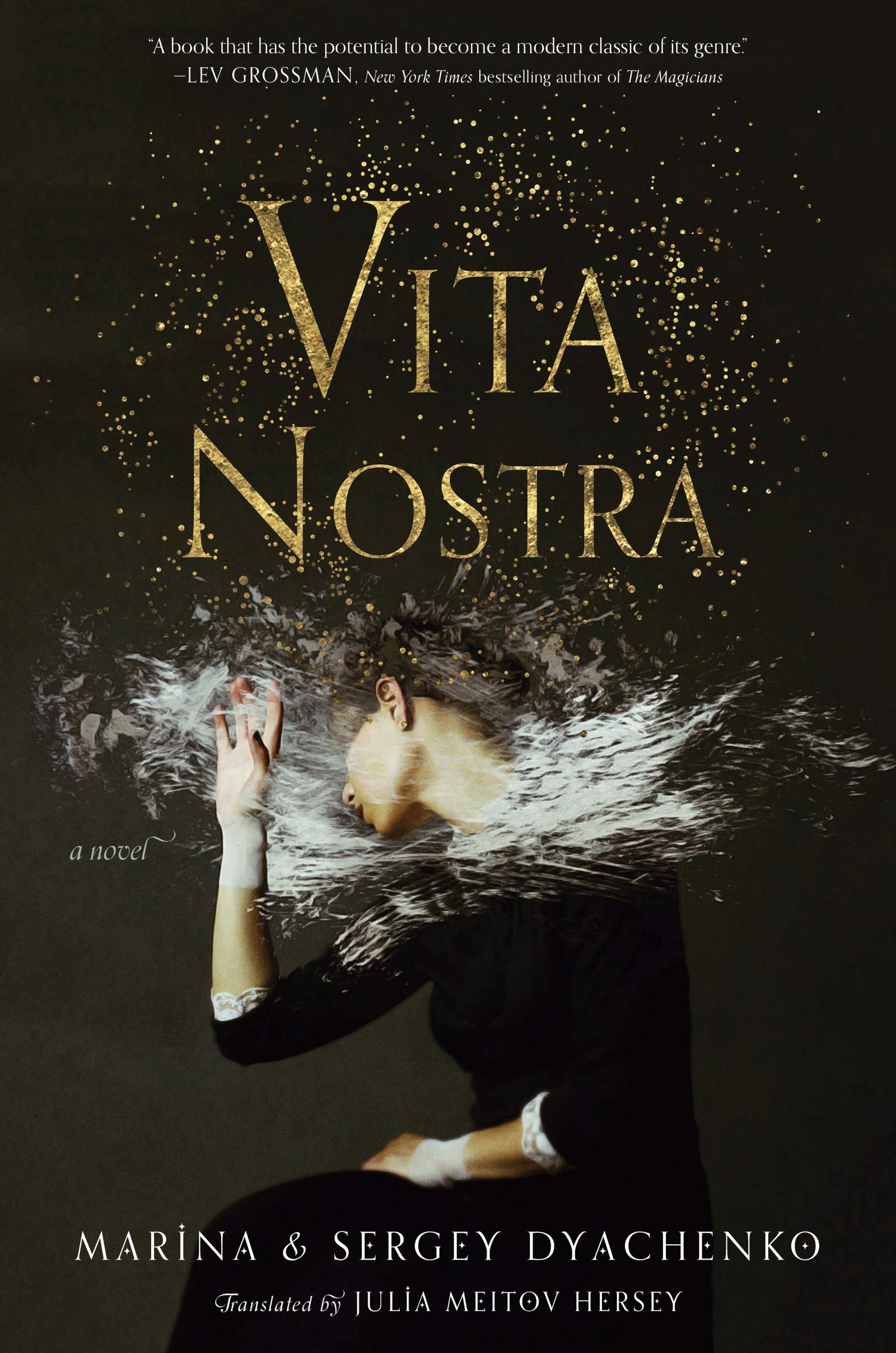
4. Vita Nostra, by Marina and Sergey Dyachenko. Okay, this is the weirdest book on the list, and I bought it because I was looking for books from Eastern Europe and from Ukraine specifically, and oh holy shit I don’t even really know how to describe it even now. I saw someone who described it as “Harry Potter, but written by Kafka,” and that’s maybe correct but I think it might be slightly more accurate if the author was the lovechild of Kafka and Lovecraft. The main character is a college-age girl who gets railroaded into college at a small school in an out-of-the-way town and begins studying, basically, eldritch horror, where absolutely nothing makes any sense at all and knowledge can’t be expressed in words and one of her assignments is to just memorize a list of nonsense words because it’s going to unlock her brain for something else and it is so fucked up and so incredibly Russian and at one point she has scales and wings just because that happens and oh my God you have to read it just so that I have someone to talk to about it. Defense Against the Dark Arts has nothing on the Special Technologies class. Nothing.
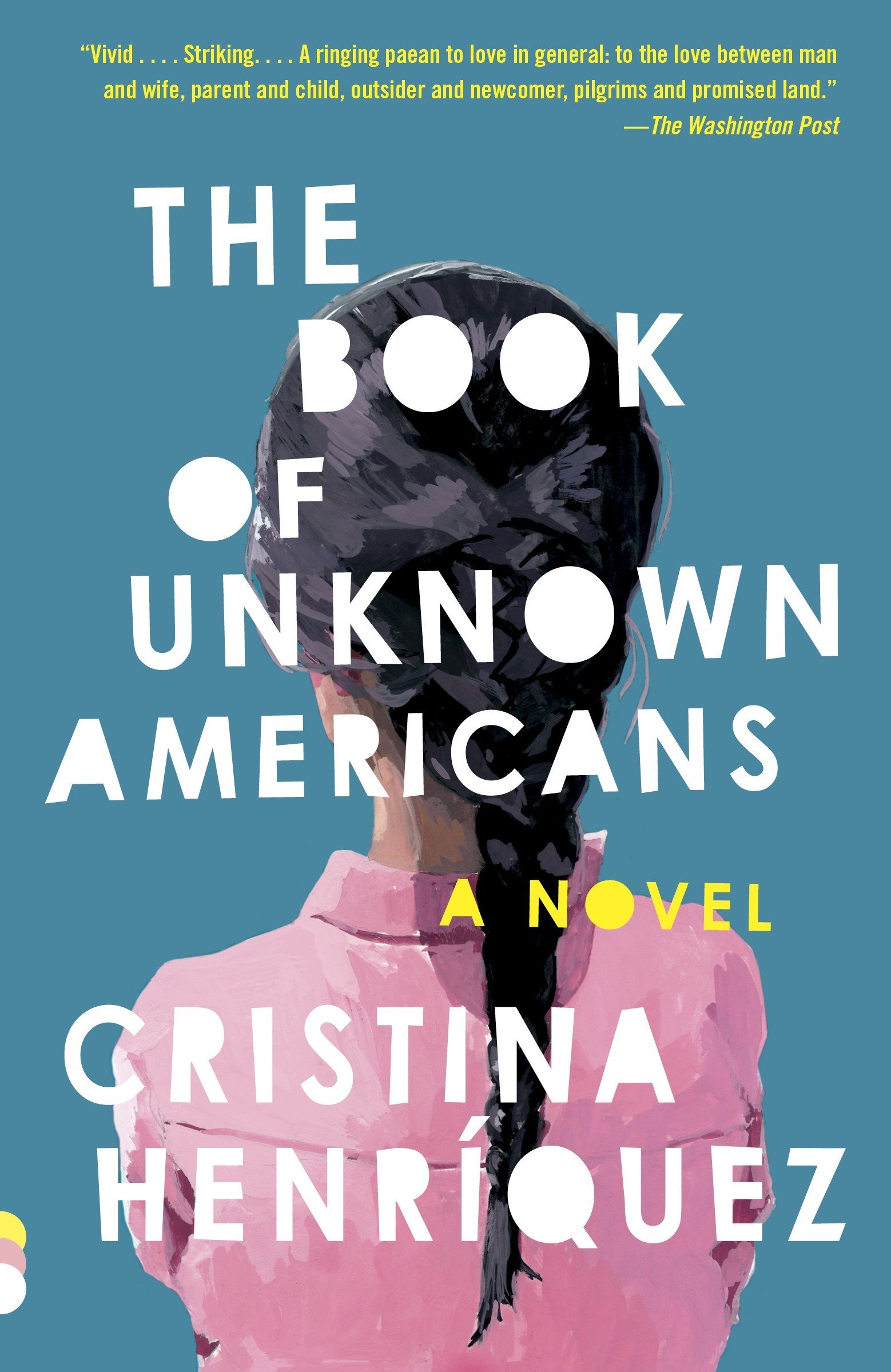
3. The Book of Unknown Americans, by Cristina Henríquez. Man, this one was really something special. The Book of Unknown Americans is set in an immigrant community– specifically, a single apartment complex inhabited by immigrants, some legal, some not, from all over Mexico and Central/South America– in Delaware. There are years where this book would have been #1 with a bullet, and it was one of the major highlights of #readaroundtheworld. It employs a rotating POV among ten or so different people of various ages, some born here, others who came as adults, and some who came as children, all Spanish-speaking but at a variety of levels of comfort with English and with American culture. The book is set in the early years of the Obama administration, and you might recall that the economy was not great during those years, so everyone is operating on a razor’s edge where losing a job or making a mistake could lead to homelessness, and the unique frustration of having been an educated, respected professional in one country who has to clean houses in America because your credentials don’t transfer and you don’t speak the language pervades the entire book. It also contains one of the sweetest love stories I’ve ever read, and even if the other characters’ stories weren’t great, the relationship between Maribel and Mayor would have gotten the book onto the list. This is a superb piece of work and absolutely everyone should read it.
Oh, and the ending is going to kill you. Maybe be ready for that.
I need y’all to understand that right now as I am typing this I am not a hundred percent convinced of the order of these last two books. One of them, if you’ve been around for a while, you can probably predict, one of them maybe you can’t. I will freely admit that I’m deciding on #1 because it makes a better story, and it would probably be most accurate to just have them tie, but they’re both absolutely outstanding and tomorrow I might rank them differently. Just FYI.
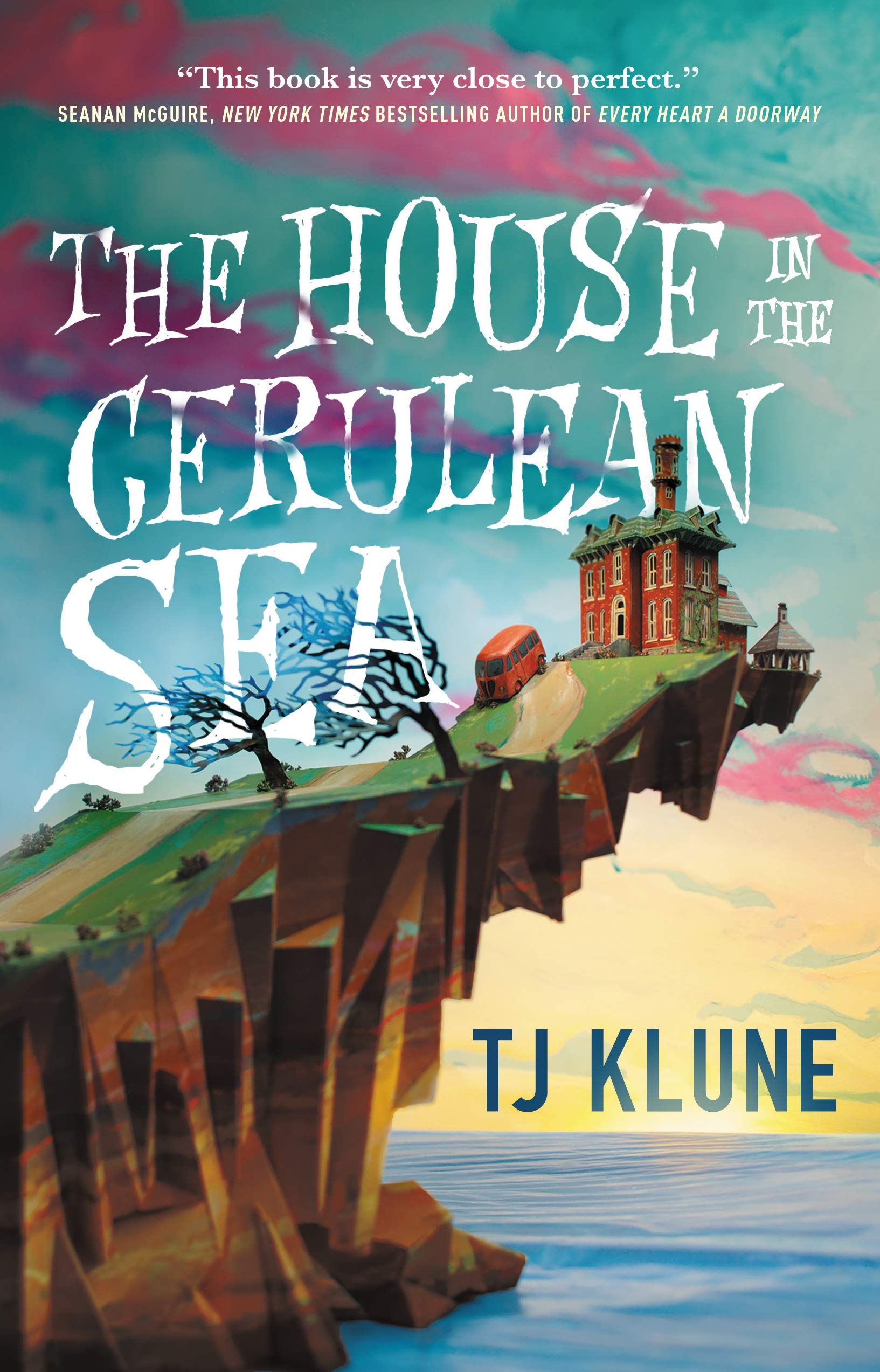
2. The House in the Cerulean Sea, by T.J. Klune. I will get into this more tomorrow, probably, or maybe even later today, but my initial post about this is my #1 post of 2021, and I have absolutely no idea why. It has literally gotten twenty times as many hits as my #2 post from this year. I have perhaps overused the word delightful in talking about this book, which is about love and found family and acceptance and optimism and taking risks for love and it was absolutely something I needed to read this year, but the simple fact is that delight is the #1 emotion I felt while I was reading it. House is about an orphanage for special children, and by “special” what I mean is that one of them is basically a gelatinous cube and another is the literal son of Satan, and the man who cares for them, and another man who is sent from the government organization that oversees the orphanages to make sure that the children are being treated well and are safe.
There is a reason that this is the only book on this list where I linked to my original piece about it, and I wrote about all of these books as I read them, and that is because of the inspiration for the book. Klune has been open about the idea that the germ of the novel came from his learning about Canada’s Residential Schools, which were absolutely horrible places, and has taken a lot of heat for that comment. The problem is that the book he has written is not about a residential school. He has taken something terrible and used it as inspiration for something that is lovely and life-affirming and beautiful, and it is an astonishingly good book. I’m not interested in arguing with someone who felt differently; your reactions to the book are your own. But I think they are objectively wrong on this one.
And, likely surprising no one, the #1 book on my list:
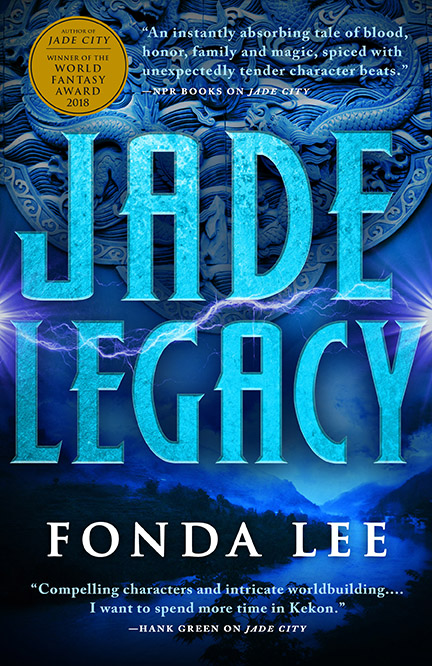
1. Jade Legacy, by Fonda Lee. To a certain extent, this was inevitable; Legacy is the third book of the Green Bone Saga trilogy, and the first book, Jade City, was my favorite book of 2018 and the second book, Jade War, was my favorite book of 2019.
Jade Legacy had a hell of a lot to live up to and a hell of a high bar to clear– sticking the landing on any story can be tough, sticking the landing on a trilogy where the second book was so good I compared it to The Godfather, Part II is even harder, and sticking the landing when you’ve decided to extend the third book over several decades as opposed to the tighter timeline of the first two books, meaning that your characters are going to age significantly and your world is going to change radically over the course of the book, is so rough I can’t even comprehend it. The fact that Fonda Lee not only managed to finish this thing but that she finished it while the world was falling apart is a towering achievement. Legacy is absolutely a worthy ending to what has become one of my favorite fantasy series of all time, vying with The Lord of the Rings and basically nothing else for that honor. It covers multiple generations and multiple continents and multiple families, and it’s about honor and death and colonialism and crime and violence and friendship and honor and yes I said honor already but it’s kind of a big thing and if you haven’t picked up this series yet after I’ve spent the last four years hollering about how good it is I don’t know why you’re even here.
(Oh, and I got it as an early ARC, which is probably the single best thing that happened to me this year; I cannot describe how excited I was when I got an email from Lee’s publicist asking me if I wanted an early copy of the book. Yes, I bought it anyway; I’d actually already preordered it when the ARC showed up, and I’ve even got another set of the trilogy that came out in a limited edition, meaning I have three copies of this book in my house.)
I cannot recommend this book any more highly. Yes, it and Cerulean Sea were very, very close this year, but Sea is a stand-alone and this is a capstone to an astonishingly good series of books. It is the best book I read this year.
Honorable Mention, in No Particular Order:The Necessary Beggar, by Susan Palwick; Island beneath the Sea, by Isabel Allende; Heartbreak Bay, by Rachel Caine; A Thousand Splendid Suns, by Khaled Hosseini; Persephone Station, by Stan Leicht; Requiem Moon, by C.T. Rwizi; The Book of Lost Saints, by Daniel José Older; Transcendent Kingdom, by Yaa Gyasi; The Searcher, by Tana French; The Witness for the Dead, by Katherine Addison; The Unquiet Earth, by Denise Giardina; Bump, by Matt Wallace; The Hidden Palace, by Helene Wecker; and The All-Consuming World by Cassandra Khaw.
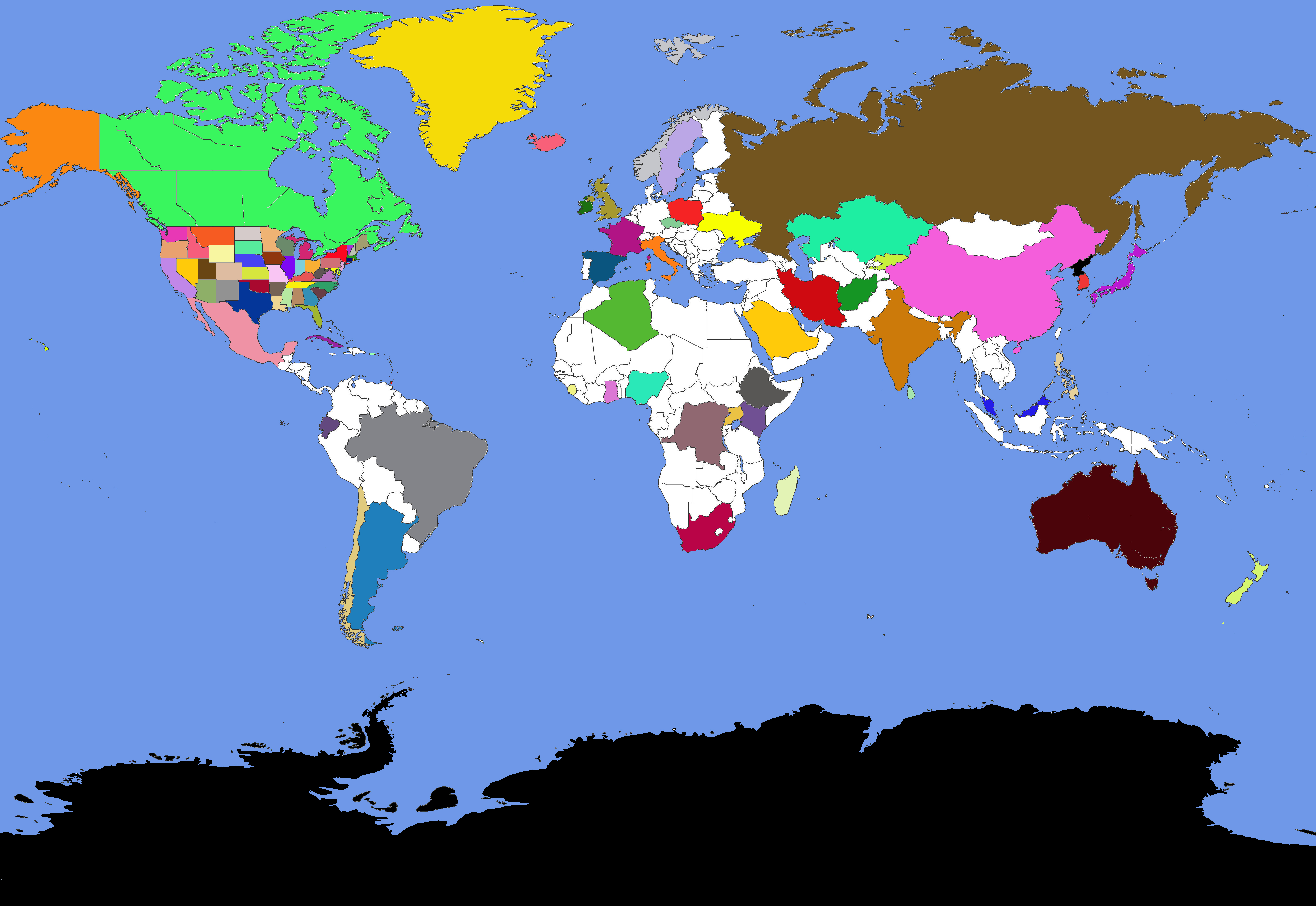
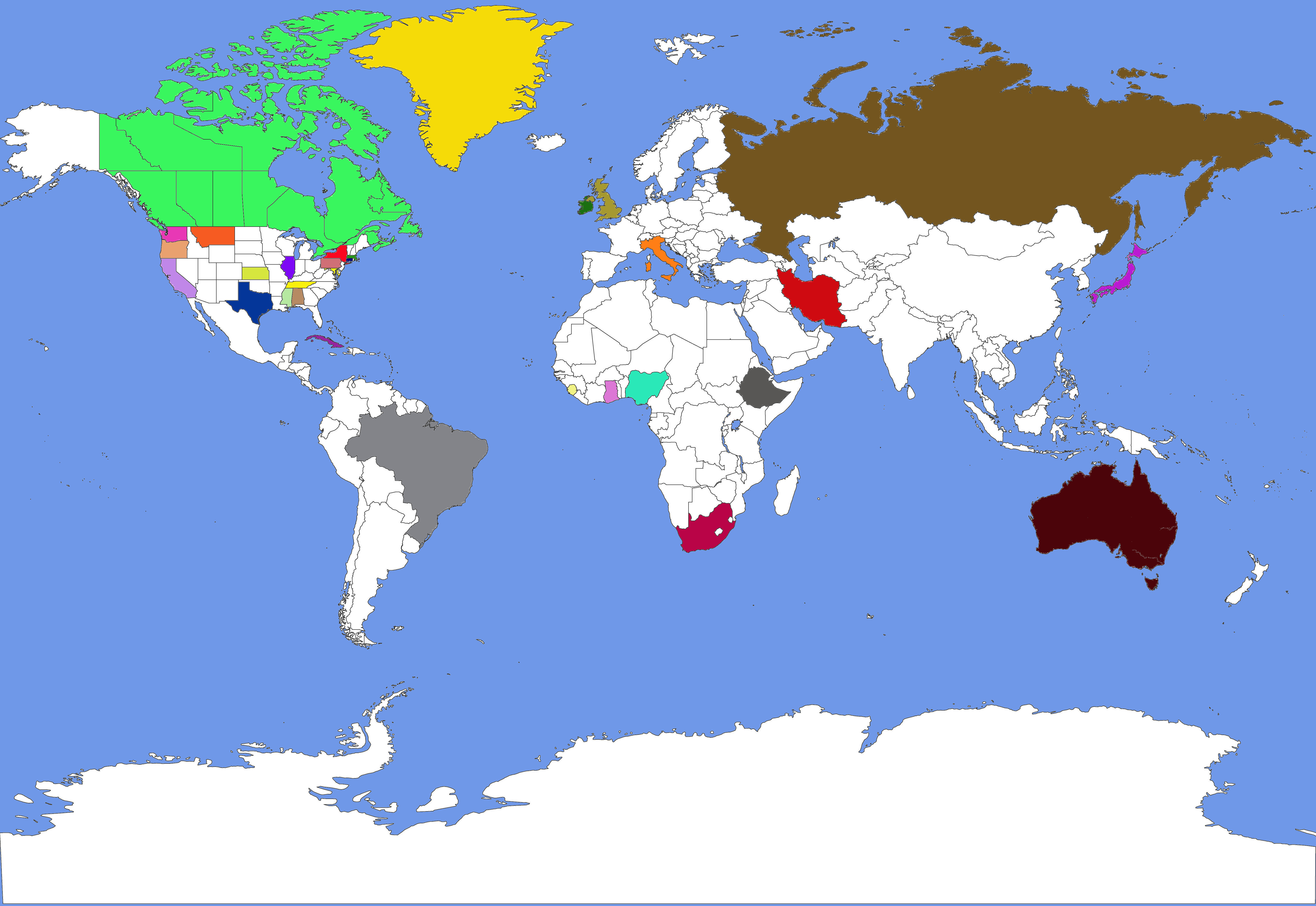
While I am going to continue adding new countries to the list for a while, at least until I feel like there’s no good way to get books from the countries that are left without rather inconveniently learning new languages, we are basically done with this for 2021, as anything else I finish reading this year isn’t going to change the tallies any. I ended up reading books this year from all 50 states, plus Washington DC and Puerto Rico, along with 48 different countries, with Antarctica counted as a country for the purposes of the list. There are a few countries represented on my TBR shelf that I haven’t gotten to yet: Zimbabwe, Turkey, Egypt and Indonesia, and I have a book from a Cambodian author that I haven’t reread in forever that I’ll read this month as well. And come to think of it I have a compendium of Iraqi science fiction that I never finished, too, that I could go back to. So that’ll be 54 countries before I buy anything new. I’ve read books from just barely under 75% of the world’s surface, which doesn’t seem too bad for a year’s work.
Other countries I definitely want to read books from but haven’t found any yet: Pakistan, Mongolia, Israel, Finland, somewhere in Central America, and I feel like I could probably hit a couple more countries in Europe without working too hard. There’s a book on my Amazon wishlist from a Yemeni author that I’ll probably grab at some point too. After that, who knows. But I won’t be feeling like I’m done with this for a little while yet.
In the meantime: Leaving aside the US, the top countries I read from this year probably won’t be too surprising: the UK (6, mostly from England), Malaysia (3,) Canada (3), Australia (2), China (2, with one more to come since I have a Ken Liu book on the shelf), and South Korea (2, but both by the same guy). States represented more than once include Texas (7), California (5), New York (5), Maryland (3), Illinois, Indiana, Massachusetts, North Carolina, Pennsylvania, Washington and Wisconsin (all 2). Texas is the highest because Rachel Caine is from there, but that’s still four different authors. The largest places I read books from are pretty obvious from the map, but the smallest is Washington DC (68 square miles), Rhode Island (1214 square miles) and Trinidad and Tobago at 1981 square miles.
All in all, I’m … mostly glad I did this? Like, filling in the map was really neat, and going looking for new books to read from a specific place was fun, but one knock-on effect that I didn’t really reckon on was that I started deliberately avoiding reading multiple books from people or places that didn’t “count” so that I could drive the numbers up. I’ll post my unread shelf like usual on the 31st, but one thing you’ll notice if you look at it and you know my tastes in reading (and if you’ve made it this far in this post, you probably do) is that I have several books from authors I really like patiently waiting for me to get to them, because I’ve been prioritizing books I could color in a spot on the map with. I only read one book in December– and only one of the last fifteen books I’ve read– that didn’t “count,” and in the meantime there’s a damn Dandelion Dynasty book on my shelf waiting for me to get to it, along with a couple of other hotly anticipated sequels and another TJ Klune book that isn’t part of a series. So I’m not doing this again once I’m done with it, and I’ll update the site one more time once I feel like I’m done, but we’re not going to be organizing our reading by geography again anytime soon.
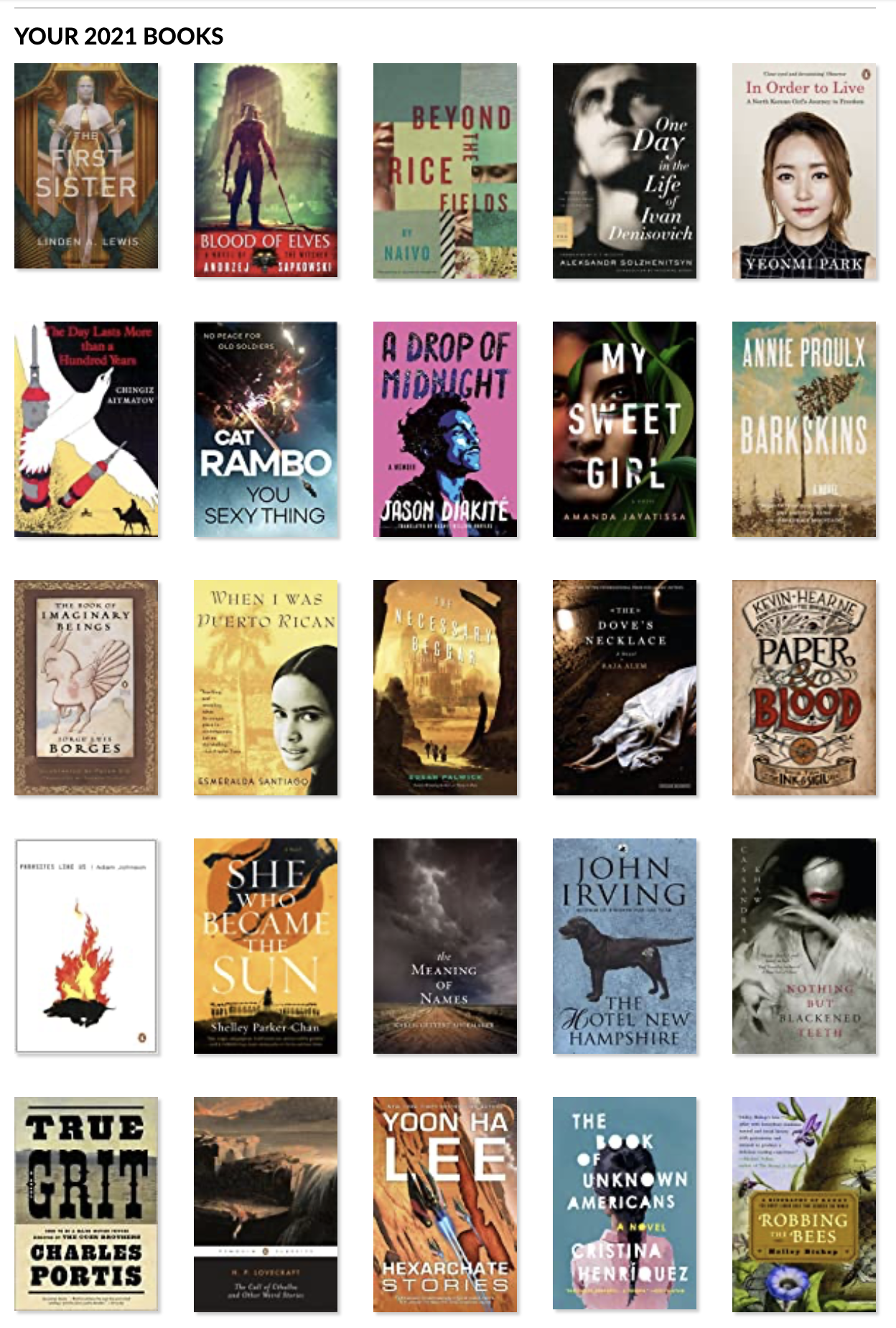
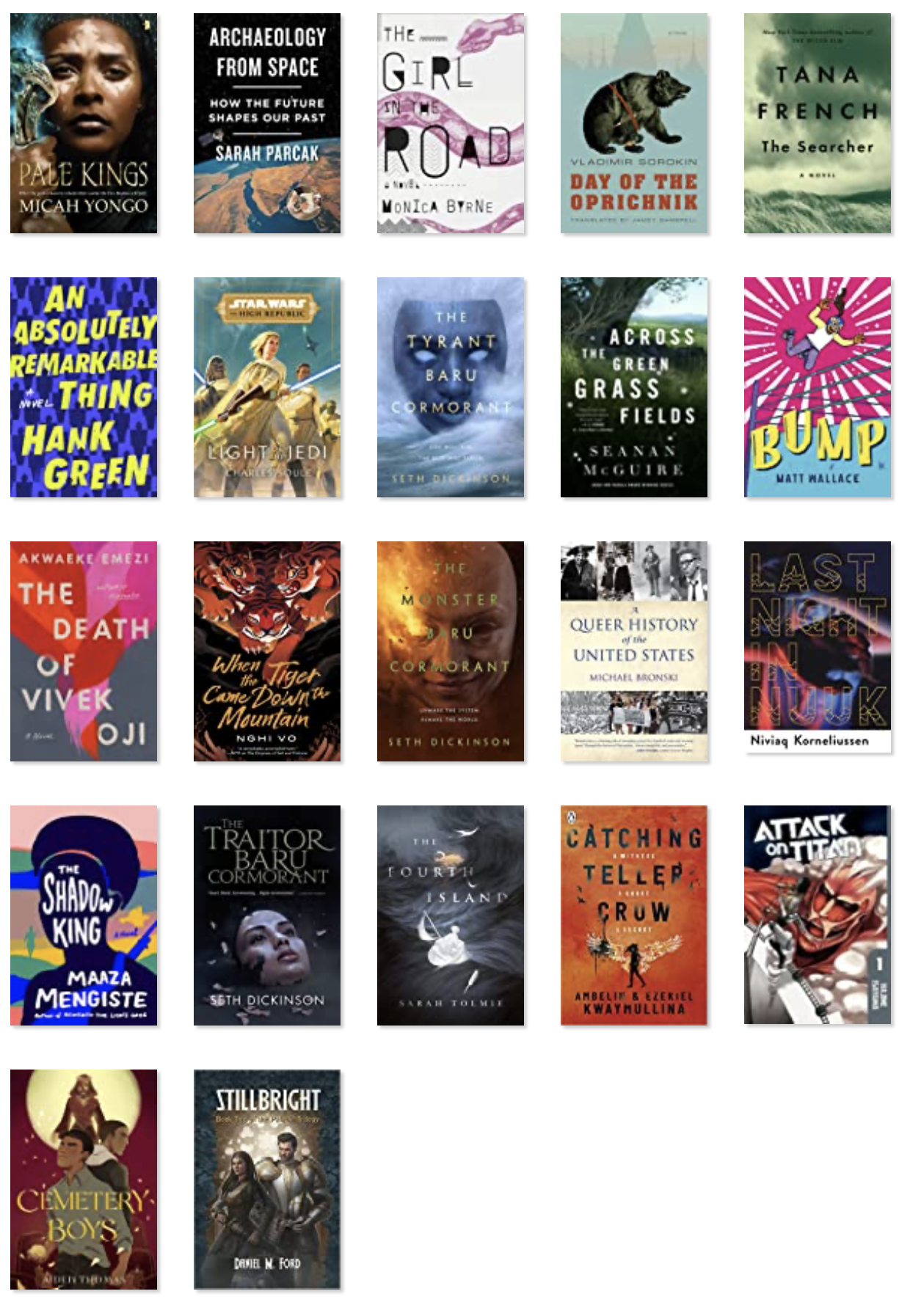
I read 132 books this year, just barely off last year’s pace, and it’s imaginable but unlikely that I’ll be at 134 by the time the calendar year technically ends, since I’m halfway through the book I’m reading right now and I think the one after that will be a novella. But this is close enough. This post really isn’t strictly necessary since you’ve had access to the #readaroundtheworld spreadsheet all year long, but what the hell: here’s everything I read this year, missing only a beta read for a book that isn’t going to be out for a while:
Of the 132 books on the list, 67 were by authors I’d not read books from in the past. This is a higher percentage than usual because of the #readaroundtheworld project, but not by as much as I’d have guessed; it’s usually in the 40% range and this year it’s just over half. There also weren’t as many authors that I read multiple books by; the big winner this year was Rachel Caine, with 4 books. Other authors I read multiple books by include Seth Dickinson (3), Cassandra Khaw (2), Seanan McGuire (2), Matt Wallace (2) and Yoon Ha Lee, also 2.
As usual, I didn’t do enough rereading this year, which is a direct result of #readaroundtheworld, and I suspect my “read whatever the hell I want” project for next year will involve more rereads– in particular, I haven’t reread the Lord of the Rings books in forever, so that’s on deck for sometime in January, and I might (I’m lying) take one final stab at Wheel of Time.
(I’m not going to do that; I will never finish those books.)
But yeah. 132 books. More to come, as I’ve still got the 10 best post (probably tomorrow) and a year-end wrap-up of #readaroundtheworld, quite possibly later today if I’m still in the mood later. What did you read this year?
I findmyself, rather uncharacteristically, not in the mood right now for my usual cavalcade of end-of-year posts. I will definitely still do the best books of the year, and I may well wake up tomorrow in a different mood, but for right now I just want to relax tonight and not think too much.
More renovation pictures tomorrow, as the painting should be done and possibly some tile laid as well.
I bought about an album a week this year, which is roughly on par with previous years, although this year my music purchases seem to have been focused on filling holes in my collection– I spent a lot of time listening to Outkast and REM and Black Crowes and Jane’s Addiction and Alice In Chains, and it turns out that I didn’t have everything they released. Prince had a new release and that got me to go back and pick up a few of his records that I didn’t have before. A lot of the new stuff (as in 2020-21 releases) was kind of experimental and a lot of it didn’t work out. But this article from Albumism, full of shiny new music mostly by artists I’ve never heard of, popped up on my radar today and that got me thinking about the new, or at least newer, music that I bought this year that made an impact, so I figured since I always write a ton of end-of-the-year pieces during the week between Christmas and New Year’s I may as well start with this. Other than one album I’m not going to be ranking anything, but here are six albums that I bought this year (mostly; we’ll get to the exception) and that I think are worth you checking out.
Mazbou Q, The Future Was. I actually encountered this guy through his TikTok feed, believe it or not, where he talks about the musical theory behind hiphop, and does so at great length and in incredible detail in a way that is incredibly interesting and illuminating, especially to someone like me who doesn’t have much technical knowledge about music and frequently struggles to talk about it in a way that is compelling. The guy’s smart as hell and his lyrics are complex and fascinating and I’m pretty sure I’m the only person I know who has heard of him, so let’s see if we can’t bring that number up a little bit.
Counting Crows, Butter Miracle Suite One. Technically an EP– this includes four new songs and four single edits of those four songs, but that didn’t stop me from keeping it on repeat for quite a while after it came on. Adam Duritz is one of my favorite singers, and while the Counting Crows aren’t nearly as big as they were in the nineties everything they release is directly up my alley.
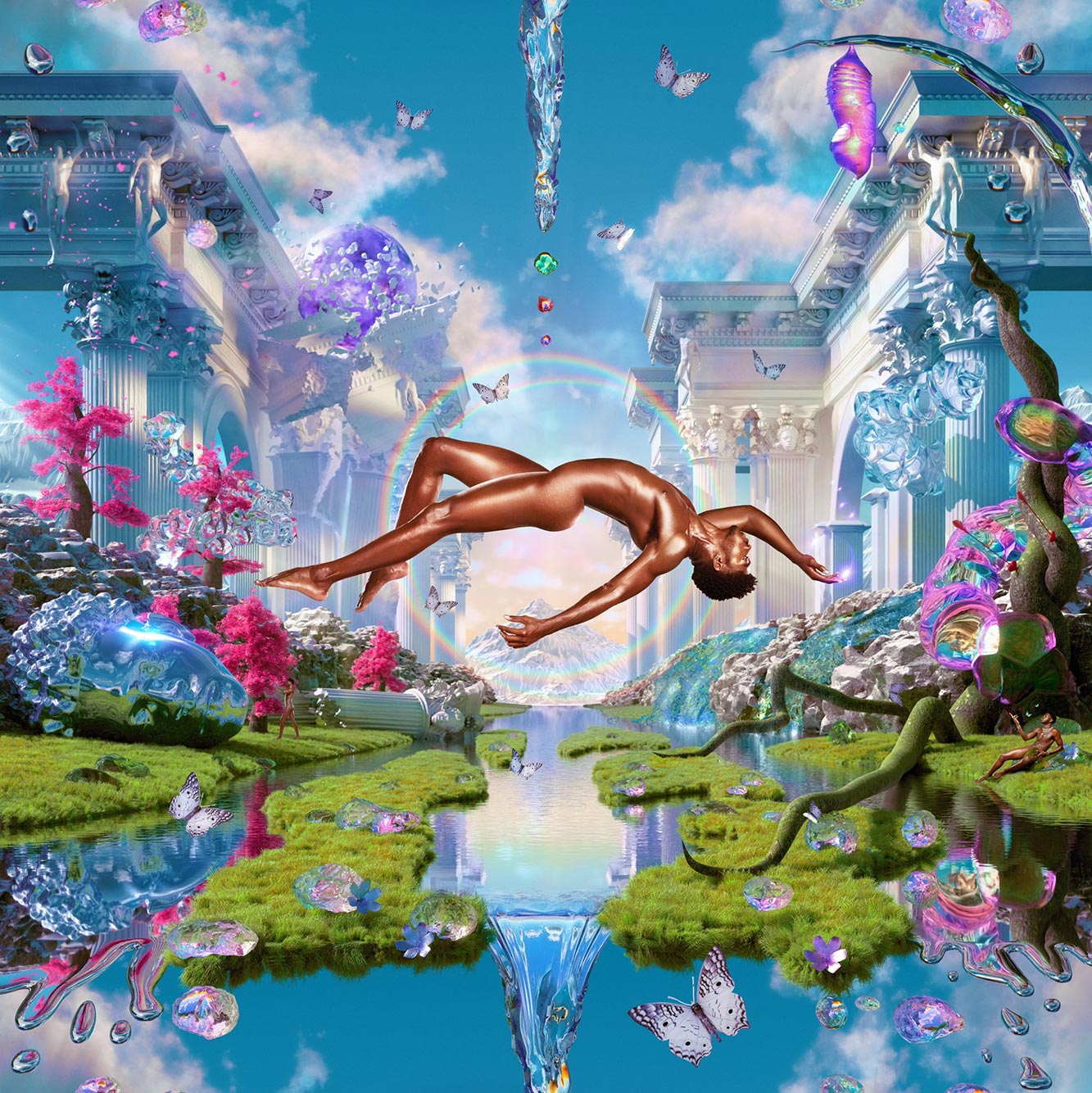
Lil Nas X, Montero. A confession! I’m not actually that big of a fan of Old Town Road, the song that made sure that everybody on the Goddamned planet knew who Lil Nas X was, mostly because we all had our own guest spots on the remixes. That said, this album is fucking brilliant, and the fact that I still think it’s brilliant despite the fact that I can’t turn on the radio without hearing three songs from it is damned impressive. The guy’s got an incredible amount of talent, both as a musician and a visual artist (my jaw was hanging open for the entirety of my first couple of viewings of the music video for Call Me By My Name) and I hope he has a really, really long and prolific career.
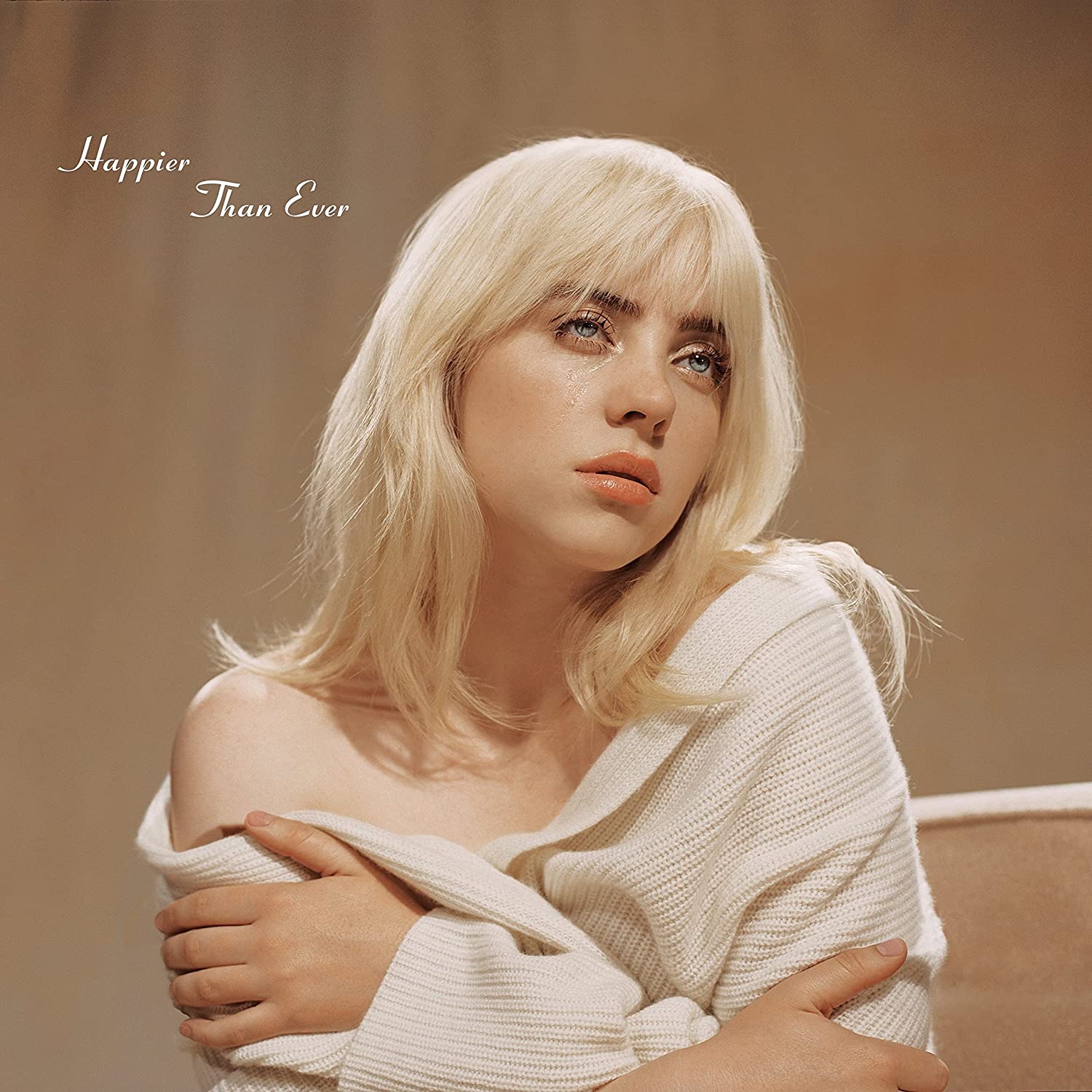
Billie Eilish, Happier than Ever. This was probably my single most eagerly anticipated album of the year, as I was looking forward to Billie Eilish’s follow-up to When We All Fall Asleep, Where Do We Go? pretty much from the moment I first listened to it. I’m not sure this is quite the triumph that Asleep was (and I have utterly no idea at all what the relative sales were like) but it’s a damned impressive record. I also bought her brother Finneas’ debut, Optimist, and while I enjoyed it I think his skills are probably more on the production end of things. That sounds like an insult. It’s not. I had this whole metaphor here about playing tennis against LeBron James but I don’t think it quite makes sense so I’m just going to assume you know what I’m talking about and move on.
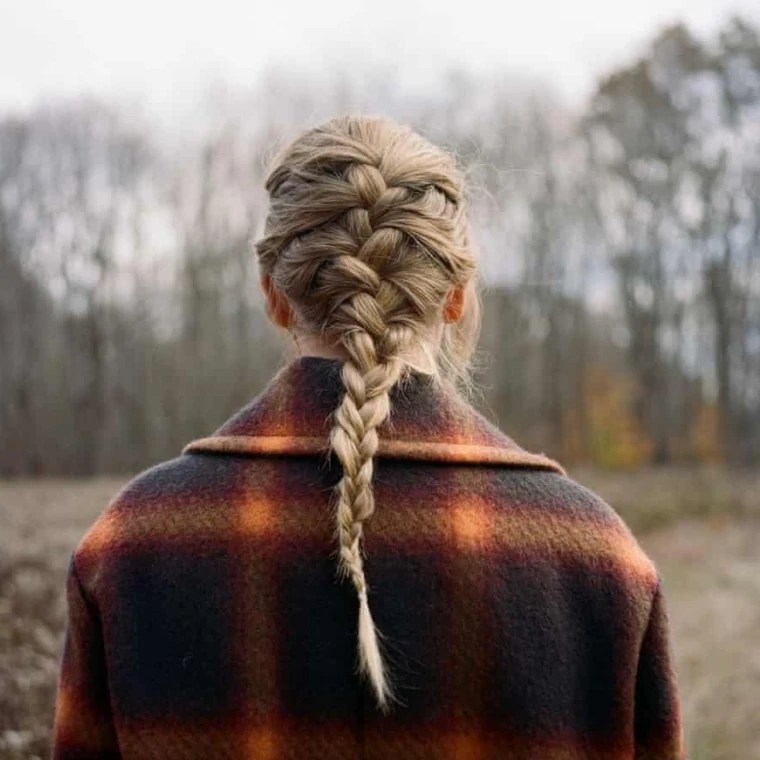
Taylor Fuckin’ Swift, Evermore. Yes okay technically this came out in December of 2020 but it’s close fucking enough, and I only bought this because I wanted to see if my enjoying Folklore was a fluke, and then I found out the reasons behind her re-releasing Fearless and Red and I ended up buying both of those on release date too, just out of, like, solidarity, and Jesus Christ have I turned into a fucking Swiftie?
Okay: Evermore and Folklore are both really good. I couldn’t tell you which one I like more because they tend to blur together in my head. And I found myself really enjoying Fearless’ re-release, but Red is kind of the perfect example of Why I’ve Never Really Liked Taylor Swift, because I wasn’t even remotely a fan of hers until this year and yet somehow I can tell you every dude she’s ever dated and that’s kinda fucked up. And I am absolutely on Team Conspiracy Theory about the ten-minute version of All Too Well, because no song written back when that was supposed to have been written would have had the words fuck the patriarchy in it. But fuck it; I’ve always been very clear that Taylor is phenomenally talented if for no other reason than that I have half of her catalog memorized without ever deliberately listening to the songs, and I like the idea that she’s re-releasing all of her old music so that she can screw over this asshole record executive dude, so I’m going to keep buying the re-releases even though I’m going to sigh a lot and roll my eyes while listening to some of the songs.
(I also, and this is related, bought Olivia Rodrigo’s debut Sour this year. I have nothing to say about it until Olivia Rodrigo is no longer a minor.)
(I have just discovered that Olivia Rodrigo is 18.)
(Someone needs to give this kid a hug and a therapist.)
Anyway.
Willow, lately I Feel EVERYTHING. I am not sure that Willow Smith really deserves to be a single-name person yet, but picking this album up was another one of those impulse, what-the-hell-it’s-$9 purchases this year, and I actually haven’t dug into her backlist but whatever the hell era of her music she’s in right now I want a lot more of it. lately I feel EVERYTHING is only 26 minutes long and all but one of the tracks don’t even make it to three minutes, which makes it even more ridiculous that I love it as much as I do. I said I wasn’t going to be doing any ranking, but this is still hands-down and far away the best new music I bought this year; the only thing close to it would have been Montero, which is also full of short-ass songs. If like me you’re an old person and you haven’t given Willow Smith a single thought since back in her Whip My Hair days, you owe it to yourself to check this out, especially if you’re an old 90s head like me. Her music weirdly blends together everything I love about rock and roll, alternative music and hiphop, and it’s just great.
I am forty pages into Annie Proulx’s Barkskins, which is the duly designated novelistic representative of the great state of Wyoming, meaning that I have completed my goal of reading one book from each of the 50 US States, with Puerto Rico and Washington D.C. thrown in for shits and giggles. I’m currently at 39 different countries, a metric I intend to continue to pay attention to for a bit, as I’m still enjoying it, but I have to admit I’m glad to have this particular reading goal in the rear-view mirror. Barkskins is a bit of a doorstopper at 700+ pages, but based on the beginning of the book I think it’ll be a pretty quick and enjoyable read for all that, and once I finish it I have a beta read that I’ve been sitting on (for much too long) for a friend and an ARC to read and review, and then I can move into 2022’s project, which is to read whatever the fuck I want for a year and not worry about the details at all. I’ve had fun with my reading projects for the last several years and I’m sure I’ll revisit the idea again in the future but I want this year to be less about hitting a metric of some sort.
If you’re curious, here’s the list. Hopefully it doesn’t look too heinous outside the editor:
Archaeology from Space
Parcak, Sarah
2/13/21
2/14/21
US/Alabama
The Raven’s Gift
Rearden, Don
5/13/21
5/15/21
US/Alaska
Son of the Storm
Okungbowa, Suyi Davies
6/26/21
7/2/21
US/Arizona
True Grit
Portis, Charles
11/7/21
11/7/21
US/Arkansas
Bump
Wallace, Matt
1/29/21
1/29/21
US/California
The Future of Another TImeline
Newitz, Annalee
5/9/21
5/13/21
US/California
The Hill We Climb
Gorman, Amanda
5/30/21
5/30/21
US/California
The Hidden Palace
Wecker, Helene
7/12/21
7/18/21
US/California
Savage Bounty
Wallace, Matt
7/20/21
7/24/21
US/California
Fear and Loathing in Las Vegas
Thompson, Hunter
6/10/21
6/10/21
US/Colorado
Rebel Sisters
Onyebuchi, Tochi
2/20/21
2/23/21
US/Connecticut
The Book of Unknown Americans
Henriquez, Cristina
10/24/21
10/26/21
US/Delaware
Robbing the Bees
Bishop, Holley
10/22/21
10/24/21
US/Florida
Treason of Hawks
Bowen, Lila
9/4/21
9/6/21
US/Georgia
Sharks in a Time of Saviors
Washburn, Kawai Strong
6/24/21
6/26/21
US/Hawai’i
Idaho
Ruskovich, Emily
10/1/21
10/2/21
US/Idaho
The Queen of Gilded Horns
Joy, Amanda
4/19/21
4/23/21
US/Illinois
Hood Feminism
Kendall, Mikki
5/23/21
5/26/21
US/Illinois
Rise to the Sun
Johnson, Leah
7/24/21
7/25/21
US/Indiana
Nightbitch
Yoder, Rachel
9/6/21
9/8/21
US/Iowa
Nubia: Real One
McKinney, L.L.
2/26/2021
2/21/21
US/Kansas
Narrative of the Life of Henry Bibb, an American Slave, Written by Himself
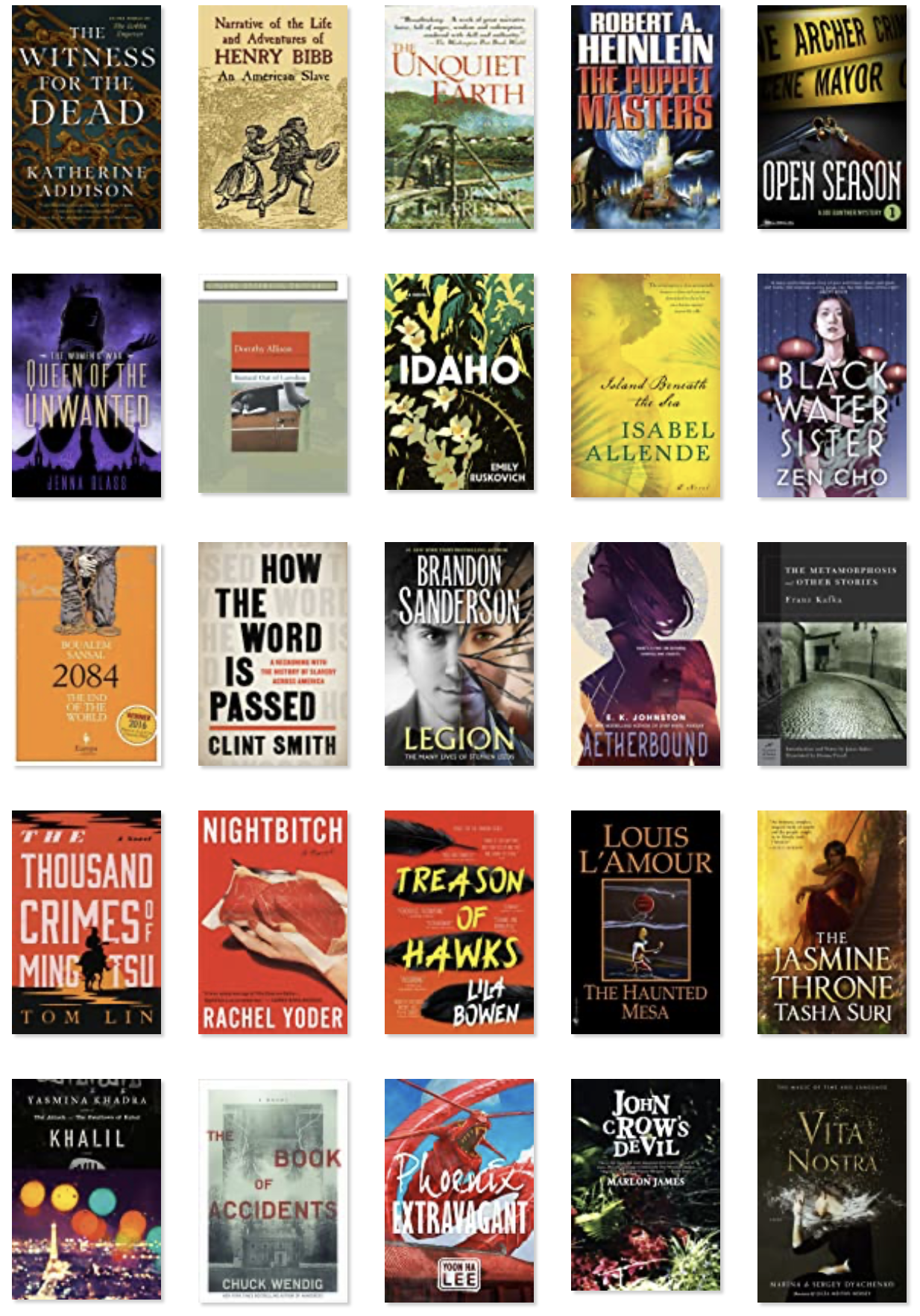
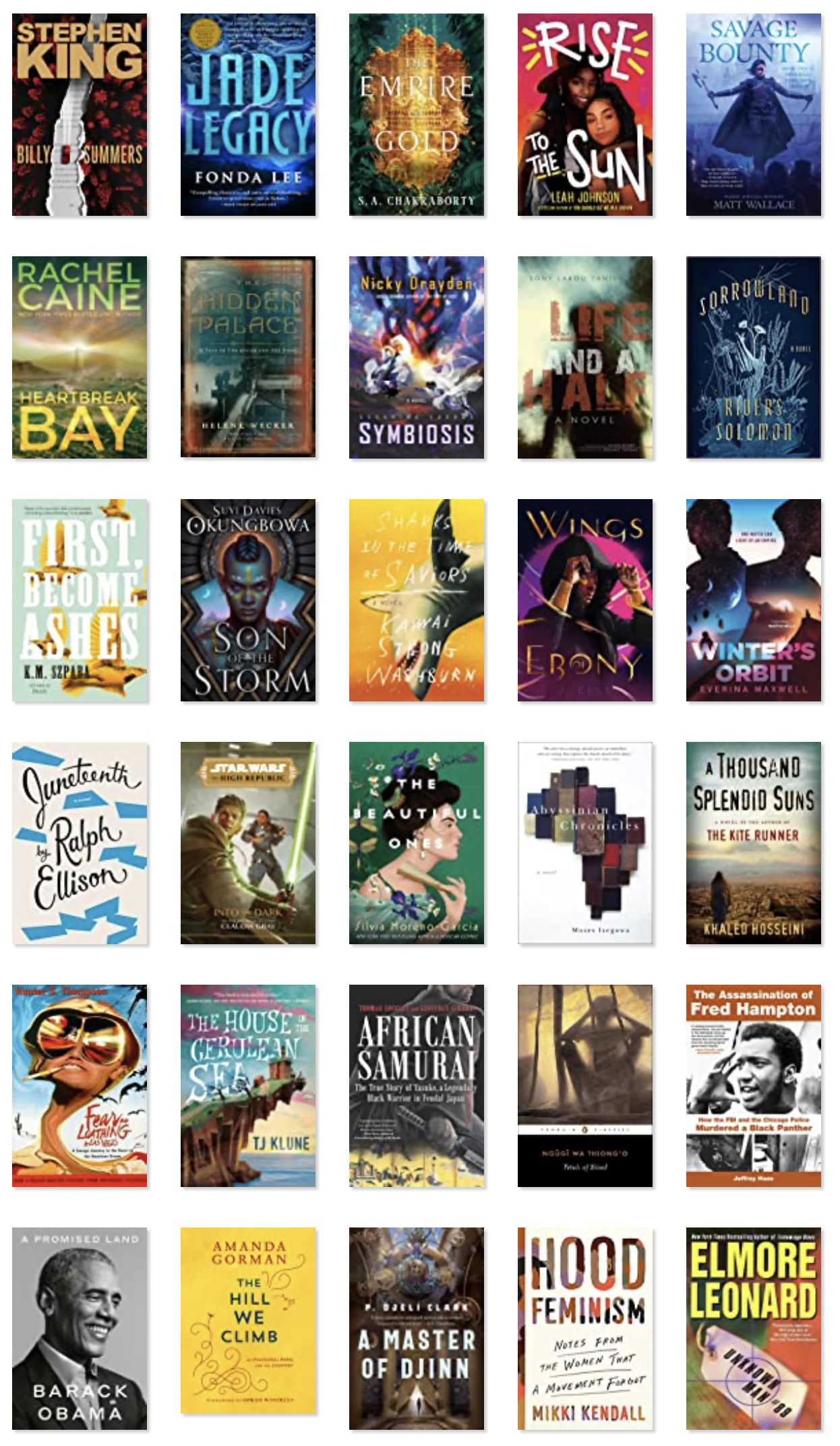
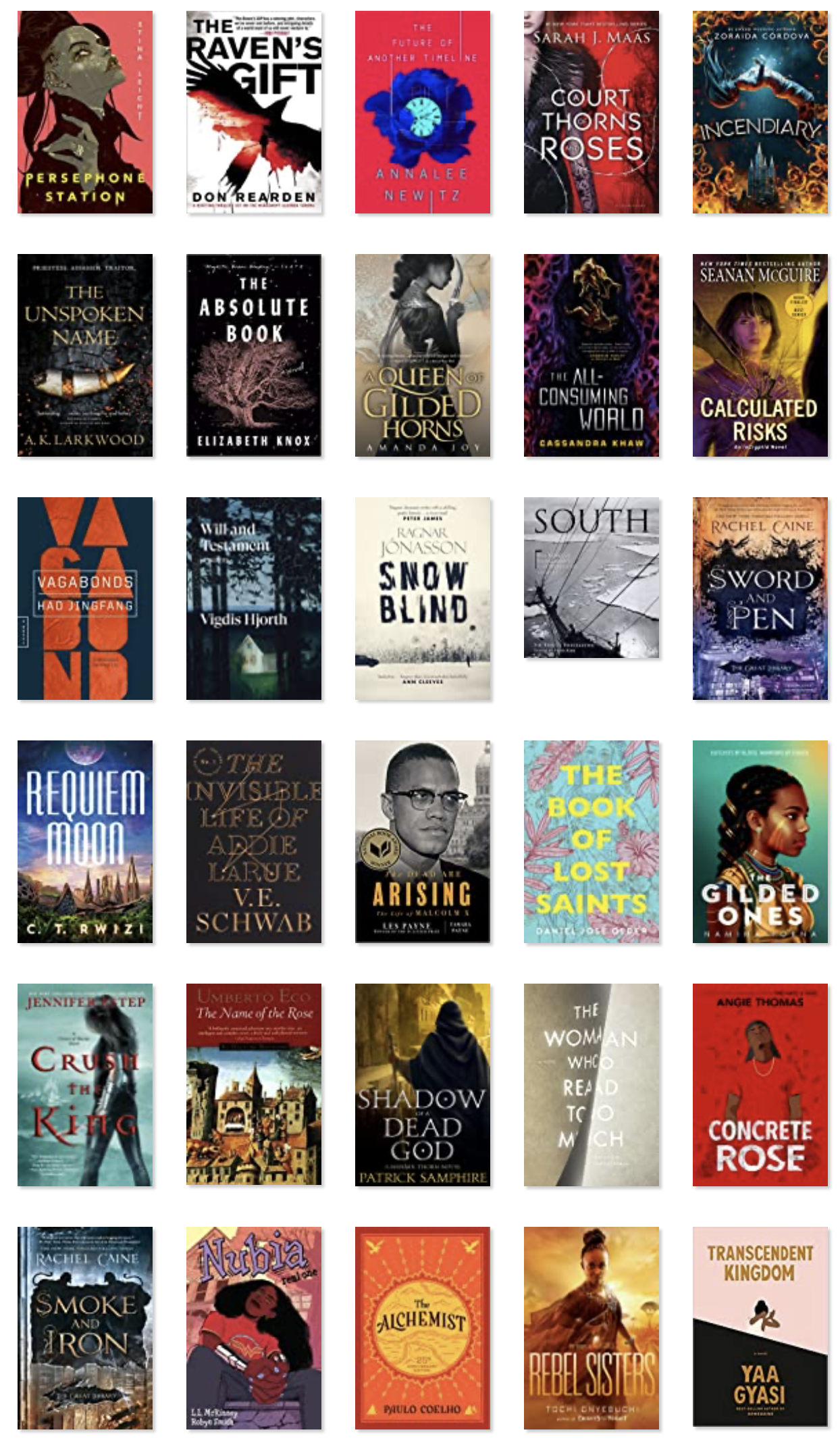
You want me to nerd out about my little reading project, right? Sure you do. We’re roughly 1/4 of the way through 2021 already somehow, and I’ve read books from 15 US states and 17 countries so far, putting me on track to successfully read books from all 50 states and 68 different countries over the course of the year. Now, realistically, this first three months has been pursuing low-hanging fruit, and I’ve already read multiple books from several different states as well as the UK, and I have at least one other book by a Nigerian on my shelf waiting for me, so as the year goes on it’s going to get more and more difficult to find books that “count” for the series. I’m sure I’ll be able to get the US done one way or another, but the fact is books from Canada and Russia and Australia and the UK weren’t exactly hard to find, and I’m at the point already where I’m picking a country and Googling “Authors from XXX” to find books. There’s several easy ones left (and I have several books on my unread shelf that will fill in some spaces) but these first few months were definitely going to be the fastest ones.
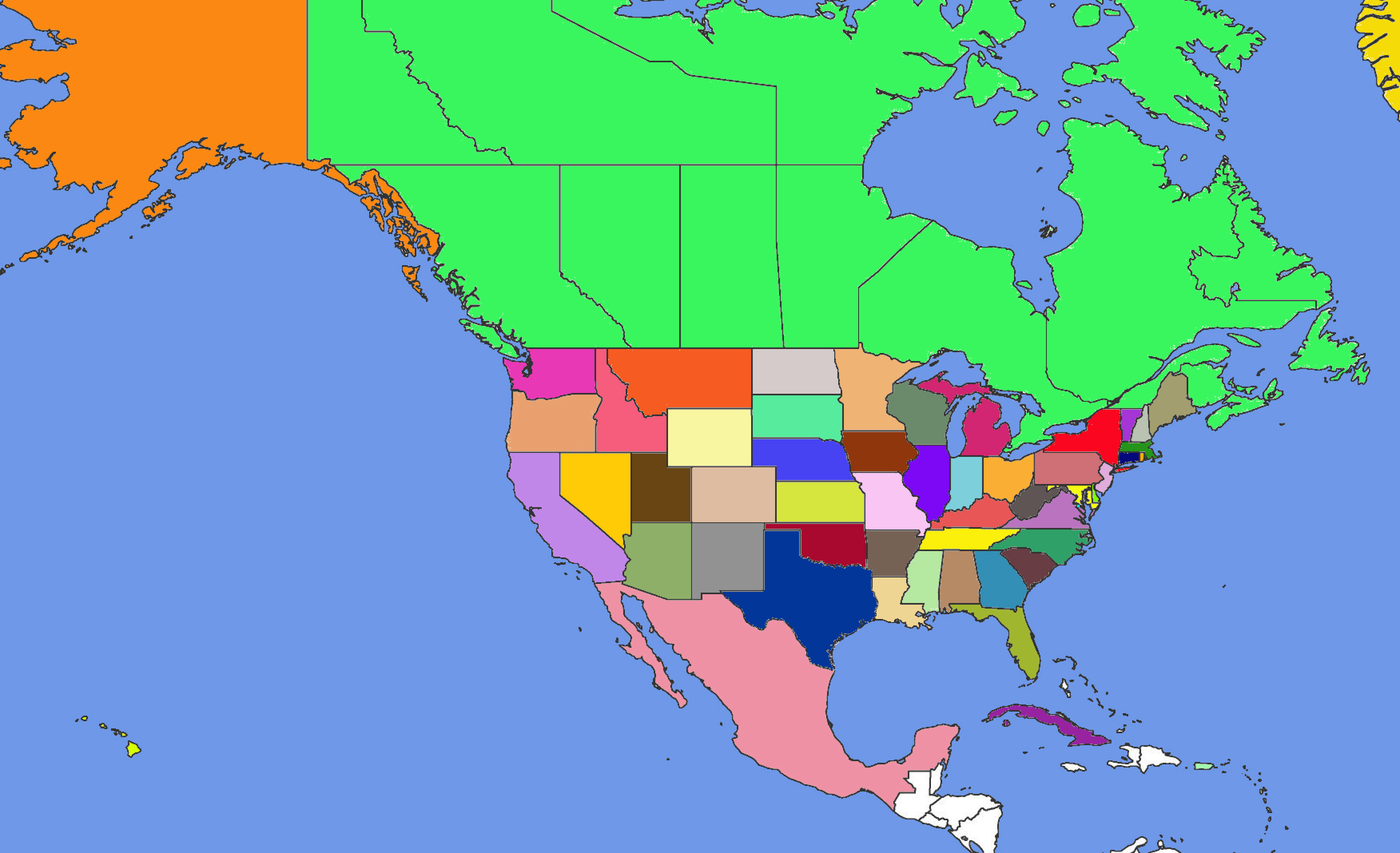
I have been keeping track of the square mileage this has covered, because of course I am, and thus far, excluding the water, 21,418,356 square miles are filled in, which is 37.24% of the world’s surface. This will also be increasing much more slowly, as I’ve got Australia, Canada, Brazil and Russia done already. I’ll be filling in Antarctica and China next month, which are the biggest two chunks left, and after that it’s all smaller countries. Russia was 11.5% of the world’s surface all by itself, so I’m not going to be getting any more big jumps like that.
(How do I plan to fill in Antarctica’s 5.483 million square miles when no one lives there? I’ve decided Ernest Shackleton counts. My game, my rules.)
This has been a fun project so far, although for the most part my international “discovery” authors haven’t really set my world on fire yet, and a lot of the books I’ve really enjoyed this year from authors outside the US have been people I’m already familiar with. There’s also been a touch of strategic rereading going on; I filled in Italy by picking up The Name of the Rose for the first time in forever, and I’ll probably reread A Confederacy of Dunces at some point this year to take care of Louisiana. I might go back to Dumas to get France filled in. But for the most part it’s going to be authors I’m not familiar with, since that’s sort of the point of the entire exercise.
Remember, if you look at the top of the sidebar on the right there, you can follow along with me as I’m doing this if you’re so inclined. I should be done with Requiem Moon in a couple of days, and my next book after that will be another Rachel Caine, so I figured this was a good time to do an update.



 Welcome to infinitefreetime dot com