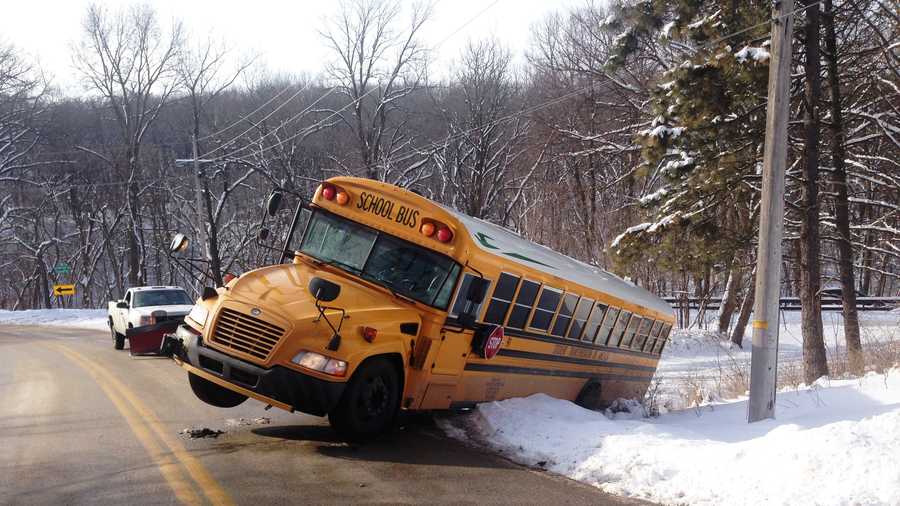
To be clear, that’s not one of our buses, although we did have a day earlier this week where every single bus was at least ten minutes late to school. It’s gross outside right now– I had to make a quick run to Target that couldn’t be put off until tomorrow, and while the roads weren’t bad, the parking lot was a bloody nightmare and I’m moderately surprised I’m still alive.
I told a class earlier this week that we should have a regular week of school because I wasn’t aware of any bad weather in the near future, so naturally we got a “We are carefully monitoring the weather and will make an announcement about a delay or cancellation as soon as feasible” email tonight. I explicitly do not want a delay or a cancellation between now and next Wednesday; we have shit to do. Which probably makes a delay tomorrow inevitable, unfortunately.
Anyway, how is it possible that after 20-some-odd years as a teacher and a few longer than that “in education” I still don’t really have any idea how school districts decide whether or not to cancel or delay school? The message I got mentions “closely monitoring the weather, along with sidewalk conditions, side streets, and bus stop access,” which … okay, that makes sense, but how? By who? That decision’s gonna be made at 5:00 in the morning. What network is the superintendent (I assume? Transportation’s surely involved, but that’s not something that’s going to be delegated, is it?) tapping into at 4:30 AM to figure out if school needs to be delayed in time for people to actually have time to react to the decision?
I would be completely unsurprised to discover that the decision was just based on vibes, on some sleepy-ass Lord High Muckety-Muck waking up and padding out to his driveway and making a call based on that, and there’s also definitely some domino theory going on, at least around here– if more than two of the three or four biggest districts close, everybody’s going down in rapid succession.
I think I’ll ask my boss tomorrow for some more details. They sure as hell aren’t asking the teachers.
(Also, I’d like for districts to implement a formal policy on days like this, that if we get an email at 7:30 the night before that we’ll have a decision “as soon as possible,” that we are also officially notified by the crack of dawn if we are not changing the schedule. It keeps me from checking my phone eighteen thousand times in the morning as I’m deciding whether I should get dressed for work. If you know we aren’t cancelling, say that.)
My son has been patiently working away at the Path of Pain since I got home from work, four hours ago. The person who put the video above together is some sort of divine creature; I never even attempted this feat when I was playing Hollow Knight, and if I had I would have invented twelve new swear words and killed one of the cats by about the halfway mark.
This kid hasn’t let a single swear word or even really a single sound of frustration pass his lips the whole time. No controller tossing. No muttering under his breath. Just persistence and patience.
I don’t know where the hell he got it from. Sure as hell not me.
Remember how, when we were kids, getting sent to bed early was a punishment? And now going to bed an hour earlier than normal is absolutely the greatest thing that could happen?
Not that my immediate family is that large, but I’m done with all Christmas shopping for my immediate family, and everyone else is pretty much gift card people. My brother will send me a list for my niece and nephew, who are too young to get mad at me for buying the wrong thing anyway, and the basement goblin will likely get cash. The tree went up after Thanksgiving and I’ve been changing the lights every time I walk into the living room just because I can.
(Seriously, Govee lights are amazing. Ignore the price; order these. They’re absolutely worth every dime.)
Anyway, what this means is that everything’s going to show up broken, or not show up at all, or I’m suddenly going to realize four days before Christmas that my wife and son don’t actually like any of the things I got them for Christmas and I’ve somehow accidentally ordered a ton of stuff for me instead. This is actually a bit of a risk with the boy; he and I have enough tastes in common that I actually rejected a gift I was thinking about for him this year because I decided I wanted it and not him. He’d have liked it, I think, but it was a little too expensive for “he’d have liked it, I think.”
I have one thing left to do for my wife, which is going to involve Doing Art, and which will be a funny joke even if I completely fuck up Doing the Art. She looks at the blog kind of irregularly, so I could probably get away with telling y’all the plan, but … nah.
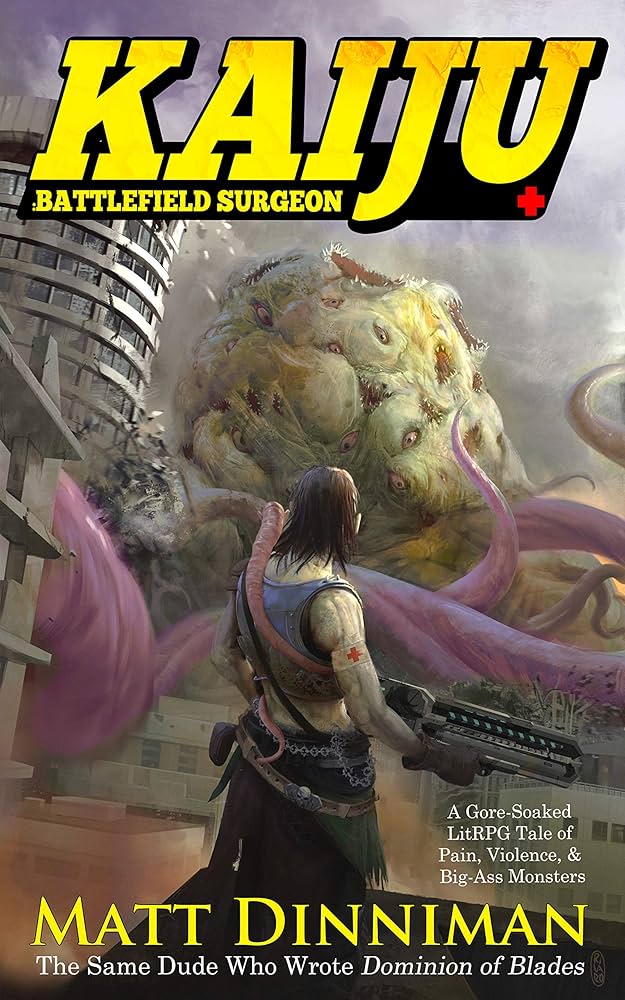
First, that my suspicion appears to have been correct: I think I’m probably good with reading the rest of the Dungeon Crawler Carl books and then never touching anything that calls itself “LitRPG” ever again. The best thing about Kaiju Battlefield Surgeon is the title, which suggests that the book is going to be delightful. It’s not bad, but it’s not something that, at about the 2/3 mark, is leading me to believe that I’m going to be spending a lot of time with any examples of this genre not written by Matt Dinniman.
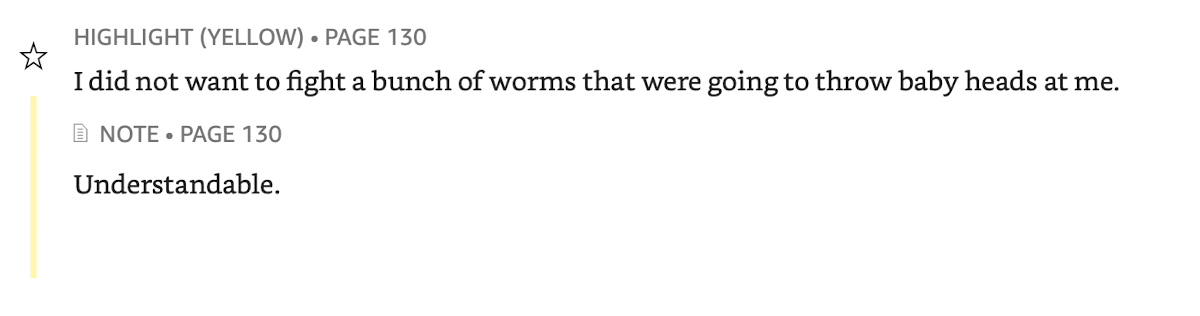
The second thing is that, yes, my Kindle is genuinely saving me money, as I’m reading this book for free through Kindle Unlimited and, believe it or not, I don’t think I feel the need to own it. Also, I got to annotate this sentence:
I haven’t used the annotate feature very much, but it might come in pretty handy when I want to be able to find bits of a book to talk about during reviews. Or, y’know, talk about the part in the book where there are worms throwing baby heads at the protagonist. Dungeon Crawler Carl definitely can trend toward raunchy and gross humor– a talking sex doll head is a major secondary character, for crying out loud– but Kaiju is a level beyond.
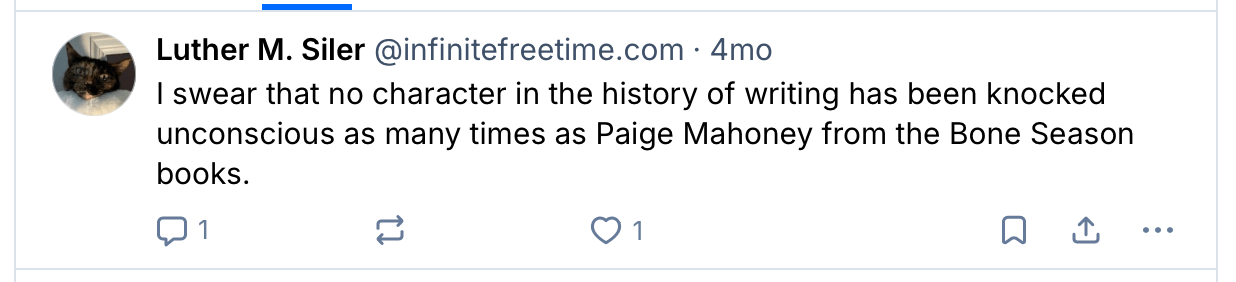
Please, for your interest and edification, note this Bluesky “skeet” from me, written roughly four months ago:
At the time I wrote that, I believed it to be true. And it is possible that it’s still correct; after all, Paige Mahoney has been getting knocked out for five books now, and Vis from Hierarchy has only had two. But it has got to be true that Domitor Vis Telimus Catenicus Leathfhear Diago Carnifex Deaglán Silverhand Siamun has been grievously injured more than any other character in the history of the written word. And it gets so much worse when he gets split into three, because then they can just totally throw logic to the wind and hurt the hell out of him in every chapter, because you’re not going to remember that spear wound in his thigh in six chapters when you come back to him, and the other two versions of him don’t have the spear wound. It’s absolutely nuts, and it’s one of those things that can’t be unnoticed once you notice it. This man has had at least seventy concussions. You’re ideally not supposed to be knocked out so hard you don’t wake up for a week even once in your life, and Vis has it happen multiple times over the course of the maybe a handful of years that both books take place over.
The second special bonus gripe is connected to Islington’s world-building, although this is not at all something that is unique to him, and in fact I’ve been seeing it a lot lately across multiple authors. Y’all, if you’re going to make “Gods!” or “Hells!” a swear word in your fantasy series, the gods or the hells need to have some presence in your book other than the swearing. Maybe this is another example of me being a sloppy reader, but there are a handful of gods named in a glossary at the end of the book, and there’s whatever the hell Religion is (I don’t know! There’s literally just a thing that the graduates can join called Religion! I don’t know what it is or what they do.) but worship and/or fear of and/or basic acknowledgment of divinity is damn near entirely absent from the book. Vis certainly doesn’t worship anything. And I’m sorry, but if any form of the concept of Hell made it onto the page at all beyond “Hells” being a swear word, I missed it. It’s lazy, especially in a world where they already both use standard English profanity and a made-up word, “vek,” that is a pure expletive in the way you might yell “Shit!” or “Fuck!” if something bad or startling happened. There’s no verb form. No one veks, and nothing is ever described as veking (vekking?) anything. But we don’t need “gods” or “hells” or “gods-damned,” which is somehow worse, and it’s one more annoying detail in a book full of them.
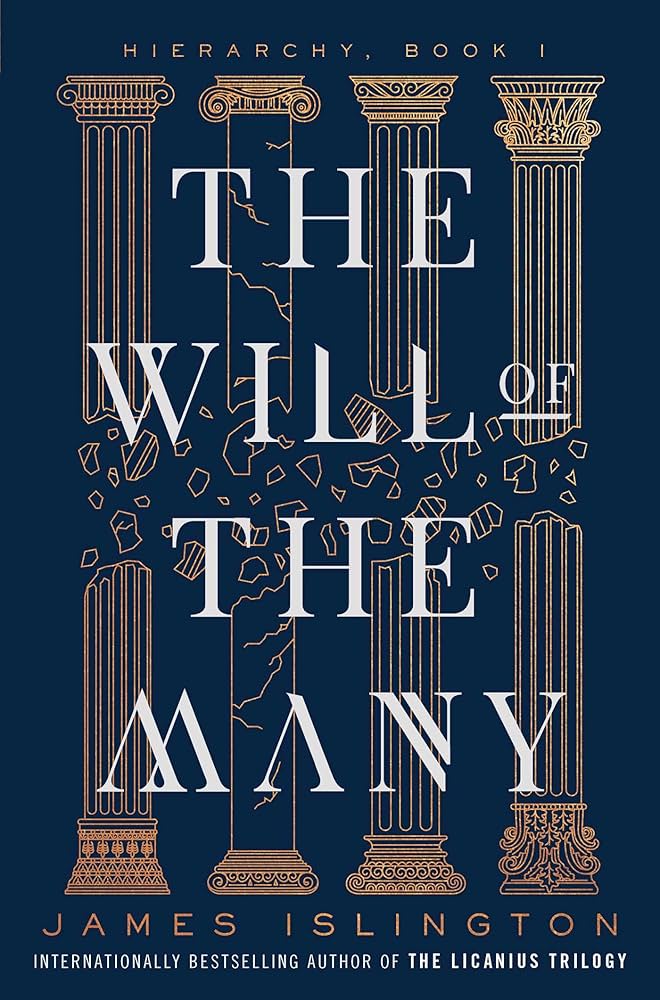
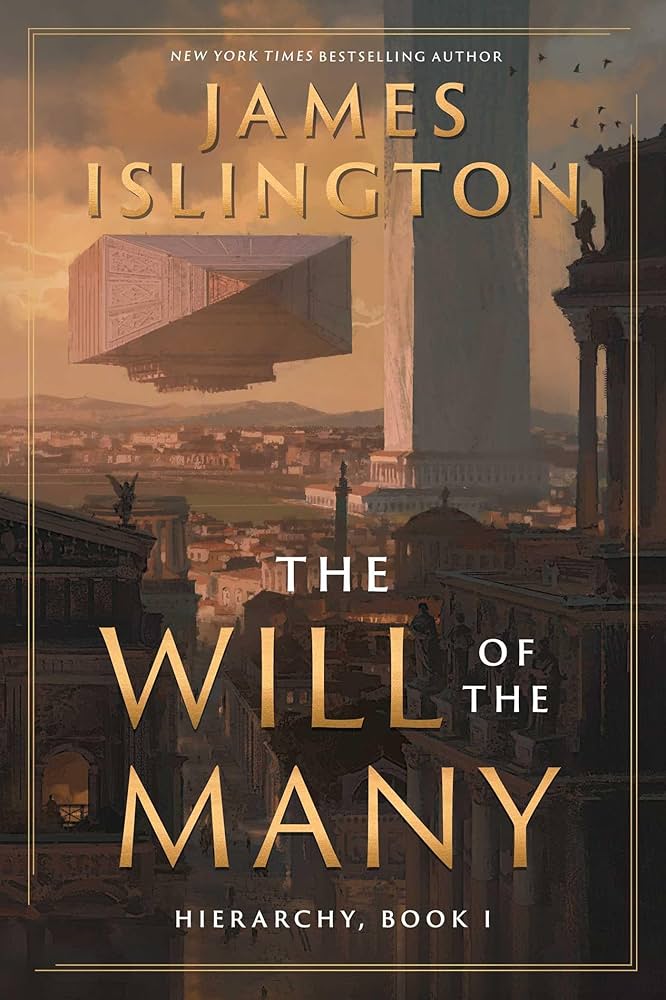
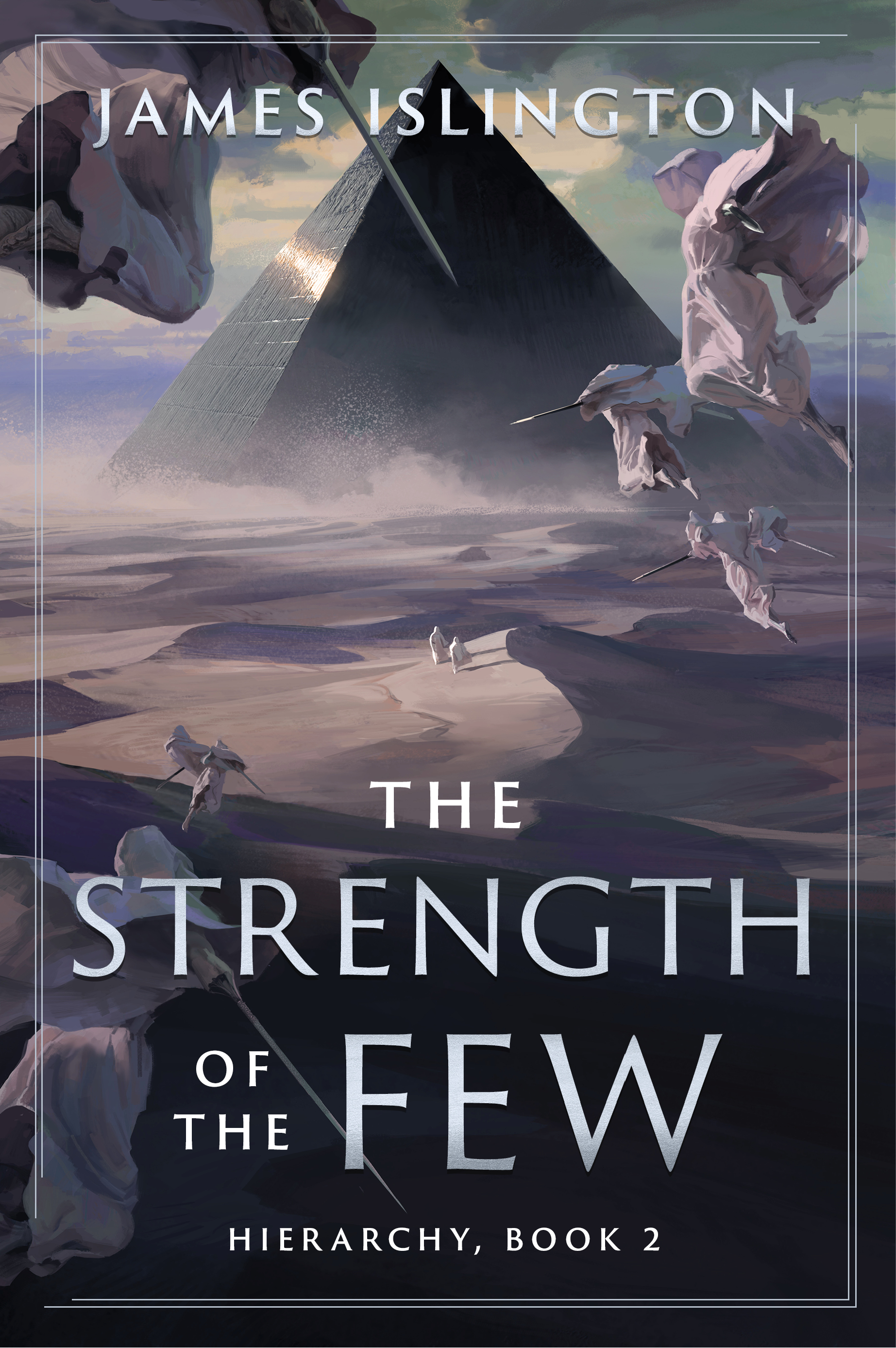
The original coverThe new coverThe “are you fucking kidding me” cover of the sequelThe main cover of the sequel
I make bad decisions, guys, and it seems like James Islington’s books are just absolutely committed to proving that at their every opportunity.
Islington has written, to my knowledge, five books. I own six of his books. I have read three and a quarter of them. I have liked one of them. I bought and read The Shadow of What Was Lost, the first book of his Licanius trilogy, three years ago. I did not like it very much, but the book as a physical object was remarkable, and I bought the entire trilogy before finishing the first book. I made it, if I remember correctly, less than 25% of the way through the second book before deciding I was done and putting it away. Other than placing it on the shelf and perhaps moving it to a different shelf once or twice, I have barely touched the third book and have never opened it.
Somehow, this did not prevent me from buying The Will of the Many when it came out– and I bought the original cover, the one with the columns up there. I read it and quite liked it– the world building was a little shallow, and the plot not especially unique; every “brilliant young person goes to a Special School” book is gonna have some major similarities, but the Rome-inflected world was at least interesting if, again, not very deeply thought-out, but whatever.
Then I started seeing the book on shelves with a whole new cover. You know this about me; I like my shit to look nice and clean, and midseries changes to covers annoy me tremendously, and I didn’t want to buy a second copy of the first book just to match the second on the shelf.
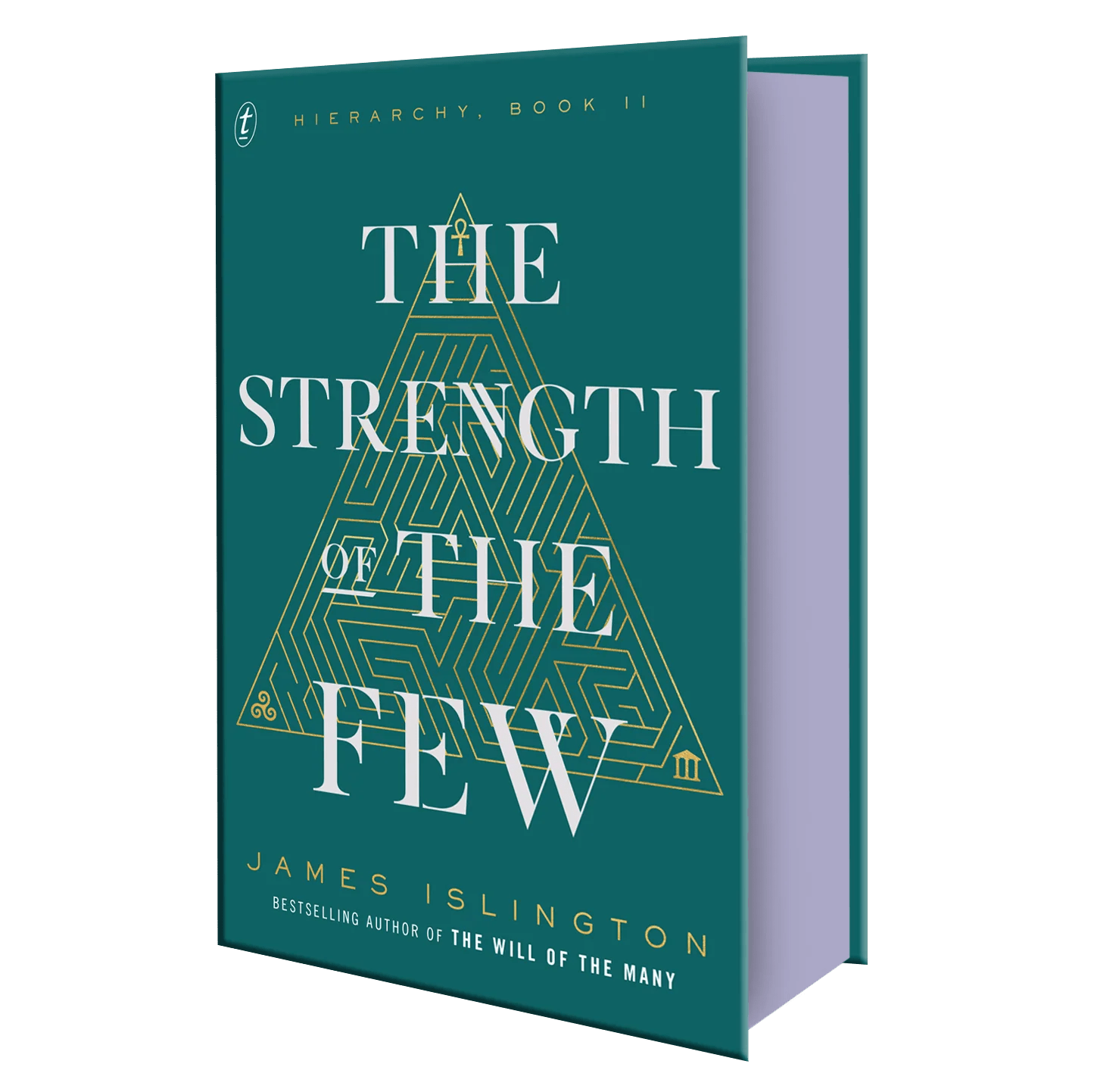
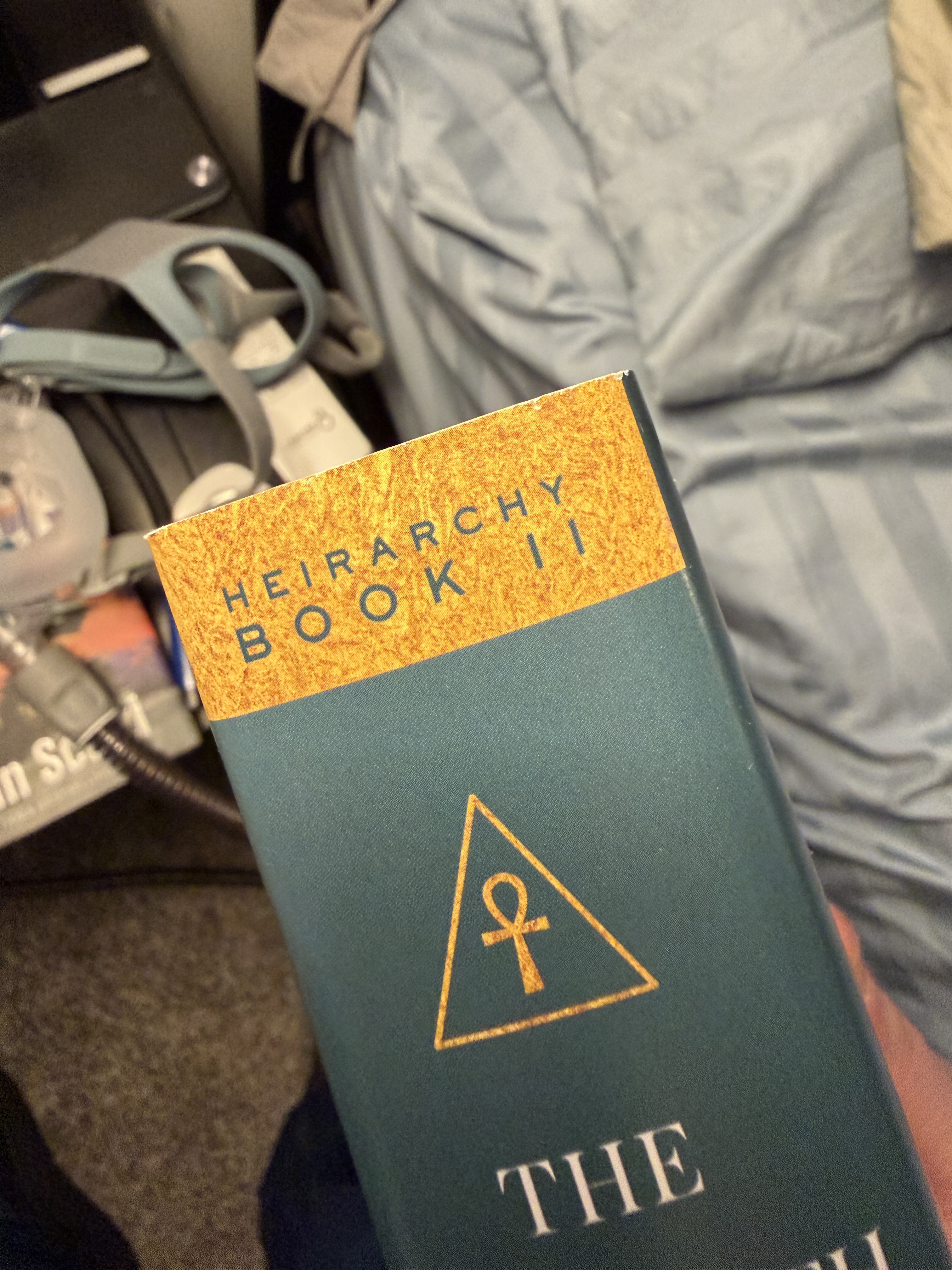
And then they made an announcement that all copies of The Strength of the Few would have reversible covers, one to match each version of the original cover! My understanding is that Islington himself was behind that decision, which I both support and tremendously appreciate. My man knows his audience! Good on you.
The fucking word “Hierarchy,” the title of the series, was spelled wrong on the spine.
I swore– a lot– and then said “Fuck it, this is why I have a job” and bought a new copy of the first book so that it would match. I cannot display a fucking spelling error on my bookshelves. Unimaginable.
(Right about here is where I’m going to stop reviewing myself and start reviewing the books, btdubs.)
I decided that since I was getting a new copy of the book anyway, I’d reread Will before diving into Strength. This, I feel, was the right move. I read so much that most of the time I have read literally hundreds of books in between any given book and its sequel, which means that I frequently don’t enjoy sequels as much as I should because I simply don’t recall the first book as well as I should. And I’d already had one Islington series go sour on me, and I didn’t want it to happen again.
The Will of the Many was an excellent read the second time through as well. It’s a genuinely good book. I stand behind it.
The Strength of the Few … was not. I’ve got it three-starred on the various book services right now and I genuinely might move it down to two. And the most frustrating thing is that a lot of the problems with Licanius are showing themselves again in Hierarchy. It was okay that there wasn’t a whole lot of clarity about how the wider world worked in Will, because the main character was confined to this little school on a tiny island and wasn’t really interacting with the wider world, so when you’ve split the … government? into Religion, Governance and Military and not really defined what it means to be “in Religion”, or when you have a couple of characters who are in the Senate, because this world is based on Rome somehow so there has to be one of those, but haven’t actually really said what the Senate is for, you can get away with it. But you’ve got to broaden that scope out in any sequel, especially when you end Book One, which was mostly a hunt for What Really Happened to the MC’s adoptive father’s brother, by splitting the entire universe into three parallel planes. At that point, I would like to understand how all this works. The main character exists in all three worlds in book two, only at least two of the three versions of him don’t know that he’s in all three worlds, and one of them is Egypt-except-not, and one of them is, bewilderingly, Wales-except-not.(*)
It means that the world you’ve learned about in the first book is only a third of the second book, and the other two worlds genuinely aren’t very interesting (not-Egypt is better than not-Wales, but not by much) and that’s before he starts sidelining and/or killing every interesting female character in the first book, and it’s also before you hit the No One You Thought Was Dead Is Still Dead part of the book, which is just fucking annoying.
There’s also a form of magic called Will, and an interesting setup in not-Rome where society has organized itself into pyramids where everyone pledges part of their Will to the people above them, and Will does stuff but it’s not entirely clear that Islington has figured out the parameters of what it can do, nor is it clear to me why holding someone’s hand and saying “I cede you my Will,” or whatever the code phrase is, lets them take part of your life essence away from you. It’s rigorously codified without actually making a whole lot of sense, which is not a great combination. I feel like if you poked the whole system too hard it would collapse.
(Even the school the MC attends in the first book was … kinda sketchy, as far as the worldbuilding goes. It’s also organized into tiers, and the MC moves from seventh tier to third over the course of a single semester, but everybody seems to be the same age and it’s not at all clear how often or even whether anyone graduates, or how long they’re supposed to be there, or really even what they’re studying; dude mentions that his classes are getting harder a few times but never really says why, and nothing is ever difficult for him, really.)
I damn near DNFed the second James Islington Series Volume II in a row, is what I’m saying here. It’s just not nearly as good as the first book, and again, much like the first series, I feel like the central conflict is not well defined here. The first book was a pretty straightforward “find out what happened to this guy” thing, and it got more complicated than that but that was basically what was going on. Now there’s a Cataclysm every three hundred years (what happens during a Cataclysm? Bad stuff, but … don’t ask what kind! People die, alright?(**) It’s bad!) and apparently we’re going to stop it somehow, I guess, and something something worlds got split up, and …
<spits>
Blech.
Again, I’m an idiot, so I’ll probably pick up the third volume when it comes out (I hope there are only planned to be three, but who knows) just for completeness’ sake, because it would really piss me off to have two copies of the first book, one of the second, and not have the third) but I think I probably have to be done with this guy after that unless everything really turns around.
(*) This got me thinking about how Rome and Alexandria, two massively different cultures, are only 1200 miles apart. That’s about the distance from northern Indiana to Houston.)
(**) The phrase “all right,” which is two words, not one, and I will let you get away with “alright” in dialogue but not much else, is misspelled every single time it appears in both books. I hate it.


 Welcome to infinitefreetime dot com