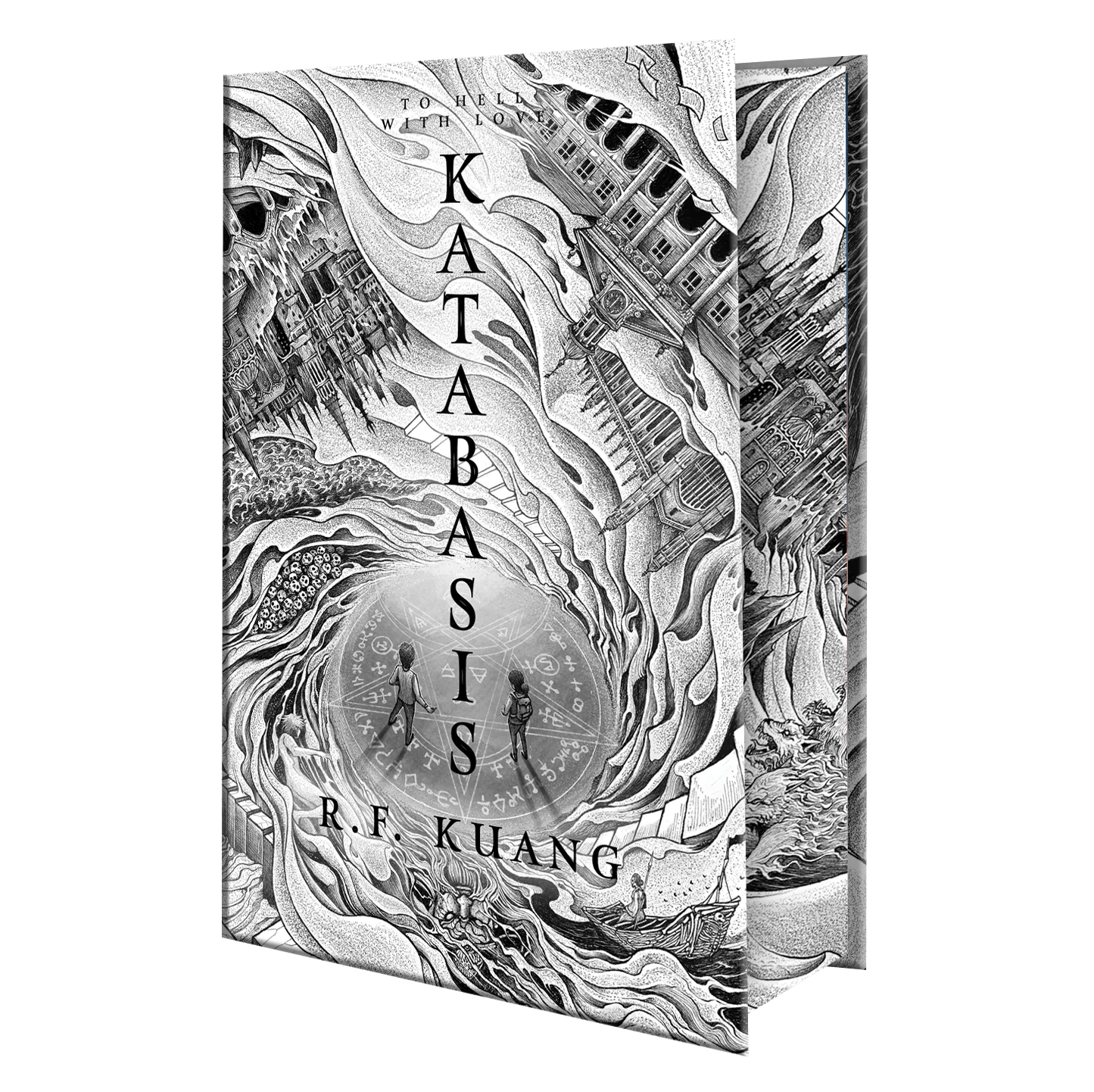
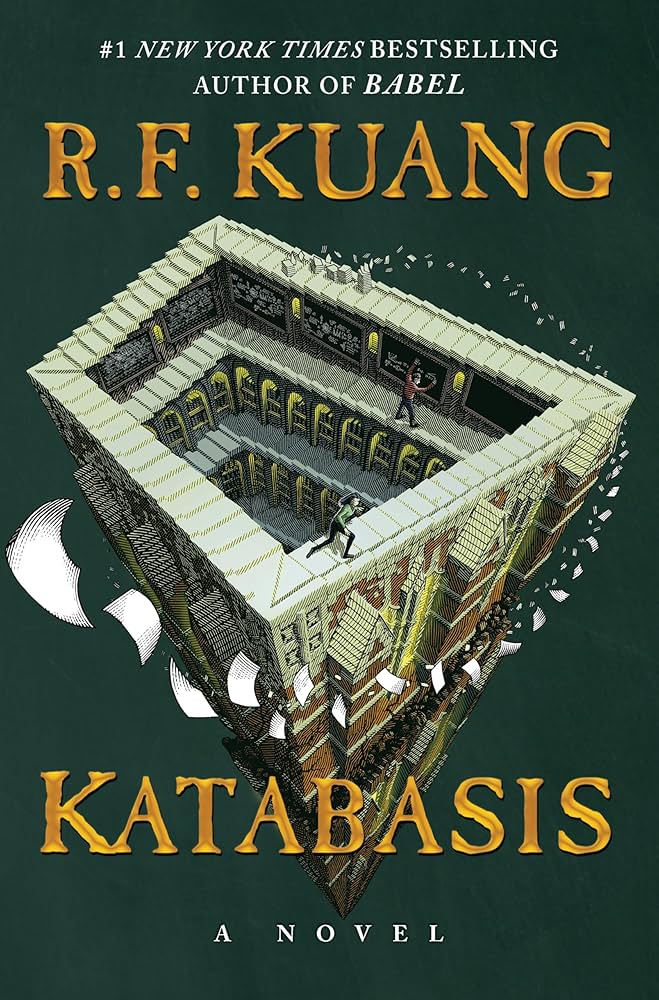
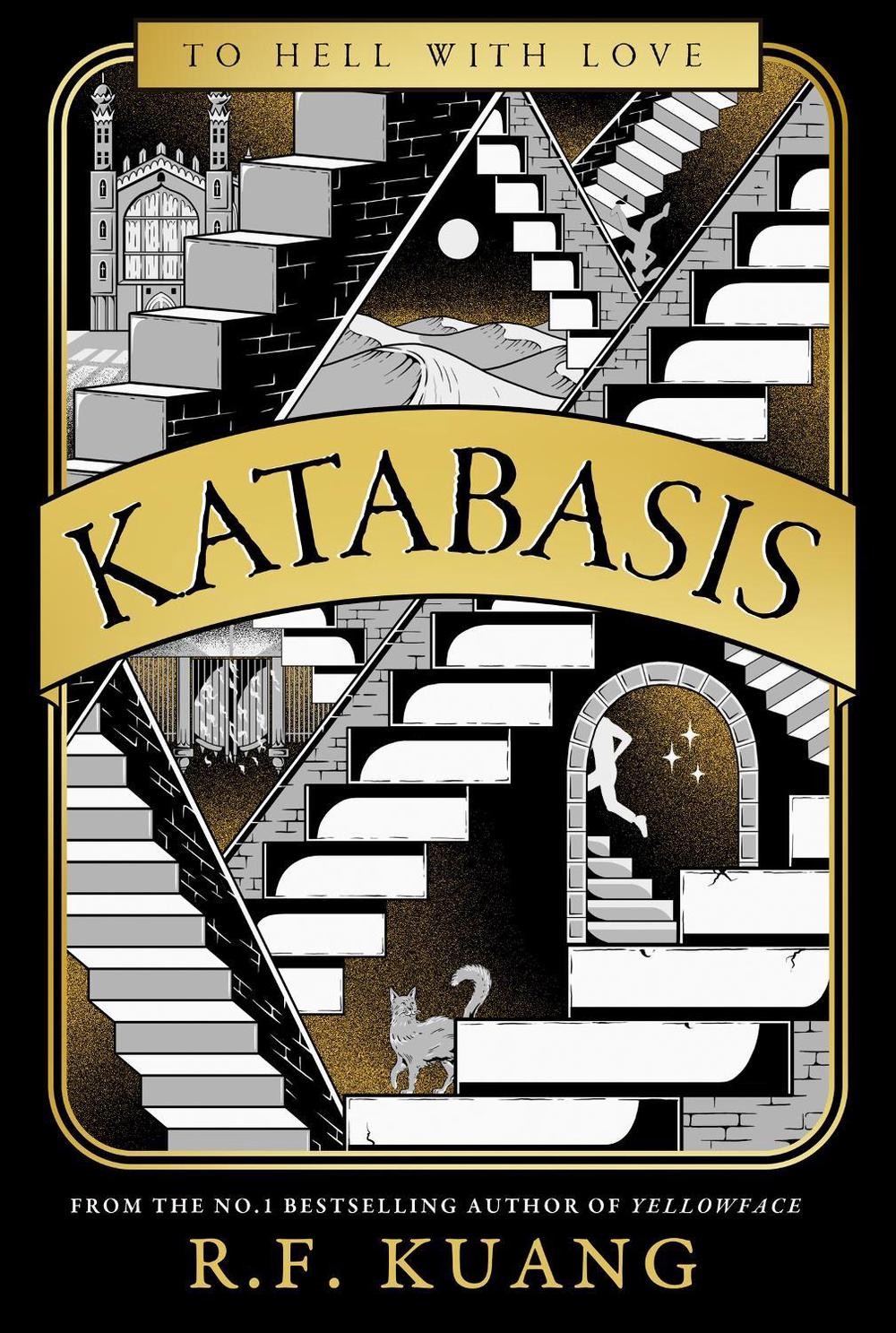
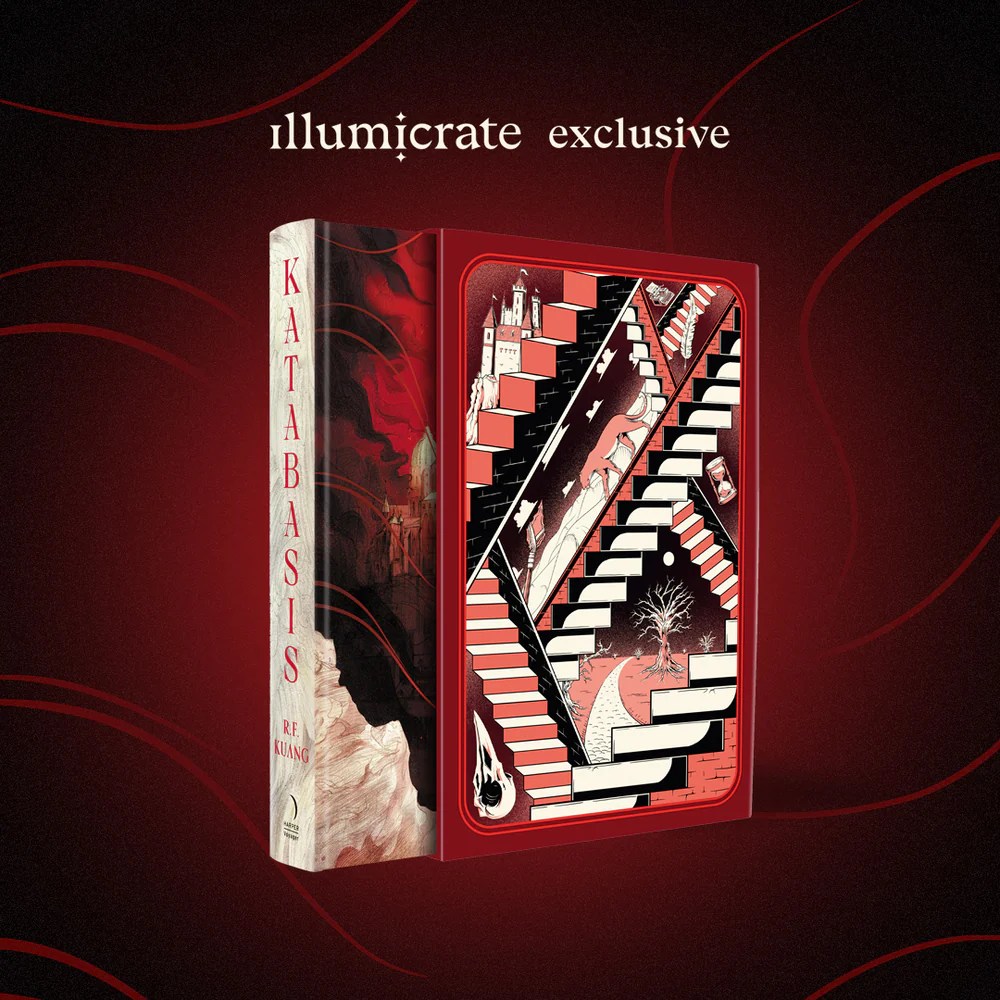
Up there are four of the seemingly unlimited Special Editions of R.F. Kuang’s new book Katabasis. I own three of them; two are currently in my house and I believe one is on the way. The fourth is the UK edition and despite everything I’m about to say it is still a maybe. Perhaps it wasn’t the wisest decision to order three expensive hardbacks of a book I hadn’t read yet, even if it was by one of my favorite authors! But as we’ve firmly established by now, I cannot be trusted with adult money.
Katabasis is the sixth book Kuang has written; I have read them all, and previously my least favorite of her books was one that was ranked third on my end of year Best Books list. My least favorite, mind you. Least. And part of me really thinks that I should sit with this for a minute and not write the review just yet, because part of the problem is that this book did not match the expectations I had set for it, and because I’ve enjoyed Kuang’s work so much in the past, I feel a need to be fair to it that I might maybe not feel with other authors. Then again, maybe not. Maybe, much like main character Alice Law about her mentor and Ph.D advisor Jacob Grimes, I’m making excuses so that I’m not disappointed.
Katabasis, somehow, has made Hell boring.
But let’s back up. Katabasis is the story of two graduate students (in theoretical Magick, of course) who travel to Hell to rescue the soul of their doctoral advisor, not because he doesn’t belong in Hell– he clearly does, and they’re both fully aware of this– but because their careers will be damaged by him being dead, and they need him for recommendation letters and such. I feel like this aspect of their motivation could perhaps have been explored a bit more; sadly, it was not. Katabasis (kuh-TAB-uh-sis, the word is Greek for “descent”) was supposed to be this dense, deeply literary work, heavily reliant on previous let’s-traipse-off-into-Hell books; there were pre-Katabasis reading lists floating around, and while I’m not actually completely certain Kuang was behind any of them, they were kinda intense!
And … well. Kuang is an academic writer; most of her books have at least partially involved schooling in some way and Babel was literally about a group of Oxford students who powered the world with magic based on translation, so this isn’t exactly a road untread for her. But this book is no more complicated than Babel was and no more academic; I was expecting a challenging read, and just didn’t get it. This is also the book that showed Kuang’s youth (she is still, somehow, not even 30) the most, I think; what she knows best is academia and grad school and I think that finally caught up to her with this book. And I get it! I’m not exactly a stranger to pretentious/prestigious graduate experiences; I hold an AM from the Divinity School at the University of Chicago, after all, which probably left me better prepared for going to Hell than most people’s educations, and I “hold” an “AM” rather than “have” an “MA” or a pedestrian “Master’s Degree” because, well, University of Chicago gotta University of Chicago. Those letters being reversed mean something. To somebody. I don’t know what, but they do.
Anyway, Alice (and is that name an accident, no, it is not) and her friend/fellow genius/academic rival Peter Murdoch head off to Hell to drag Grimes back into the world with them, and the book spirals (I see what you did there) back and forth between the past and the present as they argue about the map of Hell and, for the sake of argument, descend down to the final level to find him. They go in without much of a plan, and “no plan” really never gets better; they have a couple of never-ending water bottles and a sackful of, this is really what it’s called, Lembas bread with them so that they don’t starve to death or have to drink anything in Hell, and they mostly just wander around for five hundred pages, occasionally interacting with some of Hell’s shockingly small number of denizens. Most of Hell is an empty wasteland. They eventually arrive at the city of Dis, and I feel like if we’re going to start with a pre-reading list, maybe one of the New Crobuzon books, or Gormenghast, or the Shadow of the Torturer, or something like that should have been on there, because I have definitely read better infernal cities before.
It’s not … bad? Or at least I’m not willing to admit it was bad yet? And if you are someone who reads books for character development, this probably is right up your alley, as Alice Law and Peter Murdoch really are two of Kuang’s more completely drawn characters. But I don’t really read for character; I read for story and setting, and the story and setting here are both far too thin for my tastes. I probably owe this book a reread in a year or two regardless, just to let the expectations clear and to go into it with a better idea of what I’m about to read. But right now I’m deeply disappointed in it. The extra copies are still going to look great on my shelf, and Kuang is still an insta-buy author, but this one really didn’t do it for me.
I just went and looked, and it has been five years since I did not post about being horrendously sick sometime during the last week of August or the first week of September. Tomorrow is the last school day of August. I am, at the moment, healthy. Will I make it to work in the morning? We shall see.
Honestly, this year continues to be the best start to a school year I can remember; I’ve now made it through two and a half weeks of school without even threatening an office referral, although we did have a little drama blow-up between some of my girls today that threatened the peace and harmony of my little universe for a while. Everyone decided to be reasonable, though, so we’re all good over here in Silertown.
Anyway, I’m going to spend the rest of the night with my face buried in Katabasis, so y’all be good.
I feel like I’ve been on another run of too many “taking the night off” posts lately, but … damn. I had a good day at work, went to the comic shop, came home, did a bunch of grading, and I’ve literally been sitting here staring at the screen for ten minutes trying to come up with something even remotely interesting or witty to talk about. This is the best I can do. This happened on Sunday:
Yes, that’s two Amazon vans, both at my house at the same time, suggesting that Amazon’s logistics aren’t maybe as good as they’ve always been cracked up to be. The packages were even both for the same person, so they don’t have that excuse. The second driver to arrive spent a few minutes either angrily venting or yelling at the first driver, waving his hands (and the package) around and hollering loudly enough that I could hear him from inside my house, although I couldn’t quite put together what he was saying. The other guy never got back out of his van and I suspect he was not enjoying the conversation one way or another. Then after a few minutes the first guy drove away, leaving the second guy in his pit of vitriol, and he brought the package to my porch and drove away, never to be seen again.
You know this; I have somehow acquired enough pull as an Important Book Reviewer that sometimes publicists contact me to see if I want review copies of things. I almost always say yes; the only time I can think of that I declined a read was when the publicist made it clear that she was offering me a pure romance novel. I don’t mind romance, but I need it mixed with something, and I didn’t want to accept a book that I was already probably not going to enjoy.
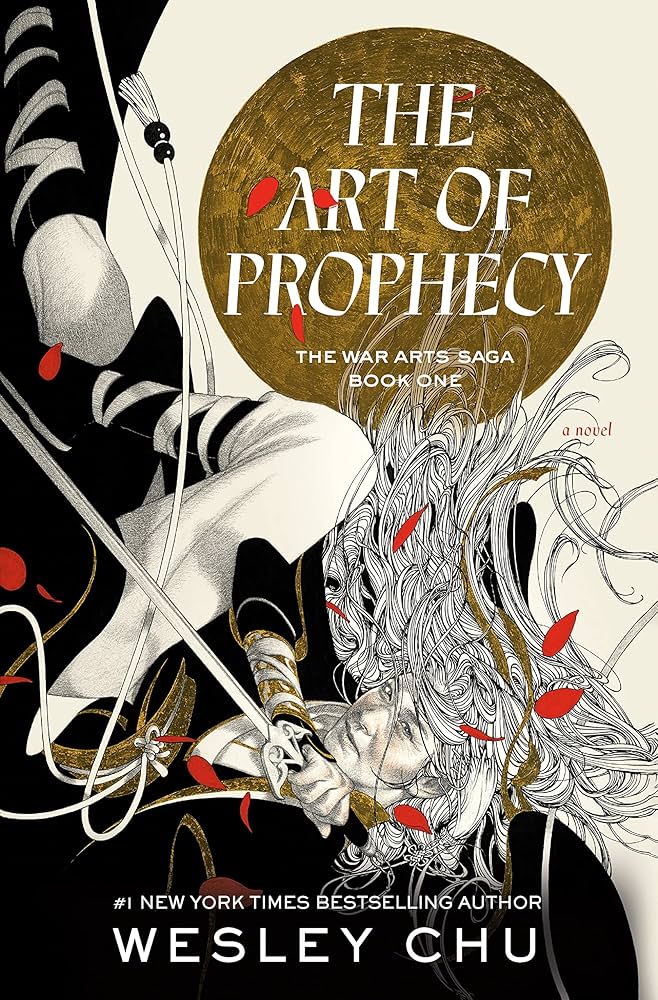
At any rate, I got an email a few weeks ago about Wesley Chu’s new book, The Art of Legend, out today at finer retail establishments across the globe. Would I like a review copy? Absolutely, I said, except there’s one problem. It’s book 3 of 3, and I haven’t read the first two. I’ve enjoyed Chu’s work in the past but reading book 3 on its own kinda feels like a heavy lift.
No problem, the publicist said … and sent me the entire trilogy. Not even ARCs! Actual official copies! So I finished Book One today, and my intent is to read Katabasis and then read the next two back-to-back. I plan to review all three of them.
This plan would backfire quickly if I hadn’t liked the first book! So it’s lucky that I didn’t; The Art of Prophecy shares the strengths of the two Chu books I’ve read in the past, with great action, interesting characters, and a quick-moving plot that would have had the book read overnight if school hadn’t just started.
The premise, as you might have guessed, involves a prophecy: a young man named Jian, the Champion of the Five Under Heaven, has been groomed since birth to be the one who defeats the Eternal Khan, saving his kingdom from the forces of evil in the process. Jian has been trained by the finest teachers in the martial arts, but is still young; only fifteen or so, if I remember correctly.
A master named Taishi arrives to evaluate Jian and his training, and she finds both severely lacking. Jian is indolent and callow, his trainers little more than grifters, and his training has been more for show. The boy is more of a professional wrestler than a prophesied warrior.
So we already have a problem.
And then the Khan goes and gets himself killed in a drunken stupor, without Jian’s help in any way, and … all hell kinda breaks loose.
This was a lot of fun, y’all, and I apparently have a thing for impatient, irascible old one-armed women, because Taishi is one of the best characters I’ve encountered in quite a while. The fact that she’s a supreme badass who more or less melts her way through damn near any adversary she encounters for the entire book doesn’t hurt at all, and her completelack of patience with Jian’s crap is breathtaking. I loved it. As I said, the wuxia-flavored action is great, and Chu avoids the trap of only describing battles using complicated names of moves. Sure, sometimes he’ll let you know that someone has deflected a Monkey Saves the Circus by using Monkey Ruins Christmas Dinner, but he’ll also describe what that means, which is my problem with the handful of wuxia books I’ve read. You’re also going to see this world from more than one perspective, as at least a couple of the POV characters are out to get both Jian and Taishi, and one of them carries a fragment of the Great Khan’s soul with her. Surprisingly, she doesn’t think her people are the evil empire.
I’m not going to spoil a whole lot of details about what happens next, but there are a lot of assassins, and Jian has to go into hiding in a martial arts school and masquerade as a novice and an orphan … which after years of wealth and pampering, doesn’t go quite as well as everyone might have hoped. Not everything gets wrapped up, as this was clearly written with a trilogy in mind from the start, but since Book Three is already out, the only thing making you wait is how fast you can read. I’m particularly interested in finding out more about a particular side character who starts having panic attacks during battles partway through the book; we’ll see how much of him we see in Book Two.
Definitely check it out. I’ve got a three-day weekend coming, so hopefully I can have my review of The Art of Destiny up within a week or so.
I got … maybe four hours of sleep last night, and it wasn’t a good four hours. Today was a good day at work but it ended with a surprisingly comprehensive interview for a supplementary position that I didn’t realize was an interview going in, and I’m *exhausted*. I will be in bed by 8:30 and asleep by 9 tonight, I swear.
The tl;dr: this was so close to perfect, but probably needed another month or so to cook before getting released.
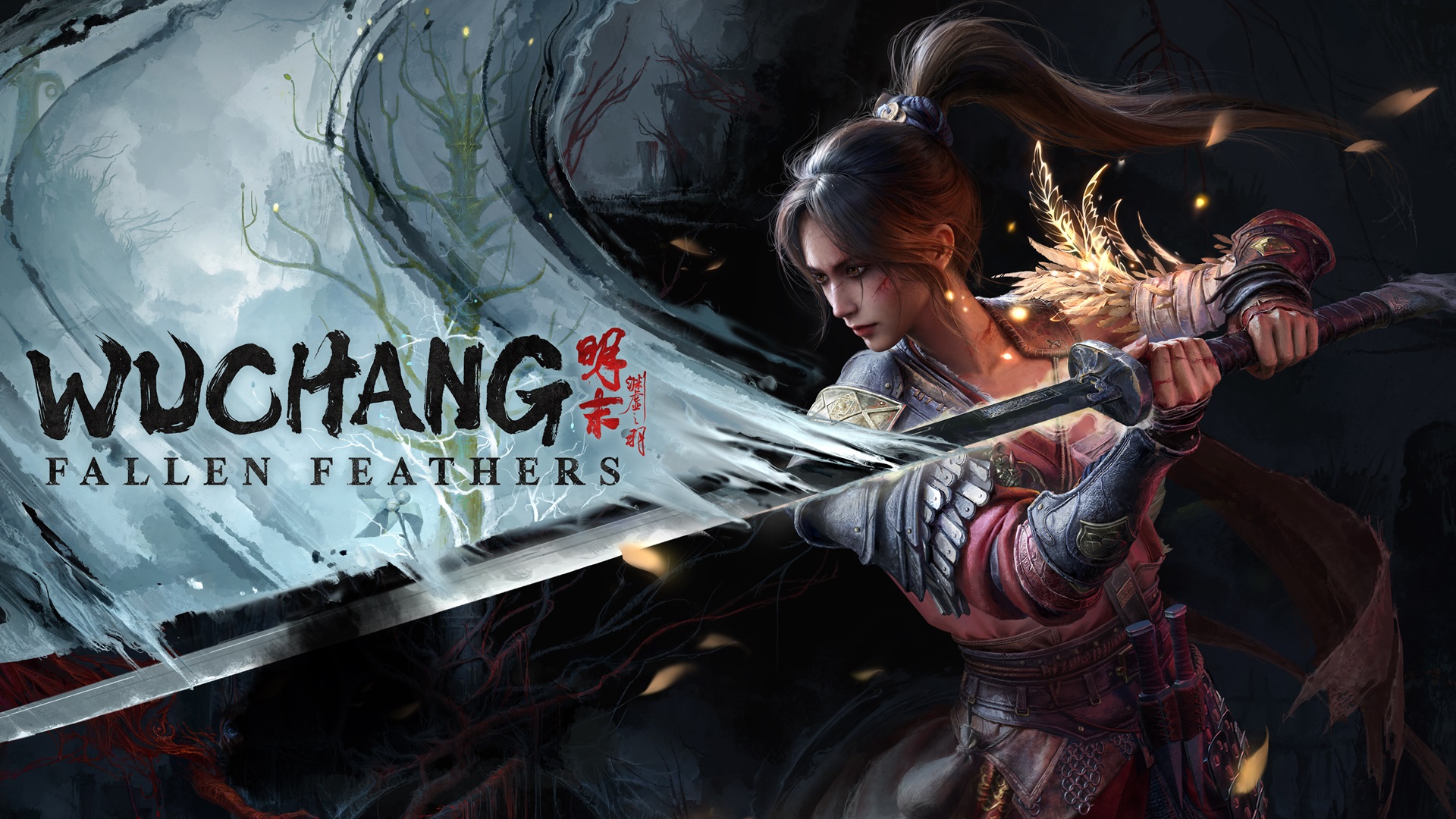
I beat Wuchang: Fallen Feathers last night after 60 or so hours of gameplay, and for the most part, I was really, really happy with it. Most of my gripes are technical, and the things this game does right, it does very right. This is a Soulslike through and through, which is currently my favorite kind of game, and it hits all the buttons: deep combat, wildly variant weapon builds, obscure quest lines, difficult boss combat, and an emphasis on exploration. The exploration is the best part; Wuchang may have the best interconnected world map I’ve ever played, and it’s incredibly rare that you’ll see a path fork off and one of them end a little bit later in a dead end with a treasure in it. Everything loops around and leaves you somewhere, and it was harder to keep a mental map going (note: this is a good thing) than I’ve seen in a game like this in a long time.
There’s three different major things that this game does that distinguish it from a run-of-the-mill Soulslike. First, what the call the Skyborn Might system. All of your spells and some of your combat abilities are based on how many stacks of Skyborn Might you have at any given time. You can have up to five, and spells will cost from one to all five stacks and weapon abilities generally cost between one and three. Skyborn Might is earned mostly by perfectly-timed dodges, although most weapons have at least one other way you can earn it and there are different items that can add to Skyborn Might as well. One that I kept equipped for most of the game automatically generated Skyborn Might on kills, which came in really handy. Skyborn Might deteriorates over time if you don’t use it, which was good and bad– it encourages you to use your abilities, on one hand, but on the other I felt like it deteriorated too fast, and I’d have liked some way to slow down that deterioration, whether it was a more permanent item or a consumable.
The second is the Madness system. Killing human enemies and dying both generate Madness, and killing nonhuman enemies and various items and locations can decrease it. Increasing your Madness has two major effects: it increases your damage noticeably the higher it is, and it at least supposedly increases how much damage you take, although I went through the whole game without ever feeling like that had caused a death. I never really even noticed it.
On top of that, if you die, you lose a percentage of your currency (Red Mercury as opposed to souls, or blood echoes, or whatever) and that percentage is based on how high your Madness is. If your Madness is less than 100% you can pick your resources up from wherever you died. If it’s at 100%, though? You’re gonna generate a Madness Demon when you go back to get it, and if that Madness Demon kills you, your shit is gone. On the other hand, if you kill the Madness Demon, you get a bunch of other stuff on top of your lost materials, and Madness Demons can be baited into attacking anything, so there are places where generating one on purpose (there are items that raise Madness as well) can be a sound strategic maneuver against an enemy that you can’t find a way to beat. This won’t work on bosses– you can’t generate demons inside a boss arena– but there are occasional more powerful red-eye enemies scattered around, and letting one kill me, generating a demon, then triggering her and running away to watch the two of them fight was fun.
The third is the upgrade system, which runs off of an upgrade tree. Each weapon style (Spear, Greatsword, Axe, Dual Blades, and Longsword, and I spent most of the game in Greatsword) has its own tree but you can go anywhere you want on the tree and you can respec any time at will. Weapon upgrades are also built into the skill tree, and the awesome thing is that 1) any weapon upgrade affects every weapon of that type, even if you get a new one later, and 2) you can respec your weapon upgrades just as easily as your own abilities. So unlike, say, Elden Ring, where if you make a change to your preferred weapon late in the game you’d better hope you have enough upgrade mats available to level that weapon up, if you had a +9 axe and you want to switch to greatsword your greatsword will automatically be +9. In fact, all five of the greatswords you’ve found will be +9, and if you find a sixth that’ll be +9 when you pick it up. In every other Soulslike I’ve played, just because you leveled up Longsword A doesn’t mean Longsword B is improved as well. This is a huge improvement.
The problem is the performance. This game, at least on Xbox (I picked it up here because it’s currently free on Game Pass) is very poorly optimized, and while you can lock the framerate at 60, you’re going to see constant blurriness and focus issues as the game struggles to keep up with itself. I played without the frame rate locked for a little while and the frame drops were so bad I had to switch back. This is on the Series X, mind you, which is supposed to be the beefy one; I can’t imagine what this would play like on the less powerful Series S. There are some balance issues– there’s a huge difficulty spike with a boss about a third of the way through the game, and the game really expects you to use a certain mechanic to beat that boss, only all weapon types don’t have access to that mechanic. As it turned out, I’d started with a Spear build, and the Spear build is the one least capable of managing this boss. I had to respec, and once I did I sailed past her. Now, again, the game encourages painless experimentation, and I could have switched back afterwards, but it left a sour taste in my mouth. I don’t object to the idea that certain bosses are weak to certain styles and stronger against others; that’s a staple of the genre– but “you need this type of ability to win here, and this weapon doesn’t have that at all” is a problem.
There’s a few other things; it’s way too easy to fall off of ledges, which is partially a skill issue, and until very recently the icon that shows where you dropped your resources was really hard to see against some level backgrounds and invisible if you were unfortunate enough to die in shallow water, but they’ve patched that problem out in the last couple of weeks. I know Soulslikes aren’t for everybody, and if they aren’t your thing you’ll want to stay away from this, but if they do, and especially if they do and you’re on Game Pass? Hooooooly shit. And it’s only $50 at full price, and it’s a good enough game that I’m considering picking it up for the PS5 anyway. Check it out.



 Welcome to infinitefreetime dot com