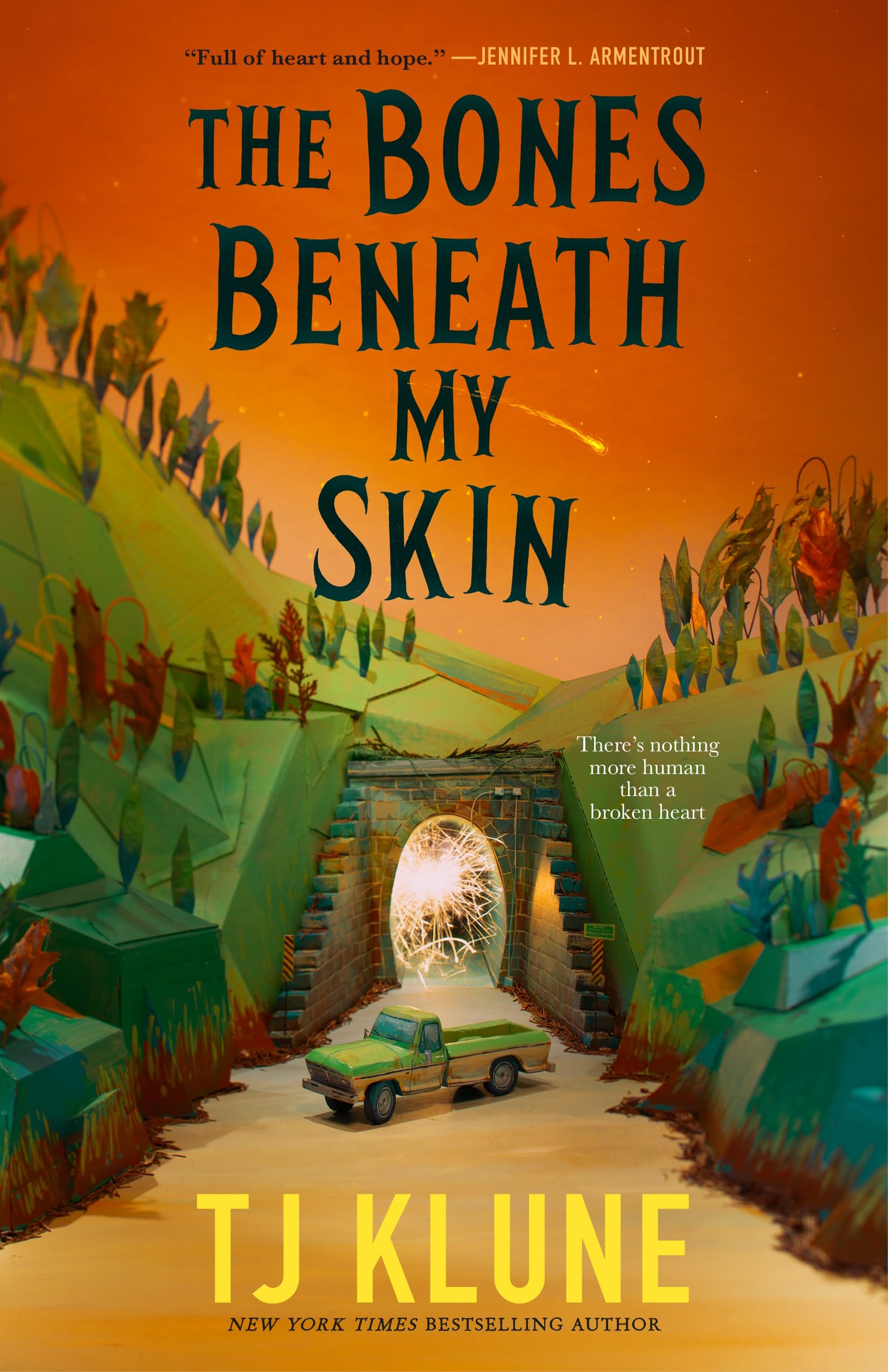
It’s well past time, I think, to declare TJ Klune one of my favorite authors. I have … eight books by him? Nine? Something like that, all of his adult novels, at least, and I’ve enjoyed all of them. In some ways, The Bones Beneath My Skin is one of his best books, up there with The House in the Cerulean Sea. It’s interestingly distinct from a lot of his other work, which usually has at least a little bit of the feel of a fairy tale about it, and one could make an argument that it’s his first science fiction novel. He calls it an “action movie” in the afterword, which I’m not completely convinced about but I see where it’s coming from.
At any rate, this book tells the story of Nate Cartwright, a reporter journalist (he never explains why he hates the word reporter so much, but damn, is he willing to be uppity about it) who in one fell swoop loses his family and his job at the Washington Post, and ends up at a family cabin deep in the woods in the middle of nowhere, where he is surprised to be greeted at gunpoint by a gut-shot, wounded Marine and a ten-year-old girl named Artemis Darth Vader. Shenanigans ensue. I don’t really want to spoil stuff all that much, to be honest, but it becomes quite clear really quickly that Artemis is not at all what she seems to be, and not just because she likes bacon more than any four normal people. (I burst out laughing when I randomly took the dust jacket off the book and discovered two pieces of bacon imprinted into the front cover. Bacon is a thing in this book.)
Klune’s strengths are on full display here– found family, great characters (Artemis is entirely unforgettable, although I can picture a reader she’s a bit much for) and a wry sense of humor. Artemis may be my favorite of all of his characters, although this book has some weaknesses, and it will be interesting to see whether the passage of a few months dulls the edges from the things I didn’t like about this book or brings them to the forefront. If I remember correctly I read Cerulean Sea similarly early in the year– February, maybe?– and it was still one of the best books I’d read that year when I got to The List. We shall see if history repeats itself.
But I want to talk about some of those weaknesses, because they’re interesting, so I’m going to put a little line here and then talk spoiler talk. Wander off now if you don’t want to see anything, but feel free to come back later.
This book was originally self-published, after Klune’s editor told him that it wasn’t great as a romance novel because there was “only one” sex scene. I contest the label of “romance novel” altogether; I don’t mind romance every now and again but while this book certainly has a romance subplot it is absolutely not part of that genre, but what I found interesting was that the book’s sole sex scene feels almost entirely out of place given the rest of the book. Maybe I’m off base here, but I feel like you can have a ten-year-old girl as a main character or a scene with explicit butt sex but maybe you shouldn’t have both. To be clear, the ten-year-old girl isn’t involved in the butt sex in any way, but still.
The book also pulls directly from the Comet Hale-Bopp/Heaven’s Gate mass suicide of 1997, to the point where it’s set at the same time, has a comet with a different name making an appearance (but the comet’s name is still hyphenated!) and there’s a mass suicide that is identical to Hale-Bopp right down to the silk coverings over the dead people’s faces and them all dying barefoot in bed. The entire subplot ties in to a character who is important to Artemis, but when I realized that he was literally just rewriting Heaven’s Gate and changing a couple of minor details, it almost killed the book for me.
It’s kind of ironic for me to say this, given that I’ve defended him in the past for pulling inspiration from tragic real events, but (to briefly recap that post) the influence of the Sixties Scoop on Cerulean Sea is so reworked and altered that many readers don’t notice it until it’s pointed out. This is not that– he has lifted the entire mass suicide and stuck it in his book. My problem isn’t with taking inspiration from real-world events, here; it’s that he’s doing so sloppily. There is absolutely no way anyone could have been alive and aware of the world in 1997 and not recognize the parallels here; they’re that glaring. And it throws you into oh no he didn’t mode in what should be one of the climactic events of the book, and the whole thing could have been done so so so much better, even if the main guy in the cult needed to be in the book somehow.
But again, in six months, who knows if this will still bug me when I think about this book. If I just remember how awesome Artemis is, you can expect this to show up at the end of the year, and one way or another it’s absolutely still a hit for Klune. I just wish he’d reworked parts of it a bit more before Tor reissued it.
I would like to pretend to be surprised that I got home from work, sat down, blinked, and it was 8:00. However, I sat down in what I’m beginning to think of as the Danger Spot on the couch, there was a kitty cat on my lap, and the blink was three hours long.
Okay, so this time it’s really-really the first day of spring, the calendar says so, so instead of 70 degrees and beautiful like it’s been who knows how many days recently, we had fucking snow. Again. And there’s more expected later this week.
That said? This wasn’t a bad day at all. Work was productive– actual teaching happened in all of my classes, which is always nice, especially after how messy yesterday was. I bought tickets to a Counting Crows show in June, meaning that I’ll be seeing both the Counting Crows and Weird Al Yankovic at the same facility within three weeks this summer, and to be honest I can’t decide which show I’m more excited about. I’m seeing Weird Al with my family and the Crows with one of my oldest friends, which is going to be super cool.
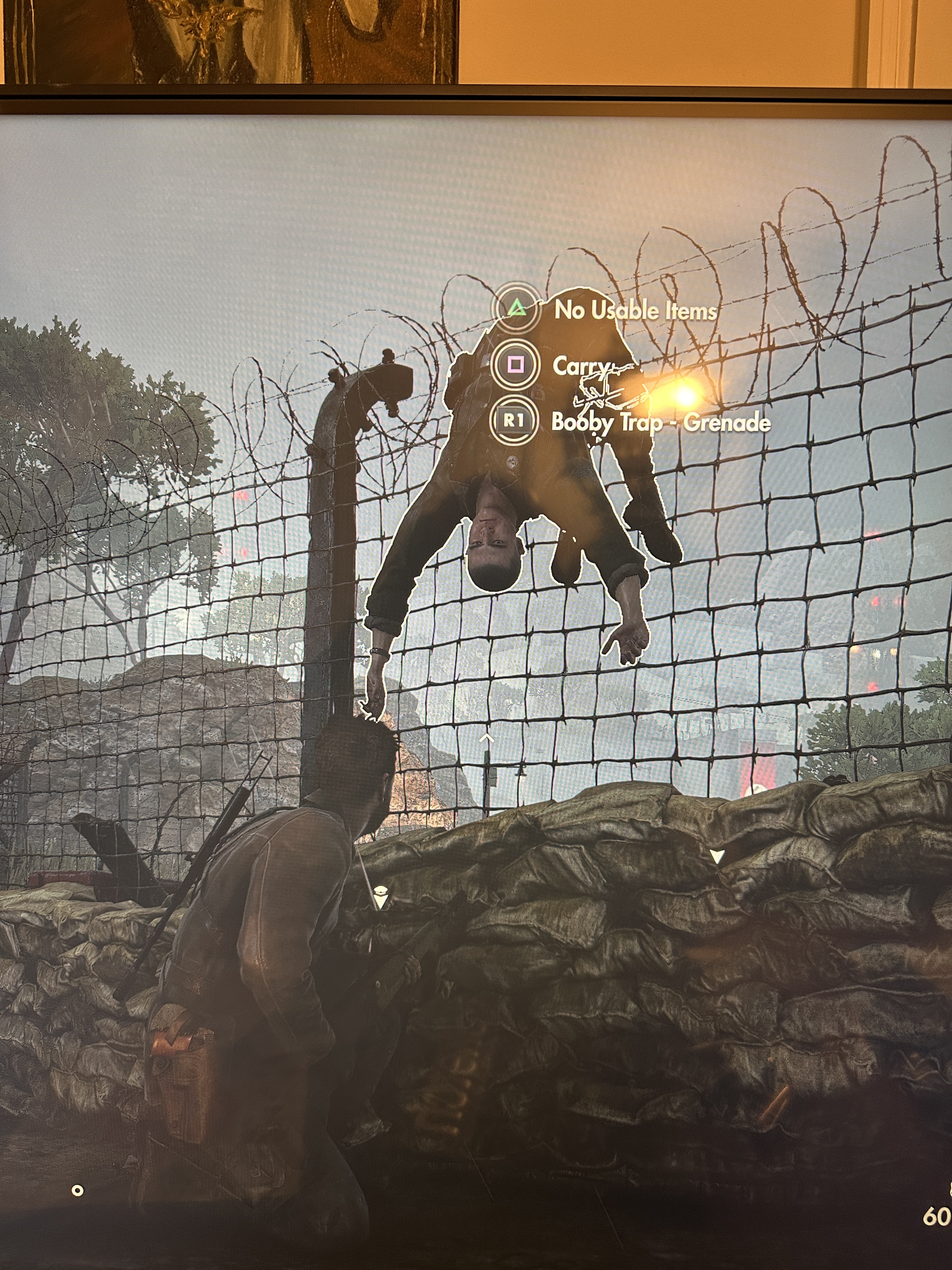
And then I came home and since I got tomorrow’s planning done at work (!!!) I had time to shoot some Nazis. This poor bastard up here got killed with a grenade, dropped neatly at his feet from a bush a dozen meters away, and blew up both him and his friend. He ragdolled into the barbed wire, which I find incredibly hilarious for some reason. I never found the other dude’s body, which I assume was blown directly to Hell.
There’s probably something really creepy about how relaxing I find WWII-based sniper games; there is something incredibly cathartic about blowing a Nazi’s face off (in high-definition, bullet-cam, slow-motion detail) from 300 meters away with no one the wiser about where you were or where the bullet came from. It’s okay, see, not because it’s a video game, but because Nazis aren’t human beings.
I really shoulda booby-trapped that guy’s body, though. Maybe I’ll go back. I left a trail of destruction behind me so who knows if there’s even anyone alive to find him (no one heard the grenade) but they’d cut back to it if something happened. It would be worth it. There are always more grenades, right?
I said it was the first day of spring last week? That was wrong. Today was the first day of spring, and the way I can tell was the fact that half the building was pissed off and the other half was crying today. All of my ability to can has been replaced with cannot. I still haven’t finished that Lego set so I think I’m gonna go do that, for real this time. Maybe go to bed early. Really early.
This is very much not a book review. Don’t get me wrong, I’m still gonna tag it under “Reviews,” but the Epic of Gilgamesh is four thousand years old and the notion of putting a star rating on it is kind of ludicrous. Now, Stephen Mitchell’s new translation includes a decently long introduction and 80 or so pages of translation notes, so I could “review” that, but I did not pick this up to read his notes or his introduction; I picked it up because I realized I didn’t have a decent translation of the epic in the house anywhere and I got a wild hair up my ass about it.
Now, that said: Mitchell’s translation– well, his adaptation, and I’ll get to the distinction in a bit– is in fact a lovely read, and it combines being compulsively readable in English with a fine poetic feel that makes reading it out loud flow beautifully. I’m not an expert here by any means– I considered shifting my Master’s degree away from Hebrew Bible and more toward Babylonian studies in grad school before deciding to abandon the entire affair, but that’s as close as I get.
The problem is neither is Stephen Mitchell, who openly admits that he “doesn’t read cuneiform and has no knowledge of Akkadian.” Which makes the decision to publish a new translation, or adaptation, or version, which is his word … interesting? He basically sat down with a bunch of English versions (of, remember, fragmentary texts in one of the oldest languages that humanity can still understand) and some scholarly treatments of the work and pulled together his text from that, first doing a prose pass and then converting it to English verse.
(There’s a whole post or maybe a series of them in here about how one translates poetry from one language to another; needless to say it’s hellaciously complicated and requires a lot of expertise in both of the languages involved and in writing poetry. I could never.)
Fun fact: the Epic of Gilgamesh contains the oldest reference to blowjobs I’m aware of. From Book VI:
‘Sweet Ishullanu, let me suck your rod, touch my vagina, caress my jewel.‘
Except! In the translation notes at the end, Mitchell states that the literal translation is “eat your vigor,” which … okay, that sounds like a blowjob too, but since he doesn’t know any Akkadian it’s hard to say how reasonable that leap is, right? An actual scholar of the language and the culture might be able to provide some details there that led to that specific choice of words; for Mitchell it’s basically just vibes. This bothers the nearly-dead Bible scholar in me; it may not be especially relevant to other people.
There’s a bit where Enkidu tears the “thigh” off of a bull and throws it at Ishtar, and she takes it and puts it on an altar and makes it a centerpiece, and I’m thinking that maybe it wasn’t the thigh he actually tore off? Would love to see what a scholar had to say about that. But that’s not this version!
Anyway. I enjoyed reading this even if I had some issues with it, and maybe I’ll take a deep breath and find something more academic about the work and maybe a more traditional translation to compare the two. Or maybe not! It’s not like I don’t have a shitton of other stuff (including, remember, a whole other book called Gilgamesh) to read.



 Welcome to infinitefreetime dot com