I live in a countrywhere one of the two major political parties is running a rapist for the presidency and basically held a white supremacist rally last night, and where one of the major newspapers has decided to make it its mission to cause the candidate for the other party to drop out, all else be damned.
It won’t actually take all that long for me to dispense with the “review” part of writing about Safiya Sinclair’s How To Say Babylon. You should check it out. There you go. Sinclair grew up in Montego Bay, Jamaica, the daughter of a Rastafari reggae musician, and the book is partially about her escape from grinding poverty to ultimately achieve a Ph.D in the United States and become a celebrated poet, and partially about trying to grow up female in a home dominated by an abusive misogynist. Sinclair, as one might expect from an award-winning poet, is a beautiful, lyrical writer, and her story is fascinating. I can’t imagine someone picking this up and not at least finding it tremendously interesting. I don’t recall how it crossed my radar, but I jumped on it, and it’s a pretty fast read.
That said, the book itself isn’t why I’m writing about the book, which ended up fascinating me but perhaps not for the reasons Sinclair intended. All the dialogue in the book is rendered as spoken, meaning that 90% of the dialogue is in Jamaican English, and I want to take a deep dive into Jamaican English grammar rules now that I’ve read this book. The dialect’s use of pronouns is kind of fascinating, and it was endlessly entertaining to me the way I was hearing anything her father said throughout the book. And, actually, after doing a light bit of Googling just now, it’s possible that there is some translation going on, because Jamaican patois is significantly more difficult for an American English speaker to understand than the dialogue in this book, which is unfamiliar but not incomprehensible. So maybe she pulled back a bit to simplify what people were saying, or perhaps conversation in their house was closer to American English than it might have been in other places. All four of the Sinclair kids ended up with university educations, so it’s clear that education was highly prized in the house– by their mother, as the book makes clear– so it’s entirely possible that a certain level of code-switching was taking place from the beginning.
The other thing is reading through this book and realizing I didn’t know anything at all about Rastafari. I went through a heavy Bob Marley phase in late high school and early college that was more or less responsible for everything I know about it, and I hadn’t appreciated just how unusual the … religion, and I’m using that word under some small amount of protest, really is. Rasta is wholly decentralized, for starters; it recognizes the Bible as Scriptural but there is no Rasta text to rely on and it emphasizes individuality to a degree where concepts like “orthodoxy” can barely even exist. In other words, Safiya Sinclair’s father was a devout Rasta, but that doesn’t mean that his practice of Rastafari lined up with anyone else, and while Jamaican culture as a whole tends toward the patriarchal, it wouldn’t be strictly accurate to say that Rasta was the reason her father turned out to be the man he did, or that it was responsible for how he treated his children and, particularly, his daughters.
(Also interesting: there are pages devoted to all four of the women in Sinclair’s family deciding to cut off their dreadlocks. There is not a similar scene for her brother, although there is a poignant moment where he declares his newborn child is going to decide on their own whether to follow Rastafari or not.)
On top of that, I absolutely wasn’t aware that Haile Selassie had traveled to Jamaica and explicitly rejected Rastafari’s belief that he was, in some way, God. Sinclair’s father appears to have believed that he was literally God on Earth; some of Marley’s lyrics lean that way as well, and Selassie straight-up said it wasn’t the case, at which point a whole lot of Rastas turned around and said that only God would be humble enough to deny he was God.
Which … wow.
And, like, think about this, right? Selassie was Emperor of Ethiopia. He was not, himself, a Jamaican, and there are no Rastafari in Ethiopia, or at least there weren’t when Selassie was alive. So this guy is Emperor of one country, and this group of people halfway across the globe decide that he is either literally God or at least the Messiah (and, again, no orthodoxy, so each individual Rasta might have a different idea about how this works) and form an entire-ass religion around him. And then he goes there, and he’s like, “No, I’m not God,” and it doesn’t work, and then eventually he dies and … Rastafari just keeps on truckin’.
There was also a lot of oppression of Rastas early on, including a couple of events that qualify as massacres and/or pogroms, and I wasn’t aware that had happened either.
I need to know more, and I want to read a formal academic history of this belief system, is what I’m saying, and not just a memoir. I feel like I’m overusing the word fascinating in this piece but it’s mind-blowing to me that this developed the way it did.
Okay. So you’ve noticed the shitgibbon’s long and abiding relationship with professional wrestling, and you know that wrestlers cut themselves on purpose all the time, and you don’t believe that a bullet fired from an AR-15 can graze someone for some reason,(*) and you think the assassination attempt was faked.
Okay. Fine. You go ahead and do that. Think whatever you like.
But before you spout that shit where I can see it, I’m going to insist that you explain the two dead people and the two injured people. And you’re going to have to do so in such a way that it makes more sense than that a nut job got ahold of a gun, took a shot at someone, barely missed, and the Secret Service, around someone whose single greatest skill as a human being might be his ability to surround himself at all times with utterly fucking incompetent people, fucked up.
Because I’m entirely willing to believe in a world where someone missed a shot and cops fucked up. That sounds just like America to me.
I have nothing else to say about this, other than the paragraph to follow, which is more about math than it is about politics.
(*) If it is possible for an AR-15 bullet to hit someone and blow their head off, and if it is possible for an AR-15 bullet to miss someone, than somewhere in between those two places there literally must be some distance where the bullet does damage– and an ear wound is going to bleed like a bitch even if it’s a small cut– that is not fatal. This isn’t even the first president who didn’t get killed due to amazing fucking luck. Teddy Roosevelt had a bullet basically bounce off a speech in his pocket. Andrew Jackson had someone come after him with two pistols and they both misfired, leading to Jackson beating the hell out of his assailant with his cane. The idea that it is impossible for a bullet to barely miss may be the dumbest conspiracy theory in a wild thicket of dumb conspiracy theories.
I generally write three different kinds of book reviews. The first kind is for books I’m enthusiastic about. That’s the most common type, by far. Rarer is a pan of a book; firstly, because I genuinely like most of the books I read (there are lots of books, and I’m pretty good at picking out ones I am going to like) and secondly because I generally don’t like shitting on a book unless 1) I think it really deserves it and 2) I think I can do it entertainingly. The least common is mixed reviews. Why? Mostly because I don’t bother to write them– “this was meh” is hard to make entertaining or interesting, and if I finished a book with not much of an opinion of it either way, it’s frankly easier to simply not write about that book.
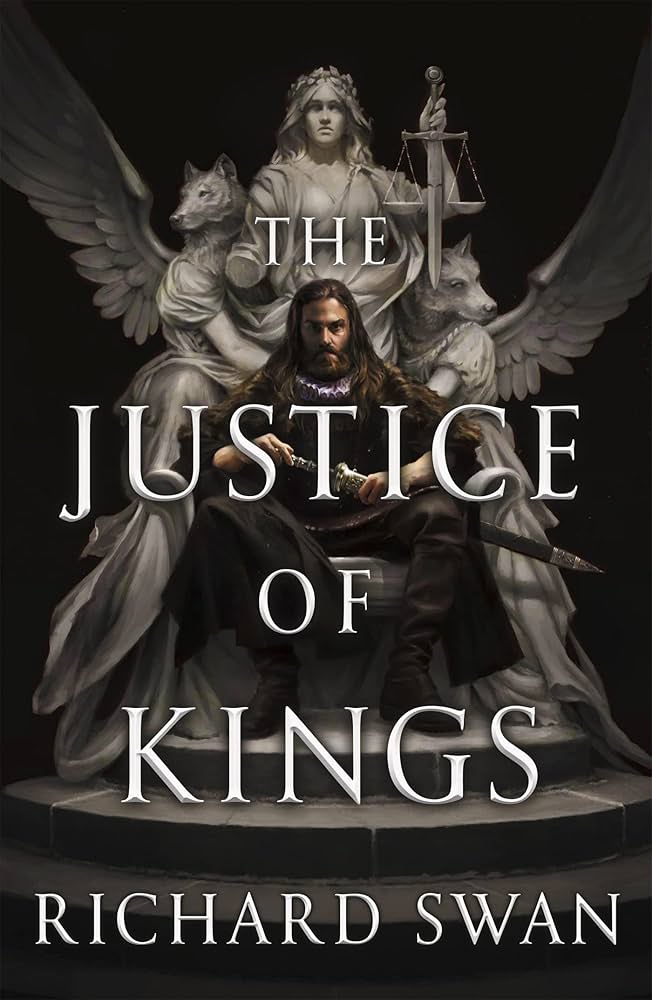
A subtype of the mixed reviews is books that I liked but everything interesting I have to say is negative, and that’s kind of where we’re landing with The Empire of the Wolf. It took me … five days? Six? to read all three books in the series, most of which are around 500 pages each. In general, I had a good time with them, but almost everything I have to say that I think people might be interested to read is negative, and a lot of it ends up a little more political than I like my book reviews to be. There are Bad Books, and there are Books I Didn’t Like, and this series fits more into This Is Not The Book’s Fault. Or maybe it is! I dunno.
So, the story: the narrator of the series is Helena Sedanka, a young woman in the story but telling it much later in her life. The main character, on the other hand, is Sir Konrad Vonvalt, an Emperor’s Justice. The Justices are effectively judges who ride circuit and double as investigators and police; Vonvalt has authority over basically everyone except the Emperor himself, and is able to decide on his own how crimes are punished. Helena is his clerk; she travels with him and is responsible for recording the details of the cases that are brought to him and the resolution of same, and she’s in training to become a Justice herself. All Justices have the power of the Emperor’s Voice, which can compel people to tell the truth, and most have other abilities as well; Konrad can also speak with the dead, for example, and other Justices can speak with animals.
The setting is, effectively, the Holy Roman Empire. Note Holy Roman Empire; think Charlemagne and Germany, not Caesar and Italy. Most of the names are pretty clearly German-adjacent and the Empire’s war of expansion is actually called the Reichskrieg, which was an actual term the Holy Roman Empire used.
The first book starts off as a murder mystery, and absolutely blows the fuck up over the course of the next two books to where they’re dealing with literal threats to reality from a demonic parallel dimension. I don’t want to spoil anything and I almost didn’t want to give you that much; you have no idea where this series is going to end up from where it starts, which is a compliment. Predictable, it’s not, and the twists and turns of the plot over the three books are tremendously well-done. To be clear, I’m about to spend the rest of this review complaining, but I’m absolutely on board for whatever Richard Swan does next. My dude has got chops; he just didn’t quite hit the mark on this one in certain ways.
Just for example: Konrad Vonvalt is an unbearable asshole.
Like, I’ve disliked characters in books before. I’ve disliked main characters in books before. But Vonvalt is unbearable in a lot of ways that make him really hard to put up with and even harder to understand why the other people in the series put up with him. Roughly a third of his dialogue involves telling other people to shut up. He is absolutely insufferably long-winded, completely full of himself, and will not listen to anything other people have to say. He would be the worst boss in human existence.
And Helena is in love with him, for no clear reason, and at various points he claims he is in love with her, despite being twice her age and her immediate supervisor, which is ick. I do not want to read about ick right now. There is enough ick in the actual world and I don’t need it in my books. I would like it if men in the actual world would stop trying to fuck their subordinates and I don’t want to read about that type of man in my books. Even then, it would be easier to put up with if the two of them had any chemistry at all; they do not. He orders her to do things and he tells her to shut up. The word “insolent” appears more in this book than any thirty other books I own. Their relationship is ridiculous in the extreme, and I don’t believe in it even before I get to the part where it grosses me out.
(Helena herself, in general, displays … not great taste in men? She has a brief relationship in Book One where she stops pining over Vonvalt for a while, and he’s not a good idea either for a whole different set of reasons. I went back and forth a lot over how I felt about Helena through the course of the series.)
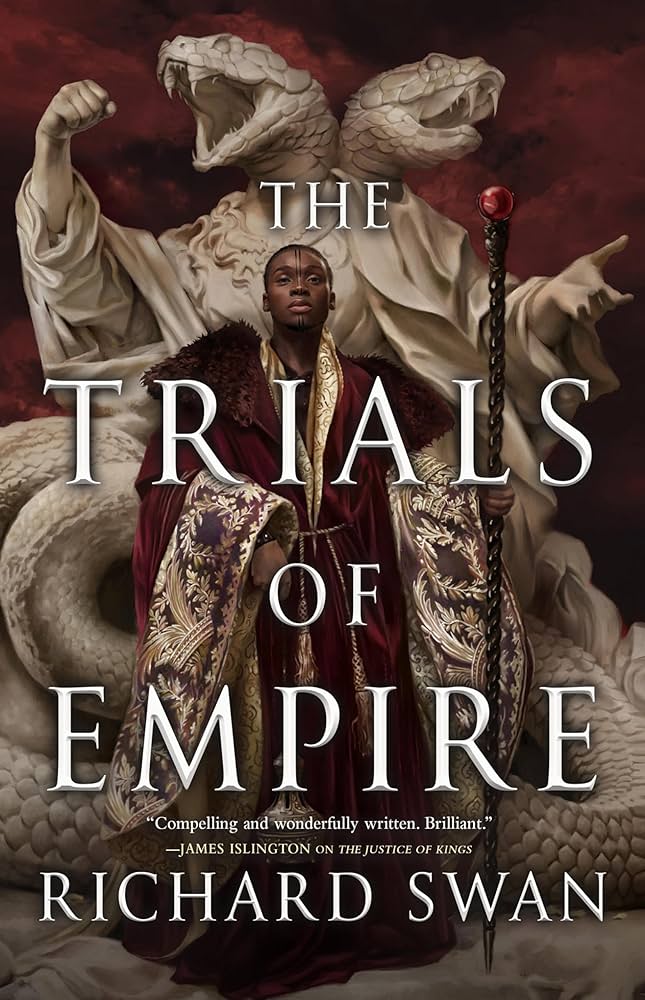
And this one may not even be the author’s fault, but see the guy on the cover of book three? That’s Bartholomew Claver, the bad guy. Bartholomew Claver is a very good villain. But if he’s ever described as being Black on the page, I missed it, and by “missed it,” I mean that I looked at the cover when I picked up The Trials of Empire, thought “Wait a minute, who the hell is that?”, then realized from his clothes that it had to be Claver, and went back to the first description of him looking for any evidence at all that he was supposed to be Black, then read the entire third book paying close attention to the physical descriptions of Claver and saw nothing to indicate anything about his skin color. And yes, I’m fully aware that there were people of color living within the Holy Roman Empire, and furthermore as an empire you would expect these folks to have absorbed some non-white cultures, but whiteness is very much the default in this series.
So we have two possibilities here: either Claver is not meant to be Black, which makes the artist’s choice rather curious, or he is, but Swan never described him as such or did so in such a subtle way that when I went back looking for it I still didn’t see it, and either way it means the only Black guy in the whole damn series is the bad guy, which is also sorta squicky.
You see what I mean, though, when I say that the reasons I didn’t like the book were kind of political, and that they maybe might not be the book’s fault? There are some structural issues too; this series could have used a fourth or maybe even a fifth book, because when I say everything goes to Hell in book three I mean that absolutely literally and a whole lot of shit happens really fast, and Swan either lost some control over his own story or had to cut some stuff back or both, and the third book feels really rushed and kind of muddled in a way that the first two didn’t. And if you’re less annoyed by Vonvalt’s personality than I was you will have a better time overall than I did. So, yeah: this is a mixed review. I had a mostly good time with this series, with the caveats as listed above, but the stuff I liked mostly outweighs the stuff I didn’t, and I’m in for Richard Swan’s next series. I just hope to hell Sir Konrad isn’t in it.




 Welcome to infinitefreetime dot com