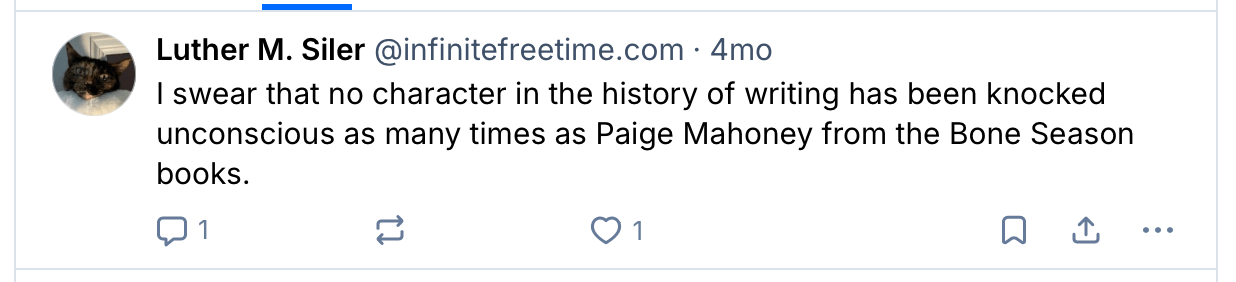
Please, for your interest and edification, note this Bluesky “skeet” from me, written roughly four months ago:
At the time I wrote that, I believed it to be true. And it is possible that it’s still correct; after all, Paige Mahoney has been getting knocked out for five books now, and Vis from Hierarchy has only had two. But it has got to be true that Domitor Vis Telimus Catenicus Leathfhear Diago Carnifex Deaglán Silverhand Siamun has been grievously injured more than any other character in the history of the written word. And it gets so much worse when he gets split into three, because then they can just totally throw logic to the wind and hurt the hell out of him in every chapter, because you’re not going to remember that spear wound in his thigh in six chapters when you come back to him, and the other two versions of him don’t have the spear wound. It’s absolutely nuts, and it’s one of those things that can’t be unnoticed once you notice it. This man has had at least seventy concussions. You’re ideally not supposed to be knocked out so hard you don’t wake up for a week even once in your life, and Vis has it happen multiple times over the course of the maybe a handful of years that both books take place over.
The second special bonus gripe is connected to Islington’s world-building, although this is not at all something that is unique to him, and in fact I’ve been seeing it a lot lately across multiple authors. Y’all, if you’re going to make “Gods!” or “Hells!” a swear word in your fantasy series, the gods or the hells need to have some presence in your book other than the swearing. Maybe this is another example of me being a sloppy reader, but there are a handful of gods named in a glossary at the end of the book, and there’s whatever the hell Religion is (I don’t know! There’s literally just a thing that the graduates can join called Religion! I don’t know what it is or what they do.) but worship and/or fear of and/or basic acknowledgment of divinity is damn near entirely absent from the book. Vis certainly doesn’t worship anything. And I’m sorry, but if any form of the concept of Hell made it onto the page at all beyond “Hells” being a swear word, I missed it. It’s lazy, especially in a world where they already both use standard English profanity and a made-up word, “vek,” that is a pure expletive in the way you might yell “Shit!” or “Fuck!” if something bad or startling happened. There’s no verb form. No one veks, and nothing is ever described as veking (vekking?) anything. But we don’t need “gods” or “hells” or “gods-damned,” which is somehow worse, and it’s one more annoying detail in a book full of them.
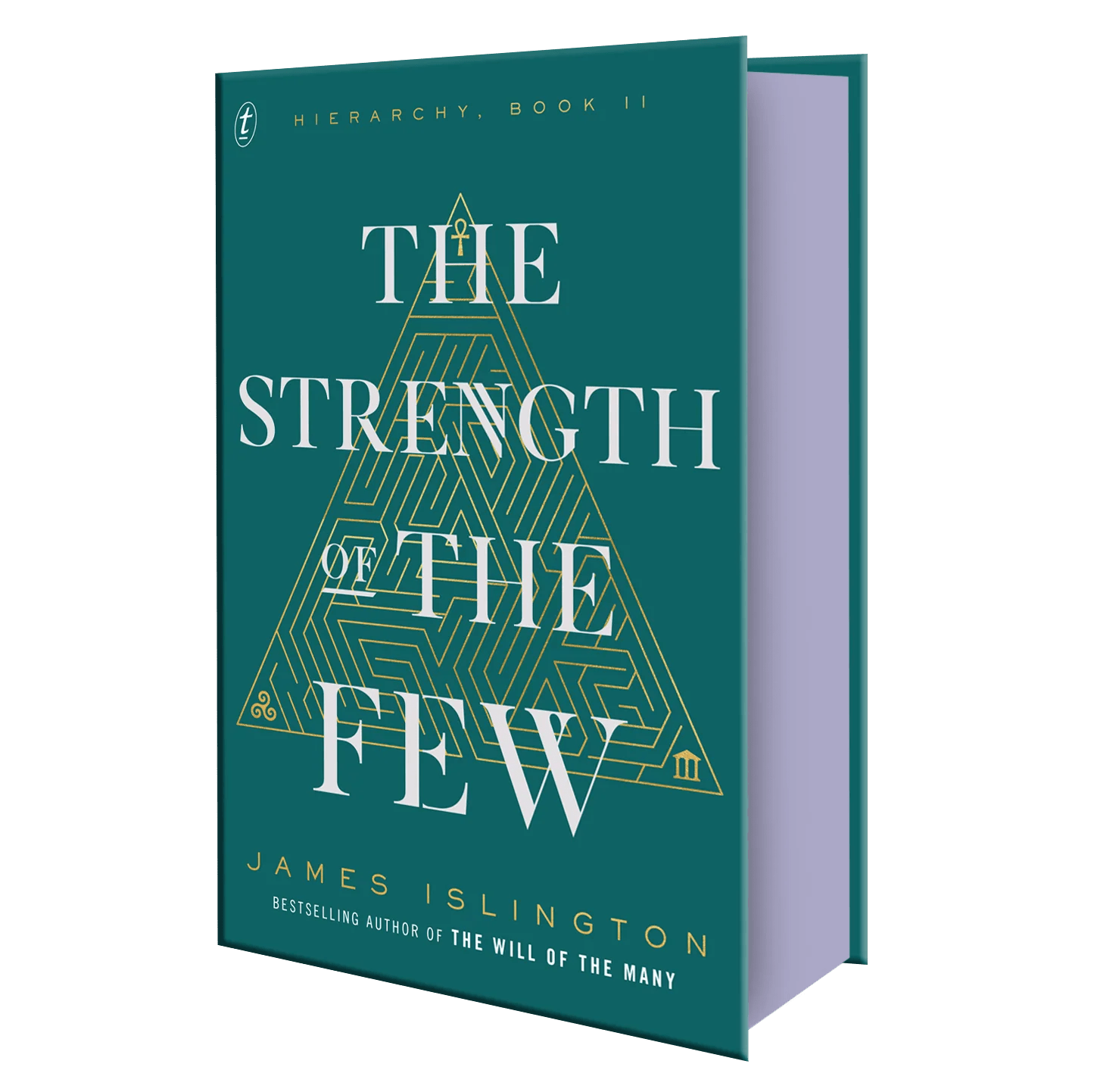
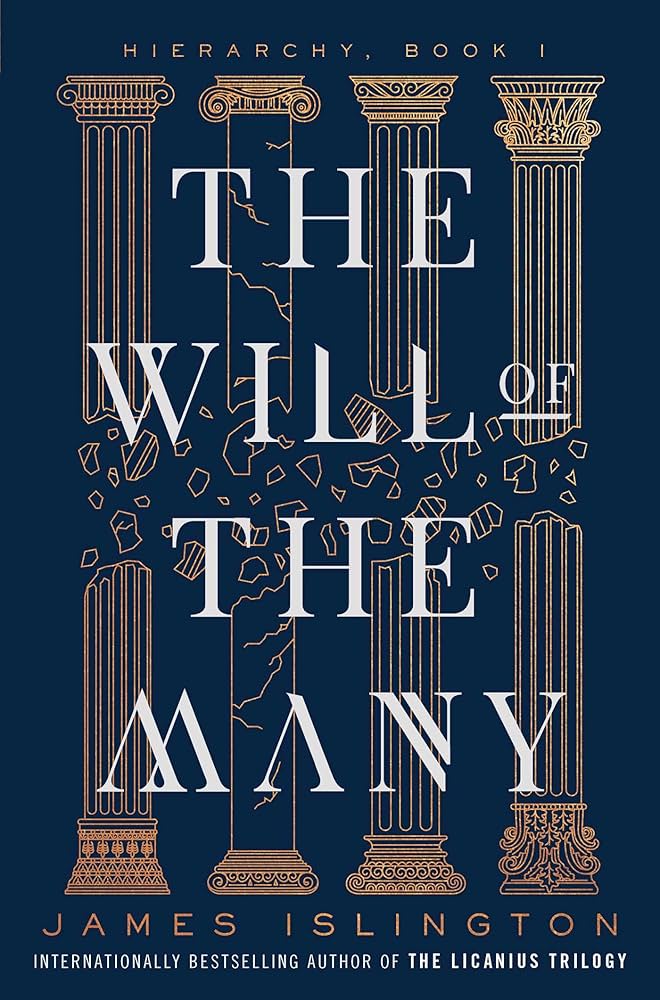
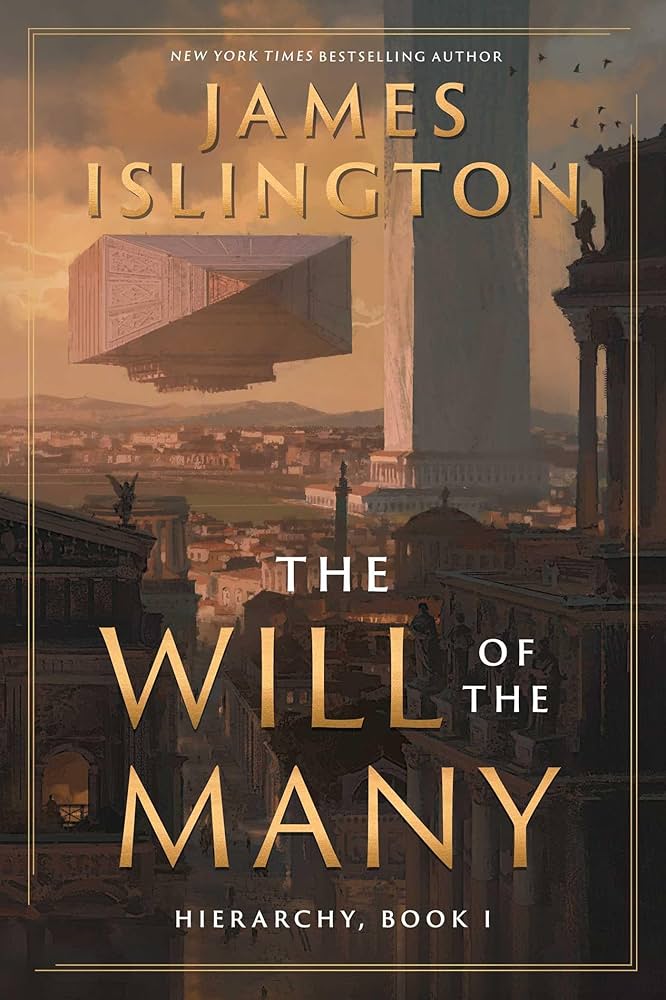
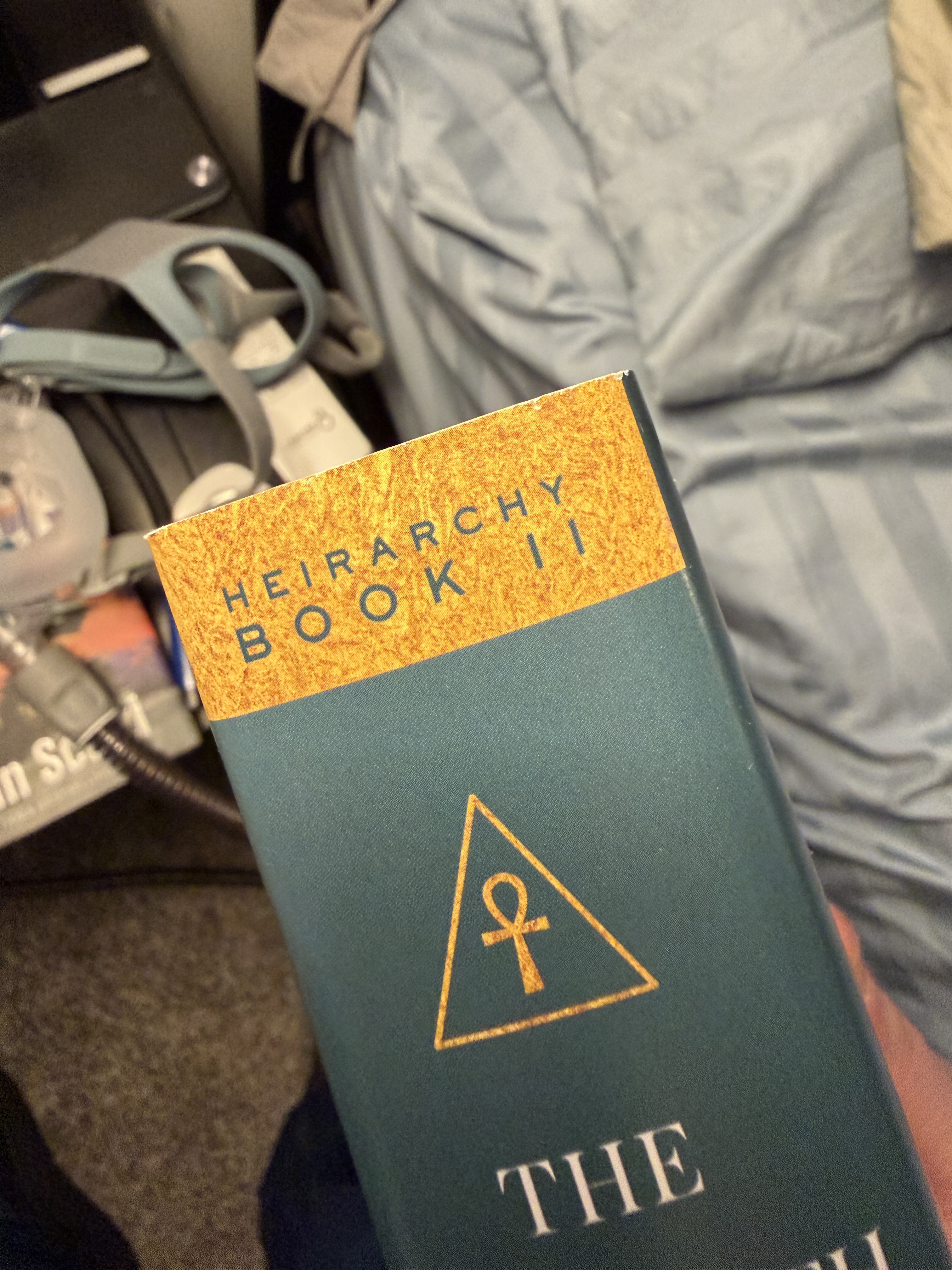
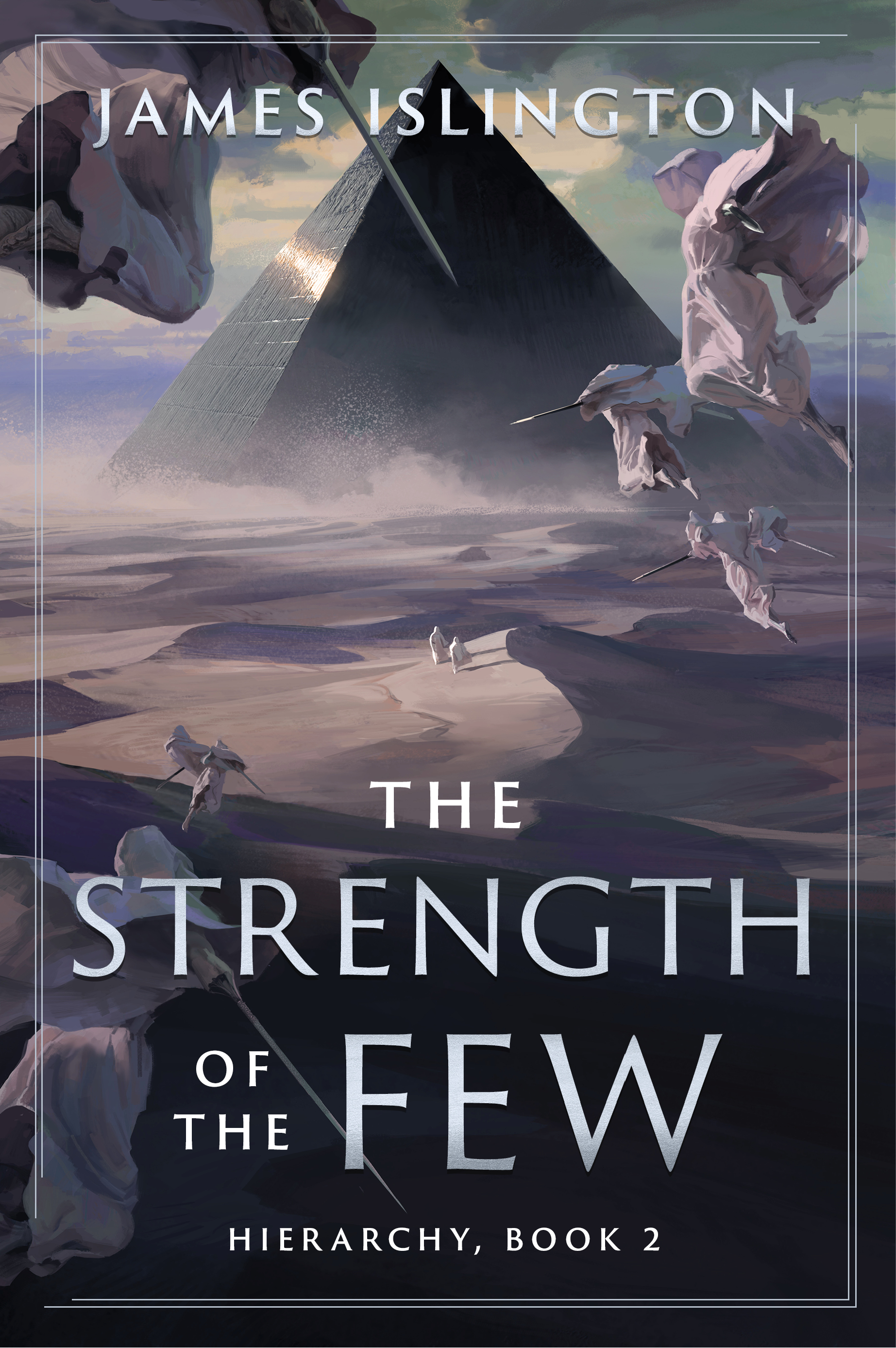
The original coverThe new coverThe “are you fucking kidding me” cover of the sequelThe main cover of the sequel
I make bad decisions, guys, and it seems like James Islington’s books are just absolutely committed to proving that at their every opportunity.
Islington has written, to my knowledge, five books. I own six of his books. I have read three and a quarter of them. I have liked one of them. I bought and read The Shadow of What Was Lost, the first book of his Licanius trilogy, three years ago. I did not like it very much, but the book as a physical object was remarkable, and I bought the entire trilogy before finishing the first book. I made it, if I remember correctly, less than 25% of the way through the second book before deciding I was done and putting it away. Other than placing it on the shelf and perhaps moving it to a different shelf once or twice, I have barely touched the third book and have never opened it.
Somehow, this did not prevent me from buying The Will of the Many when it came out– and I bought the original cover, the one with the columns up there. I read it and quite liked it– the world building was a little shallow, and the plot not especially unique; every “brilliant young person goes to a Special School” book is gonna have some major similarities, but the Rome-inflected world was at least interesting if, again, not very deeply thought-out, but whatever.
Then I started seeing the book on shelves with a whole new cover. You know this about me; I like my shit to look nice and clean, and midseries changes to covers annoy me tremendously, and I didn’t want to buy a second copy of the first book just to match the second on the shelf.
And then they made an announcement that all copies of The Strength of the Few would have reversible covers, one to match each version of the original cover! My understanding is that Islington himself was behind that decision, which I both support and tremendously appreciate. My man knows his audience! Good on you.
The fucking word “Hierarchy,” the title of the series, was spelled wrong on the spine.
I swore– a lot– and then said “Fuck it, this is why I have a job” and bought a new copy of the first book so that it would match. I cannot display a fucking spelling error on my bookshelves. Unimaginable.
(Right about here is where I’m going to stop reviewing myself and start reviewing the books, btdubs.)
I decided that since I was getting a new copy of the book anyway, I’d reread Will before diving into Strength. This, I feel, was the right move. I read so much that most of the time I have read literally hundreds of books in between any given book and its sequel, which means that I frequently don’t enjoy sequels as much as I should because I simply don’t recall the first book as well as I should. And I’d already had one Islington series go sour on me, and I didn’t want it to happen again.
The Will of the Many was an excellent read the second time through as well. It’s a genuinely good book. I stand behind it.
The Strength of the Few … was not. I’ve got it three-starred on the various book services right now and I genuinely might move it down to two. And the most frustrating thing is that a lot of the problems with Licanius are showing themselves again in Hierarchy. It was okay that there wasn’t a whole lot of clarity about how the wider world worked in Will, because the main character was confined to this little school on a tiny island and wasn’t really interacting with the wider world, so when you’ve split the … government? into Religion, Governance and Military and not really defined what it means to be “in Religion”, or when you have a couple of characters who are in the Senate, because this world is based on Rome somehow so there has to be one of those, but haven’t actually really said what the Senate is for, you can get away with it. But you’ve got to broaden that scope out in any sequel, especially when you end Book One, which was mostly a hunt for What Really Happened to the MC’s adoptive father’s brother, by splitting the entire universe into three parallel planes. At that point, I would like to understand how all this works. The main character exists in all three worlds in book two, only at least two of the three versions of him don’t know that he’s in all three worlds, and one of them is Egypt-except-not, and one of them is, bewilderingly, Wales-except-not.(*)
It means that the world you’ve learned about in the first book is only a third of the second book, and the other two worlds genuinely aren’t very interesting (not-Egypt is better than not-Wales, but not by much) and that’s before he starts sidelining and/or killing every interesting female character in the first book, and it’s also before you hit the No One You Thought Was Dead Is Still Dead part of the book, which is just fucking annoying.
There’s also a form of magic called Will, and an interesting setup in not-Rome where society has organized itself into pyramids where everyone pledges part of their Will to the people above them, and Will does stuff but it’s not entirely clear that Islington has figured out the parameters of what it can do, nor is it clear to me why holding someone’s hand and saying “I cede you my Will,” or whatever the code phrase is, lets them take part of your life essence away from you. It’s rigorously codified without actually making a whole lot of sense, which is not a great combination. I feel like if you poked the whole system too hard it would collapse.
(Even the school the MC attends in the first book was … kinda sketchy, as far as the worldbuilding goes. It’s also organized into tiers, and the MC moves from seventh tier to third over the course of a single semester, but everybody seems to be the same age and it’s not at all clear how often or even whether anyone graduates, or how long they’re supposed to be there, or really even what they’re studying; dude mentions that his classes are getting harder a few times but never really says why, and nothing is ever difficult for him, really.)
I damn near DNFed the second James Islington Series Volume II in a row, is what I’m saying here. It’s just not nearly as good as the first book, and again, much like the first series, I feel like the central conflict is not well defined here. The first book was a pretty straightforward “find out what happened to this guy” thing, and it got more complicated than that but that was basically what was going on. Now there’s a Cataclysm every three hundred years (what happens during a Cataclysm? Bad stuff, but … don’t ask what kind! People die, alright?(**) It’s bad!) and apparently we’re going to stop it somehow, I guess, and something something worlds got split up, and …
<spits>
Blech.
Again, I’m an idiot, so I’ll probably pick up the third volume when it comes out (I hope there are only planned to be three, but who knows) just for completeness’ sake, because it would really piss me off to have two copies of the first book, one of the second, and not have the third) but I think I probably have to be done with this guy after that unless everything really turns around.
(*) This got me thinking about how Rome and Alexandria, two massively different cultures, are only 1200 miles apart. That’s about the distance from northern Indiana to Houston.)
(**) The phrase “all right,” which is two words, not one, and I will let you get away with “alright” in dialogue but not much else, is misspelled every single time it appears in both books. I hate it.
Really, the phrase “bisexual nun” was all I needed.
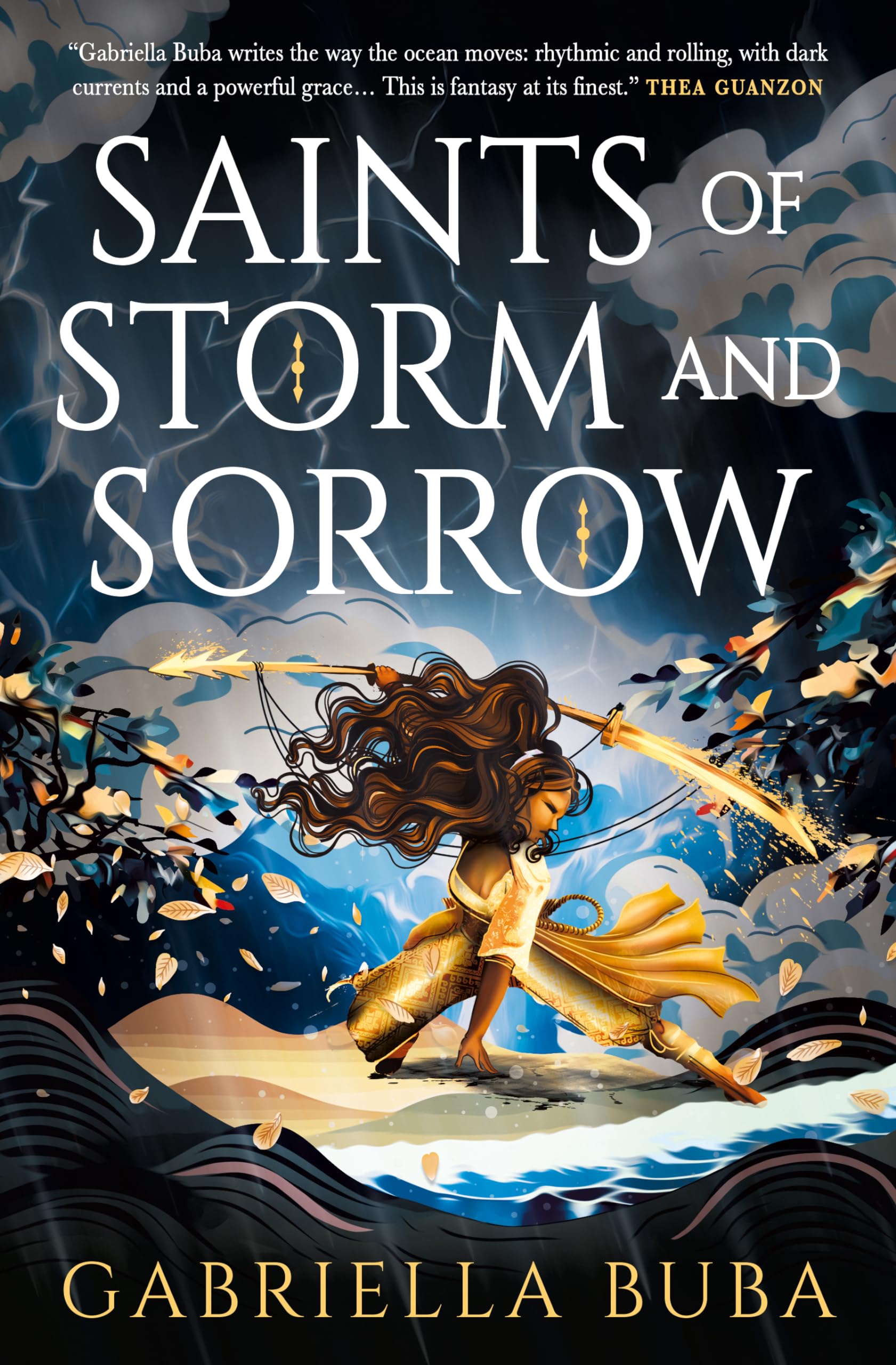
Here’s the thing about Gabriella Buba’s Saints of Storm and Sorrow: it’s one of those books where a lot of what I have to say about it is negative, but I’ve already pre-ordered the sequel, out this summer, and I’m genuinely looking forward to reading it. I lost some sleep to reading this book, and several times I had to force myself to put it down at the end of the night to go to bed. There’s something compelling and propulsive about Buba’s writing that ended up outweighing some of the things about this book that didn’t make sense or didn’t quite work, and I guess I just need you to keep that in mind while you’re reading this, because I want to talk about the weird stuff. I ended up four-starring this, but in a different mood I could have been talked into a three, and for most of the first half it was going to be a five. So one way or another it’s kind of all over the place, but the tl;dr to this whole post is that the book is well worth the time to read it even if there are some issues.
So here’s the thing. The main character, Lunurin, is a nun. She is also a priestess, quite possibly against her will, of a storm goddess called Aman Sinaya. Now, when I first read this in whatever blurb or online review I saw that caused me to order this, along with the phrase “bisexual nun” and the phrase “Filipino-inspired,” I assumed that this meant that this book wasn’t set on Earth.
And … technically, it isn’t? But it totally is. Lunurin is a Catholic nun. The bad guys are the Spaniards. They speak Spanish. They’re in the Philippines. I’m pretty sure the word “Catholic” never shows up, but … there is no attempt to be subtle here. Lunurin and her female love interest are both Catholic nuns, biracial and despised for being so, in a colonial atmosphere that is more or less identical to the Spaniards colonizing the Philippines. (Do you know any Filipinos? Ever notice how they all have Hispanic-sounding last names? There’s a reason for that.) And the book wants to get into the syncretism that happened whenever Catholicism ran into indigenous religion, which is a fascinating and complex subject, but if the colonized people can literally call down typhoons while being literally possessed by their gods, and Jesus … doesn’t do any of that? It kind of wreaks havoc on your worldbuilding. Christianity toppled, say, Norse religion, sure. But you know who the Norse didn’t have? Actual fucking Thor. And Lunurin can call down lightning by letting her hair down. And everyone just acts like Christianity is a reasonable alternative to that, just because the priests say so?
Nah.
I would kind of love for a book where Christian missionaries run into a religion that literally grants powers to its priesthood, but this isn’t that book and that’s not the story that Buba is interested in telling. She wants to start a book that is already past the colonization phase and so that’s what she gives us, and it’s not exactly the book’s fault that it sent my brain down all sorts of other pathways once I realized what was going on. There’s something to be said about having trouble accepting the basic premise, of course, but I’m a lifelong fantasy/sci-fi reader and suspending disbelief is something I’m good at. But I’m not going to pretend it wasn’t an issue.
Let’s see, what else? This is something that’s going to get fleshed out better in the sequels, I’m sure, but I never quite understood the relationships between any of the main characters. Two of them end up married, and I’m not sure either of them wanted it except one of them kinda did and the other sort of shrugs and rolls with it, and the nun female love interest is an absolute mess of a character, which is yet another complaint that may or may not represent a problem with the book. Messy people exist! But holy shit is Catalina a mess. She’s inconsistent, jealous and a religious fanatic (nun, remember) and there’s also a healthy degree of self-loathing going on as well as some internalized racial hatred, and … she’s realistic, in a lot of ways, I think, maybe? But that doesn’t automatically make her fun to read about.
There are a couple of explicit sex scenes that tonally really do not match the rest of the book, too, so be aware of that. This is not a romantasy by any stretch of the imagination, and I let that fool me into thinking that at no point would glistening cocks be involved. Or, well, one cock that glistens at least once. And, again, I’m not convinced that the people fucking actually like each other, or whether they’re trying to play each other, and it’s okay for the characters to not know each other’s motivations, and it’s okay for the characters to be inconsistent in their motivations, but I definitely don’t get them and I’m not convinced the author did either. The problem is that in this particular scenario complicated characters come off exactly the same as characters with no actual arc and no planning, and I genuinely can’t tell which one this is.
So yeah. Again, I’ve bought the sequel. Lunurin’s relationship with her actual goddess– as opposed to Jesus, who doesn’t seem to be real and doesn’t occupy a lot of her time despite the nunnery going on– is fascinating, and again, she doesn’t appear to like her very much, and while I have my problems with the setting as it currently exists, it’s got its positives just out of sheer originality. It may be that I’ll read book two and tap out for what I’m presuming will be a third book in the future (this may be a duology, I’m not sure) or I might shift into full-throated approval. We’ll see. But I’m giving this one a thumbs-up regardless, now that you’ve read all the caveats and quid pro quos and such.
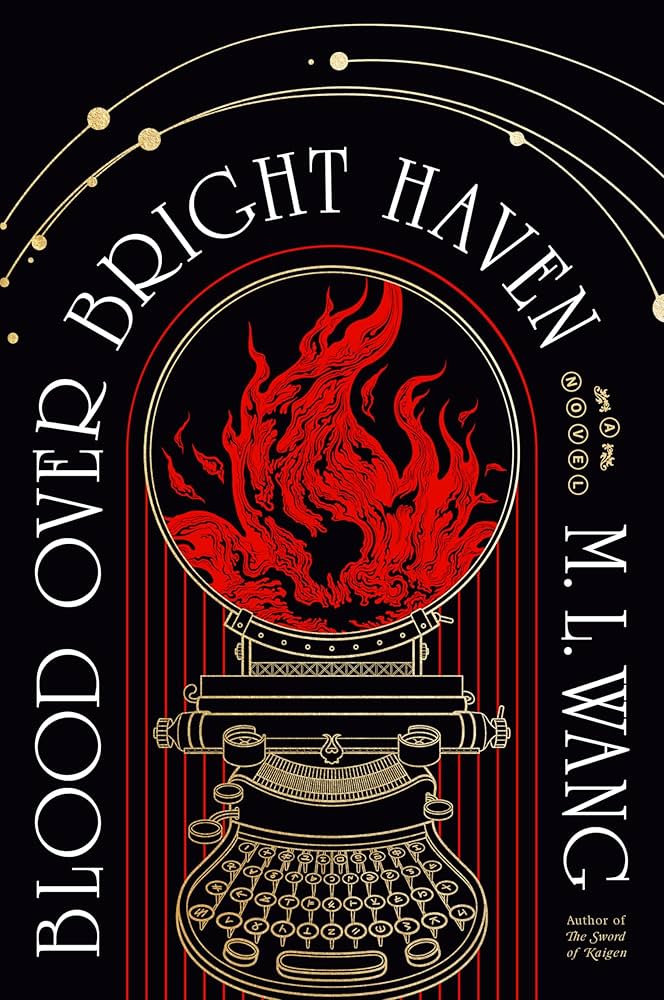
I discovered the work of M.L. Wang through BookTok, which is, by and large, convinced that her The Sword of Kaigen is one of the best books ever written. I read that one first, and … it’s not one of the best books ever written, not by a long shot, but it was good enough to get me to pick Blood over Bright Haven up and then take several months to get around to reading it. I didn’t start off well with this book either; by pure coincidence it shares a lot of plot points with Ava Reid’s A Study in Drowning, which I read immediately before it, and starting a second book in a row where the main character was a trailblazing female academic in a field where no one wanted her around and who cried all the time was a bit jarring even before it turned out that, somehow, in both books the fact that said main character was a huge fucking racist was a big plot point. Now, this is fantasy racism, which doesn’t make it a lot better,(*) mind you, but it’s a big theme of both books, so be prepared for that. Also, while we’re talking about things that might be in a content warning, Drowning has a character who is a rape survivor (although, creepily, the act in question comes off as consensual the first time it’s described) and there’s a rape attempt in Blood.
A Study in Drowning was not a great book– serviceable, but not much more– and it kind of poisoned me against Blood over Bright Haven for the first third or so. I nearly put it down. I’m glad I didn’t.
For starters, and I don’t want to get too deep into spoilers, because you deserve to experience this at the book’s pace, Sciona is very much not the main character of Blood over Bright Haven, even though it will seem like she is for most of the book.
Second, Blood over Bright Haven is one of the angriest books I’ve ever read, up there with Yellowface and Iron Widow,(**) although, again, you spend enough time in Sciona’s head that you might not realize how angry the book is at first. This is a deliberate misdirect on the part of the author and in retrospect it’s tremendously effective at prepping you for the big twist midway through the book. A bit of background: Sciona starts the book off by being named a Highmage of her home city-state of Tiran, an office that no woman has ever held before. This happens quickly; another weird similarity it has to Drowning, come to think of it; you get yourself mentally ready for her to take half the book to become a highmage and it’s, like, a chapter. Magic in this book is fascinatingly mathematical and complicated and meaty, it’s more like writing equations or geometric proofs than what for lack of a better word I’ll call “traditional” spell casting, although it’s not as explicitly mathematical as, say, To Shape a Dragon’s Breath.
Anyway, for our purposes the salient part of writing a spell is that you have to determine where the spell gets its energy from, and how much energy it might take to pull off any given magical effect. If you pull too little you’ll get partial results and if you pull too much, something is probably going to explode. Sciona is a prodigy at mapping, which is the process of figuring out where magical energy sources are and how to pull from them, and she gets put on a huge project involving pushing back the magical wall that surrounds the city, a huge … public works project, which isn’t quite what you might expect from a fantasy book but that really is what’s going on here.
Also, spells are written on magical typewriters, which is just super fucking cool.
Anyway, blah blah blah class conflict blah blah blah sexism blah blah blah plot development and then she figures out where the sources of her magic are really being pulled from, and I’m not telling you anything else, because you deserve to experience this on your own, and probably by this point if you’re like me you’ve decided you don’t like Sciona all that much. Unlikable MCs are tricky, right? First of all, you often can’t be sure if the author realizes they’ve written an unlikable main character, or if it’s just your reaction to that person (I call this “Lana Lang syndrome”) and also because the author wants you to keep reading, which can be a hard sell if you don’t like living in the head of the person you’re reading about.
I’m just going to say that it was clear quickly that M.L. Wang knew exactly what she was doing here, and that Sciona’s personality flaws are clearly intentional and are also pretty essential to the book unfolding the way it does. She has a great conversation (well, fight) with a relative late in the book where the relative just rips her to shreds and every word she says about her is true and I just kind of read it in awe of how fully in control of her characters Wang was.
Also, and I’m not going to go into details because, again, I want as few spoilers as possible, but reading this book on Thanksgiving lent the whole book a really interesting synchronicity with actual life. You’ll understand when you read it.
And, yeah, I’m about to end the second review in a row with the phrase “one of the best books of the year,” and a wish that M.L. Wang’s many fans on BookTok and elsewhere would realize which of her tradpubbed books (she has several that she published herself, and this and Kaigen were both originally indie titles) is clearly the superior one, because this book deserves the press and attention that The Sword of Kaigen has gotten. Go read it.
(*) The sole physical characteristic that the Kwen characters are given is “copper hair,” and I’m still unclear what precisely the difference between copper and red hair is, but you could take this as evidence that the despised minority in this book are white people, which is an interesting choice that ultimately doesn’t end up mattering very much since this is very much a Not Earth book.
(**) The fact that all three of the authors here are Asian women is a coincidence. It’s an interesting coincidence, but a coincidence nonetheless.
This is not a review of Everina Maxwell’s Winter’s Orbit, or at least I don’t intend to tag it as one. That said, it’s as close as I’m going to come, and you’ll have a pretty good idea of what I thought about the book by the time I’m done writing anyway. And we should definitely take a moment and stare at that outstanding cover, which is the best thing about the book.
Also, note that the two silhouettes at the top are both pretty gender-neutral, as that’s gonna be a thing.
Let’s talk for a second about how we assign gender to people we haven’t met. Typically this is a thing that happens so fast as to be nearly automatic, to the point where if we aren’t able to immediately assign someone to “male” or “female” it’s immediately noticeable and, for a lot of people quite stressful. (I’m leaving the discussion of whether that’s okay aside, for the record.) But here’s what we do: a quick visual scan for secondary sexual characteristics, right? Prominent breasts, facial hair, hips, then things like clothes and hair length, and sometimes we’re in situations where one thing will trump another. I can’t be the only guy in the world who used to have long hair and has been addressed as “ma’am” by someone behind me who hadn’t seen my face yet, and not one of those people didn’t immediately change their mind and get apologetic the second I turned around and they saw my beard. Never-not-once did anyone think “Wow, that lady has a beard!” Similarly, as a fat guy, while I’m not exactly proud of this, the fact is I’ve dated women with smaller breasts than me. Nobody’s ever looked at my chest and decided I was a woman.
Transgender and nonbinary people have become a lot more broadly socially accepted in the last few years, and the notion of asking people what their pronouns are (or explicitly noting them in, say, an email signature, or a sticker on a name badge) has become something that people are much more likely to do now. This is what happens when those secondary sexual characteristics fail us; sometimes we misgender people, and people making their pronouns clear from the jump has become a good way to avoid making that mistake. There’s still no good way to visually identify someone as nonbinary, though, because people who are nonbinary may still initially scan as feminine or masculine (and people who do present as ambiguous aren’t always nonbinary) so if someone uses they/them as their pronouns (or anything, really, other than he/him/she/her) there’s no immediate way to find that out other than asking, if the person doesn’t do something to make it clear to other people.
In my Benevolence Archives, elves are nonbinary, to the point where displaying visible secondary sex characteristics is viewed as a birth defect. Elves use xe/xir as pronouns, and everyone just knows that, because that’s how elves work. How do elves reproduce? Dunno, I haven’t decided yet. But I decided early on in building the universe that each of the major races would approach gender roles and gender differences a little differently as a culture. For elves, it’s irrelevant. Other cultures range from dwarves, which are a strict matriarchy, to the strict patriarchy of the ogres, to the slightly softer gender role differences of gnomes and humans.
One more side path, and then I’ll circle back to Winter’s Orbit. Feel free to pop over to this post about Sarah Gailey’s novella Taste of Marrow real quick. In short, my main issue with Gailey’s book was one character, named Hero, who uses they/them pronouns, and it becomes very clear over the course of reading the book that Hero is not so much a character as a little game that Gailey is playing with their (Gailey also uses they/them pronouns, although I don’t think they were doing that when Marrow came out, which makes me wonder if I should go back and edit it) readers. Hero is never physically described at all, either by their clothing or their body, and Gailey goes so far as to make sure that Hero never has to talk to anyone other than the core group of characters so that there is never a situation where someone might meet them and guess at their gender. Making things somewhat more annoying is that the book is set 100 or so years ago, making everyone’s open acceptance of whatever is actually going on there slightly less realistic than the central story tenet of the book, which is cowboys riding hippos.
I’m happy to read books with trans or nonbinary characters. And this isn’t so much a complaint about “I don’t know what’s in this person’s pants!” as I have no idea at all what this character might look like, and that’s annoying. Give us something! Nonbinary characters shouldn’t be in your book just so that you can have one character that your audience is endlessly digging for clues about just to figure out how to picture them.
(This can be tricky, of course, and I’ve also read books that made sure you knew characters were trans by doing things like having scenes where a trans woman character more or less loudly announces I SHALL NOW GO URINATE WITH MY PENIS IN THE LADIES’ ROOM, which also sucks because it’s character development via bludgeon. I have a minor side character in BA who I have known was gay since the jump but it’s never made it on the page because I’ve not been able to come up with a way to make it not sound forced in. But that’s a separate conversation.)
So. This book.
Winter’s Orbit began in a way that caught my attention immediately. The book begins with the Emperor (note: male form of the word) summoning her grandson and commanding him to marry a man whose husband has just died, because it is essential that this bond of marriage between the two families be maintained. In going over the grandson’s qualifications for said marriage, he is described as “not gender-exclusive.”
As first five pages go … yeah, my attention was captured pretty quickly. And finding out a few pages later that the two main cultures in this book both identify gender by, effectively, clothing accessories was, if nothing else, not something I’d seen before. One planet, if I’m remembering correctly, identifies men with wooden jewelry and women with crystal jewelry, and if you’re not wearing either you’re nonbinary and use they/them. The other planet apparently uses knots in scarves as a gender identifier, to the point where one character doesn’t recognize a knot and has to be corrected by another when he misgenders someone.
At one point the main character is asked about his ancestry, and he names two “primaries,” and then says for the rest of his genetic mixture the person asking would have to go check his records, so while this is the only detail we get about childbearing (and there are no children whatsoever in the book) one can assume that giving birth is no longer something that half the population is expected to do.
You may already see my problem. In this book, use of “he” or “she” tells you absolutely nothing about what someone looks like, and not only that, there’s not any correlation between gender and societal role– the Emperor and at least one general are both “she,” for example, and suddenly “not gender-exclusive” makes more sense than “bisexual” might have, because in this world there’s no connection at all, as far as I can tell, between someone’s body and their gender. So this book is getting a lot of attention for gay representation, but there’s actually nothing to let us know that Kiem and Jainan both have penises, or more to the point, since they both identify as male, that there’s any concept of homosexuality that can be mapped to this world in the first place. In fact, having read the book, I think there are a couple of hints that Jainan has XX chromosomes and a body we’d call a woman’s; he is described several times as smaller than Kiem, has long hair, and– more telling– there is a scene where he takes his shirt off in front of Kiem and Kiem turns around to give him privacy, which seems slightly unlikely if there aren’t female-presenting breasts under that shirt.
The book explicitly talks about their skin color– both are shades of brown, with one darker than the other– and Jainan’s long hair comes up a couple of times, but other than that they are given no physical description at all. They actually have sex at one point in the book without the author giving any details about what they’re actually doing. I don’t expect this book, which is YA, to flirt with being porn or anything like that, but … come on.
For that matter, if you’re going to posit a world where physical characteristics don’t tell you anything about a person’s gender, relegating those to external pieces of jewelry or knots in scarves, for crying out loud, and where different genders don’t have any particular societal role … why are we still bothering in the first place? What, precisely, makes Kiem a “he” other than that the author is calling him that? What does “he” or “she” even mean in this world? Can Kiem change jewelry tomorrow and expect people to start calling him “she”? Is there any societal weight at all to one’s choice of gender? How does nonbinary even make sense as an option when your gender doesn’t actually, like, do anything? In our society, saying that you don’t buy into the male/female dichotomy has some implications. In a world where gender is meaningless, what does nonbinary mean?
How do you tell someone’s gender if that person is naked?
Do people with uteruses still get pregnant? Clearly this one character has tons of different contributors to his genetic makeup, but he’s royalty; is that true for commoners as well? If we’re still doing political marriages, does viability for producing offspring matter, or can any two people create a child?
The book gets into none of this, which I find immensely frustrating, because frankly the implications of this simple decision about how gender works are the single most interesting thing about the book to me. And that’s a damn shame, because if you’re going to make fiddling with gender a part of your worldbuilding, you owe it to your readers to explore the implications of what you’ve decided to do. And that’s before we have to carefully avoid giving any useful description of anyone in the book– it goes without saying that no one ever has facial hair, for example– so that your setup can even work.
I don’t think it’s asking for much to expect authors to put as much thought into their worldbuilding as the reader will within the first fifteen pages. I dunno; this piece is 1800 words or so long so maybe I’m displaying some sort of hangup on my part, but c’mon. Do better.
Start with what sounds like a promising premise. No, really– I’ll not like your book more if I originally thought I was going to enjoy it, and I have to start reading your book before I can realize how bad it is. So you actually need to do something cool with at least the basic setting of your book to get me to pick it up in the first place. Don’t worry– I like lots of different kinds of things, so “interesting setting” isn’t actually that high of a bar to clear. Alternatively, have someone I like and/or respect recommend your book, or even just catch me in the right mood and I’ll start reading.
Once you’ve got your basic setting, don’t do any more thinking about it at all. It may be that bits of your setting don’t quite make basic sense. That’s okay! People who like for their fantasy books to hang together coherently are few and far between, and besides, why would you want to overthink things? Just say whatever you want. So long as it’s badass, it’s okay, right?
Women don’t read books, and neither do men who like women, so there’s no reason to pay any attention to your female characters, make them realistic, or really use them as anything other than sex objects and/or punching bags. Sometimes at the same time!
Rape is Realistic, which means it’s okay to have it in your book all the goddamn time. Pay no attention to the part where “realism” is not demanded in any other aspect of your writing. Women Back Then had to worry about being raped, so the male characters in your book should all be rapists and the women should all worry about rape all the time– unless they’re sluts, in which case it’s impossible to rape them anyway.
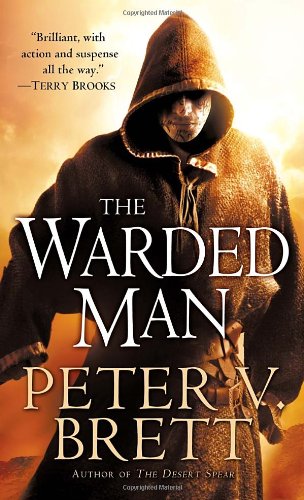
Ladies and gentlemen, let’s list the sins of Peter V. Brett’s The Warded Man:
It’s actually pretty well-written on a sentence-by-sentence, paragraph-by-paragraph level. This actually ends up being critical to getting me to hate it, because had it been poorly written in addition to being crap (let’s assume for the sake of argument that we can actually treat these as being separate characteristics) I would have abandoned it much earlier and thus it would not have had the chance to piss me off as much as it did.
The setting is thus: There are demons in the world, called Corelings, and they come up out of the ground every night to wreak havoc on the world and Kill All Humans! The world is thus very dangerous to everyone, and human society is more or less on the brink of extinction. The Corelings are winning, in other words. The sun drives them off, so daytime is safe, but being outside after dark is basically fatal. Corelings can be driven away by use of a set of magical symbols called Wards, but Wards can be fragile (step on one, and it loses its magic, for example) and making them correctly is difficult. This is actually a decently intriguing setup for a novel and got me about halfway through the book. However?
He didn’t put a single damn second of thought into it beyond that. You know what every human habitation would have if the world worked like this? Walls. You’d build the walls before you put buildings inside them, and you’d carve your wards into something as permanent as possible and put them on the walls. Portable rope-and-board warding circles exist, so if you were trying to build a settlement at Point B you could put most of the wall together at Point A and then transport it so that you could get them set up quickly.
Clothing would have wards on it– if wards couldn’t be worked into cloth for some reason, people would be wearing more permanent garments– helmets, for example, or maybe bracers of some kind– that could have wards carved into them. The author appears to have never thought of this idea, which I started wondering about maybe twenty pages into the book. The idea’s really obvious, honestly; you’d think he’d at least have had a sentence or two where he explained why this can’t work.
Corelings can’t rise through worked stone. This would tend to suggest that most towns at least have a central area with cobblestones so someplace is safe from them. They don’t.
“Hey, what about tattoos?” you might be thinking right about now, having learned about this scenario two minutes ago. It apparently took hundreds of years of being constantly killed by these things before one of the main characters comes up with the idea of actually tattooing a ward onto himself. Which not only works, but turns him into a demon-fighting ninja straight out of a Rob Liefeld comic book from 1995. And a thoroughly dislikeable one, too, even though previously he was an interesting character. Sadly, HIS PARENTS ARE DEAD!!! which means he smolders with generic rage.
In addition to the defensive wards (one of which, by the way, inexplicably hardens glass to be like steel, even though every other ward does something to demons) there are offensive wards that you can put on weapons to help you fight demons; otherwise, they’re basically invulnerable. They were lost, though– all of them, so long ago that many people don’t believe they existed, even though none of the defensive wards were lost. This is both possible and makes sense… somehow. Until the main character finds a spear in a tomb, cracks the wards, pledges to start making weapons with those wards for everyone, and then… just doesn’t, for some reason, in favor of becoming Tattooed Demon Batman.
There are three main characters. One is Tattooed Demon Batman. The other is boring. The third is a girl, with big tits, who spends the entire book avoiding rapists– like, literally, at one point she surreptitiously doses a guy’s food with some sort of impotence drug because she’s traveling with him (not a lot of room in a tent inside a portable ward ring) and she knows he’s going to rape her. He’s real open about it– if she needs his help, she’s giving up some nappy dugout. Charmingly, after spending the entire night trying to fuck her and being unable to get it up, he tells her he’ll kill her if she tells anyone about it. This doesn’t stop her from considering asking him to help her again later on in the book.
With about a hundred pages left, she’s brutally gangraped. For no fucking reason at all other than apparently Peter Brett figured something awful needed to happen to her. Did I mention she was a virgin? Because of course she was.
Ten pages after that (maybe not exactly, but close enough) she fucks Tattooed Demon Batman, who she’s just met, because that’s what rape victims do. Tattooed Demon Batman and Other Boring Dude kill two of the three rapists by stealing their warding circle (roll with it) but the book makes sure to mention that the big scary one of the three rapists doesn’t appear to be among the bodies.
Throw in several chapters of slut-shaming, too, and three mothers– one a cheating, emasculating harridan and two whose purposes in the narrative are to die horribly so that their sons can feel bad about it. The only semi-positive female character is a Wise Old Crone. No, really, I’m serious.
This book fucking sucked and you should not read it, and Peter V. Brett should feel bad for having written it. The worst bit is that I could easily keep complaining for another thousand words but the boy just woke up so I have to go.

 Welcome to infinitefreetime dot com