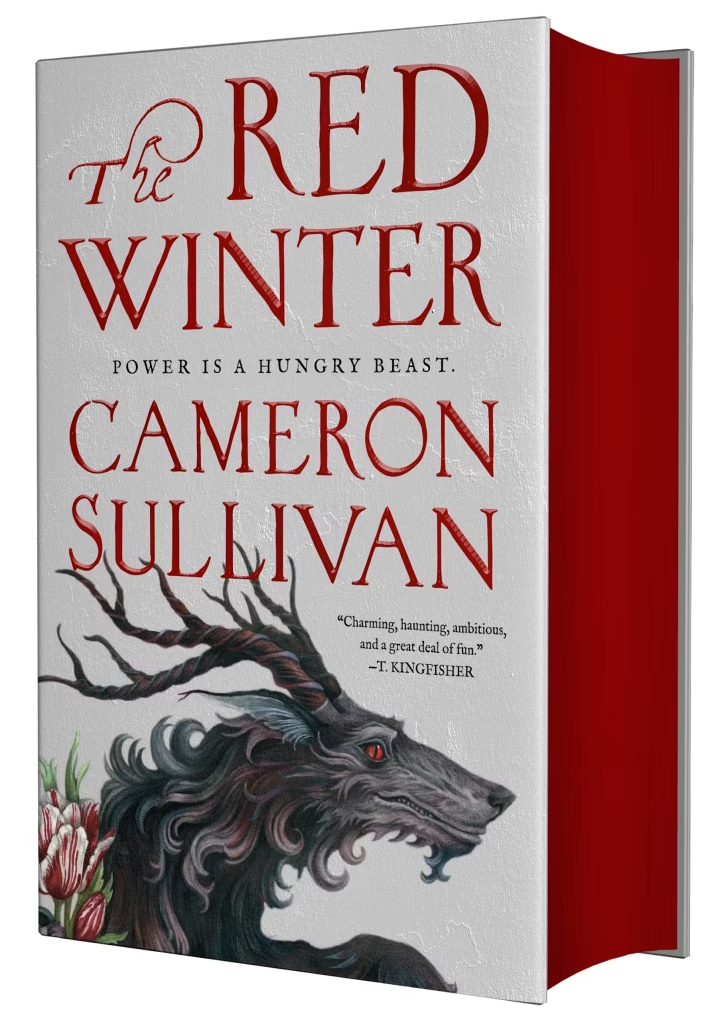
I feel like I haven’t started a review with “Man, look at that awesome cover” in a while, but look at that awesome cover.
I had planned to review an entirely different book tonight, and I have a couple of movies to talk about as well, and I can already tell I’m going to have to review the book I’m reading now, and tomorrow and Saturday already have the traditional first-and-last-of-the-month book posts planned, so expect a flurry of review talk around here for the next few days. I picked this up last night specifically because I thought I could finish it by the end of the month; I was once again taken by surprise by an Aardvark book, basically not putting it down other than for sleep until I finished it, and at just over 300 pages, it’s a quick read.
Did you see Get Out? You should have. I don’t appear to have reviewed it here, but it’s a great movie.
Imagine that Get Out was a book.
(If it was a book, tell me, because I didn’t know that and I want to read it.)
Imagine that Get Out was more about feminism than racism.
Now imagine that Get Out was about feminism and set in a fictional Black free town in Mississippi in 1927, just a few years after the massacres that destroyed the Black communities in Rosewood, Florida and Tulsa, Oklahoma.
And buckle the fuck in, because this one is a hell of a ride, with a fantastic twist toward the end– hell, a couple of them– and I don’t know what the hell is going on with July right now, because I’ve had too many DNFs and too many six-star reads for a single month. I’m not even gonna give you any details beyond the setting. Go in blind. Just trust me. And damn, somebody shove Jasmine Holmes a huge pile of money and make a movie out of this. Jordan Peele? You out there? This is your next project.
Every time I say this, I expect to get some pushback from someone, and I never do: World War I was a war that was fought for absolutely no reason at all, and every single person who died in it died for nothing. World War II is widely regarded as The Last Good War; its predecessor may have been the most wanton waste of human life I’m aware of. It was fought at a time where the technology to kill people far outstripped the technology to defend them, and every single thing about it was horrible.
Daniel Kraus, author of Whalefall, has written a book about World War I, where a group of American soldiers discover an angel dying in the mud in no-man’s-land between American and German positions. I read Whalefall when it came out in 2024, and I was surprised just now to discover that I five-starred it when I read it; my memories of it are not especially positive and I was expecting to discover I hadn’t liked it very much. I almost didn’t pick this book up, and then it won a Pulitzer, and FOMO kicked in, and to hell with it, it was cheap.
But I didn’t almost not buy it because I didn’t like Whalefall. I almost didn’t buy it because the book is structured as a single sentence, 304 pages long.
And the thing is, call me a philistine if you want, I’m generally not fond of people who try to fuck with structure too much in books. I like my narratives straightforward and my narrators reliable. I like dialogue to have quotation marks around it. I like all the text in a book pointed the same way. And I like sentences and paragraphs to be reasonable in length. I like a good long sentence once in a while, anyone who has read me for more than a few days knows that; 304 pages is Too Long.
So here’s the good news: if you have avoided this book because of the single-sentence thing, it’s absolutely a gimmick, and it’s almost unworthy of the book, to be honest. Here’s a randomly-chosen two-page spread:
You will note that there are, if not precisely paragraph breaks, certainly gaps between clauses that serve as such, and note the image break in the top left as well. The book also has chapters. Now, you’ll also notice that every paragraph starts with “and,” which you should expect to see a lot of, and all of those “paragraphs” end with commas, so technically this is all one sentence, or at least part of it.
But, c’mon. One of the reasons for paragraph and sentence breaks is to give the eye a place to rest, and the commas do that perfectly well. You will not notice, as you’re reading, that this book is one long sentence.
You will also notice that it never slows down, and it never lets up, but that’s more a function of the writing than the structure. Kraus could have sprinkled periods at reasonable places throughout this text without changing a single word and the character of the narrative itself would not have changed one whit. And, honestly, read those few paragraphs, and you’ll know whether you want to read this or not; follow that instinct.
I will say that I did really enjoy this book– it’s not on my 2026 shortlist, but if there’s going to be a book that sneaks onto my end-of-year list without having been on the shortlist, this will be it; it just depends on how well it sticks with me. It’s a better book than my recollection of Whalefall, certainly, and I suspect if I reread Whalefall tomorrow I would still think so. The sheer hopelessness of the WWI setting and the idea of saving a downed angel was a good enough high concept for a book to begin with, and the voice of the novel is perfectly matched to the setting and the characters. There’s also one other narrative trick in the last part of the book that I’m not going to spoil but which works very well; the book ends perfectly.
Well, sort of. You’ll see when you read it.
I have another Daniel Kraus book on my TBR shelf, one that just came out; he wrote a science fiction novel called The Sixth Nik, which means I’ll have read three of his books and they’ll have been from three wildly different genres. I know he’s got a ton of other books; Nik will determine whether I start seeking out his back catalogue or not.
I had a shingles shot yesterday, because I’m old now, and my doctor warned me that the shingles shot has a higher than average chance of kicking the ass of the person it’s administered to. I wouldn’t say the shot has kicked my ass, but I’m definitely not in the mood for anything today and more than a little dumber than usual. So I’m not writing a real post tonight, but I will tell you that I’ve finished two books and watched two movies in the last few days that, under other circumstances, I might review. If you’re especially interested in my opinion on any of these, let me know, and I’ll move it up in the queue.
(There’s no queue. But if anybody wants a review of any of these, you’ll get it.)
Three of these will be at least mostly positive. One, and you can probably guess which one, will very much not, and since you already know I hated it, I’ll just give you actual reasons.
This had better be the worst thing I read this year.
More on it later, possibly, but I have a terrible movie to watch before I talk about the terrible book. Needless to say, I have no idea who Michael Korda is, but I don’t believe he even read this fucking thing.
I made multiple attempts to acquire this book through physical retail channels– I’m not sure why, but I really wanted to buy it in person– before noticing it was like 60% off or something like that on Amazon and giving up and ordering it, and it shows up with that … thing on the spine. I’m genuinely considering returning it and just reading it on my Kindle, because that’s going to bother me every single time I look at the book for the rest of time.
Maybe I’ll go to Half Price Books tomorrow and see if they have an earlier edition.
This will be brief, as it’s been a stressful day; we had most of the rest of the work done on the bathroom (there are, sadly, still a couple of tasks to finish) and the guys were both an hour and a half late and then took much longer than they anticipated, which means I’ve spent the entire day waiting, and I’m currently chewing my arms off and climbing the walls at the same time.
The Standard Malcolm X Disclaimer: Malcolm is one of my favorite Americans; I nearly named my son after him (I had my wife talked into it and everything, and then we mutually decided to name him after his grandfather instead) and I have most of a shelf of books about him. “This book is about Malcolm X” means that I’m going to read it and unless it is tremendously poorly written, I’m going to enjoy it. It’s kinda baked in from the jump. And this book is certainly not poorly written.
Peter Goldman’s book was the first major biography of Malcolm X, coming out in 1973, with the edition I read dated 1979. I’m honestly surprised I’d never encountered it before, but I read The Afterlife of Malcolm X back in February and it got referenced enough times that I felt compelled as an amateur Malcolm scholar to pick it up.
And it’s a surprisingly solid biography, especially when one considers that it was written by a white guy in the early 1970s. Goldman appears to have had a good relationship with Malcolm and while the book isn’t as heavily footnoted as I might have liked, I didn’t encounter anything that smacked of shoddy historiography. He focuses heavily on the last year of Malcolm’s life, and then — and this is what made me decide to go ahead and write about it — also spends about a fifth of the book talking about the trial of the three men who were eventually convicted and sentenced for the assassination. Now, Afterlife covers that material as well, but that book is more interested in Malcolm as a cultural icon and I don’t think one book substitutes for another. The real interesting bit of the book is the 1979 addendum at the end, where Goldman says that he no longer believes two of the men convicted for the killing had anything to do with it.
I can’t really issue a blanket recommendation for this book, not because it’s bad but because it’s 2026 and there has been a ton written about Malcolm X in the years since he was killed. If you’re only going to read one book about him, you should read The Autobiography of Malcolm X, a book every single American should read anyway. If you want to read a biography, specifically, I’d recommend Manning Marable’s Malcolm X: A Life Of Reinvention or Les and Tamara Payne’s The Dead are Arising: The Life of Malcolm X. If you already read those books and you haven’t read this one? Definitely give it a read.
I finished another really good book today— maybe you can use context clues to figure out what it was!– but I feel like I’ve maybe used up all of my holy shit this was good you have to go read it now reviews for July? Or maybe that’s not a thing, or maybe I ought to just review the two books I DNFed in between this one and There Is No Antimemetics Division. Y’know, to combat the idea that all I do is slobber all over every book I read. I dunno. Are my book reviews too positive? Maybe I’m not trustworthy anymore.
I will say that July has been weird in that it’s featured both more amazingly good books and more DNFs than a typical month does.
Anyway, what else happened today? I spent part of my afternoon clearing out my Literal Physical Inbox, better known as the wire racks on my desk that I dump mail and paperwork into when it is too important to throw away and yet not quite important enough for me to file away immediately. Getting this done was a goal over Winter Break that didn’t happen, and then a goal over Spring Break that didn’t happen, and I swore to myself that I wasn’t getting through July without taking care of it.
I found stuff dated 2022, by the way.
Along the way I uncovered a ton of professional growth paperwork for my license renewal, which isn’t a critical necessity yet– my teaching license doesn’t expire until July of 2028, which means that technically it’s good through the end of the 2028-29 school year, but I figured I’d get a jump on getting the paperwork filed.
About half an hour ago I told my wife I was going to worry about getting it done tomorrow, expecting it to take the whole morning, and then I logged into the license renewal site just to see what I was getting myself into … and I’m done with the paperwork already. It took less than fifteen minutes. I have to wait for them to approve everything, which shouldn’t take more than a couple of days, and then I need to get my CPR certification up to date, and I think after that I can officially apply for my renewal, so in theory this might be done before the school year starts. Tomorrow morning I’ll find a CPR recertification class, which will probably take longer than uploading my paperwork did.
That will square up my teaching license through 2038, a year so far into the future as to be meaningless, and it might be the last time I have to renew my license, as I’ll turn 62 in 2038 and you best believe I’ll be retiring as soon as possible, even assuming that I make it through twelve more fucking years of teaching. That, all by itself, feels completely crazy. Not as crazy as the idea that if I don’t retire in 2038, I’d have to renew through 2048. That year’s not even going to happen. Let’s be real.
I liked this book so much, I’m willing to forgive the author for wanting me to call him QNTM. I don’t know why, but I have a weird visceral reaction to authors using their Internet handles on their books. It’s made even weirder when you remember that “Luther Siler” is a pen name. I don’t know a single thing about QNTM other than that he wrote this book (and, I guess, that he’s a he, judging from his author picture) but if he’s going to keep writing books this good I’ll call him whatever the hell he wants.
This is one of the most original books I’ve ever read. I can imagine China Miéville writing something like it, which is not to say that Miéville has written anything like it yet. I’m not sure who or what else to compare it to. This is going to be a fairly short review, first because I don’t want to indulge in any spoilers, and second because beyond describing the premise, I’m really not sure how the hell to talk about this book. So I’m going to give you the basics, and I’m already telling you you need to read this if you’ve ever enjoyed science fiction that was smarter than you were, and that is going to have to be enough.
The main character of the book is Marie Quinn, who is in charge of the Antimemetics Division of something called the Unknown Organization. Her division is responsible for tracking, categorizing and occasionally keeping captive entities and objects that have the property of erasing themselves from memory. That’s what an antimeme is; it’s something that you view or interact with or occasionally get messily killed by and the very moment you’re not interacting with it you forget it exists. Some can erase specific kinds of memories (the book is generally not funny, but one entity that feeds on the very specific memory of knowing how to ride a bike has a fe pages dedicated to it) and some have the capability of also erasing notes, videos and recordings that reference their existence as well.
So, given that, and given that the potential threat these types of entities pose to civilization should be immediately clear, let me ask you two questions:
How do you fight against these things, if you forget they exist the moment you turn away from them?
How the hell do you write a book about fighting against something like that?
This is a short book; at under 300 pages it can be read in a day easily, and somehow, despite the complexity of the premise, it’s impressively clearly written. You would think this would be a mess to read, and in a lesser author’s hands, it would be; I certainly couldn’t have written this book. I almost read it twice in a row, and there’s a very good chance I’m going to read it again before the month is up. It’s an incredible achievement, both as a story and as a piece of craft. I know I’ve been super positive in my reviews lately (and I have read some amazing books in 2026) but once again I need to tell you that you absolutely have to read this one. Go grab it, right now, before you forget.