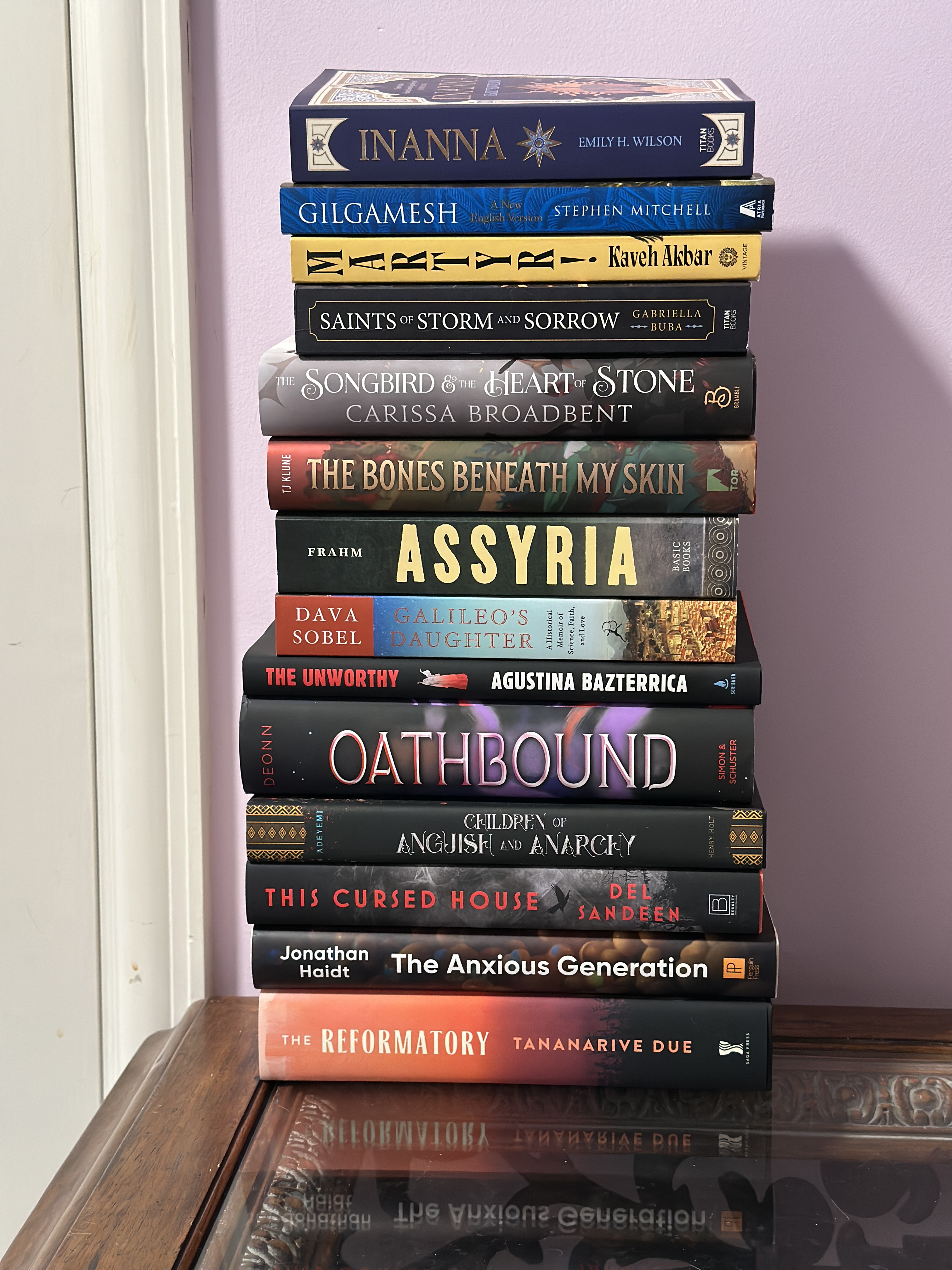
There are actually quite a few good choices for Book of the Month in here. The Reformatory? Oathbound? The Unworthy? Martyr!? The Bones Beneath My Skin? All are great choices, but I have to go with Galileo’s Daughter, by Dava Sobel. Review coming in the very near future. Lots of great books this month, though.
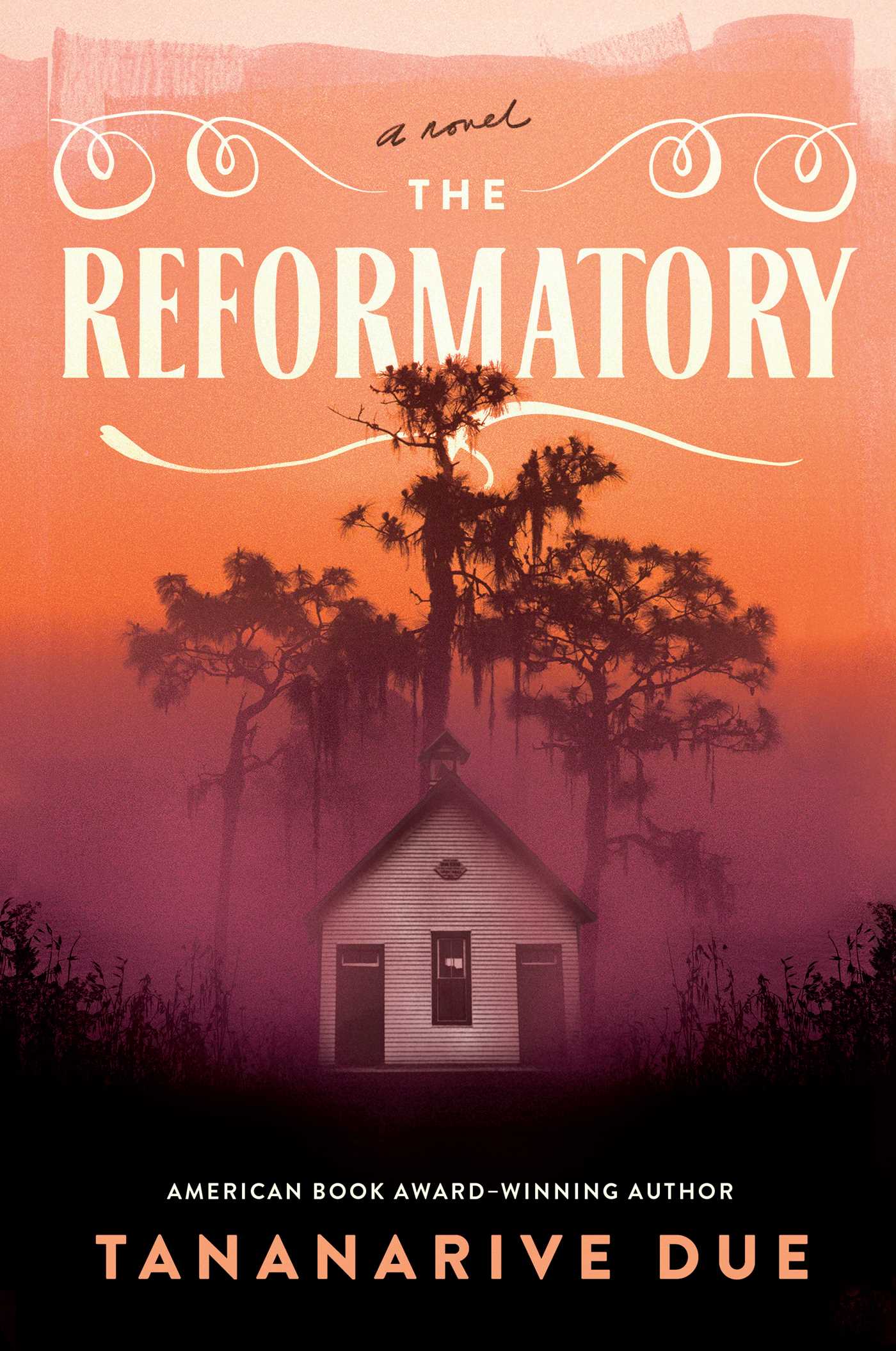
I feel like I haven’t treated Tananarive Due with enough respect.
The Reformatory is the third of her books that I’ve read. I did not know that until just now! I remember reading her book My Soul To Keep way back in 2016, and at the time I really liked it, but for some reason every time I think of it now I feel like it wasn’t something I enjoyed. And I just discovered that I read her debut novel, The Between, in 2020.
When I tell you that I don’t remember anything about that book, I need you to understand that not only do I not remember any details about the story, I did not even remember the book existed. That cover looks unfamiliar. I cannot picture where my copy of it is in my house, and I surely read a print copy. I don’t know what the spine looks like. If you had asked me ten minutes ago what the name of Tananarive Due’s debut novel was, I would not have been able to tell you. My recall of books from years ago is not always great, I admit that, mostly because I read 100+ books a year. But forgetting a book existed or that I ever read it at all is not a thing that I do.
And that after my weird about-face on My Soul to Keep? I have no explanation for this phenomenon.
Anyway, The Reformatory is really good, and if six months from now I find that I’ve turned on it too, I’m gonna need someone to come get me.
The Reformatory is the story of Robert Stephens Jr., a 12-year-old boy who is sent to the Gracetown School for Boys for a supposed six-month sentence after kicking the son of a wealthy white man in the knee. The book is set in 1950 in Florida, thick in the middle of Jim Crow, and the Gracetown “school” is a segregated, haunted nightmare, run by a grotesque abomination of a man. It is widely understood that Robert won’t be getting out in six months, as the warden is renowned for finding excuses to hold on to any boy sent to him until their 21st birthday regardless of their original sentence. Beatings and torture are commonplace and the inmatesprisoners “students” are encouraged to turn on each other at any opportunity.
The book bounces back and forth between Robert’s story and his sister, who Robert was defending when he kicked the other boy. She is trying her best to get him released, which is easier said than done in any number of ways. Their father has fled to Chicago after his attempts at unionization upset the Klan, and it’s fairly clear that part of the reason Robert is being treated as poorly as he is is because the authorities can’t get at his father.
The book would be scary enough without the haints, is what I’m saying, and the presence of a large number of ghosts at Gracetown becomes almost a distraction from all of the more grounded evil taking place there. Of course, a number of them are ghosts of children who were murdered or otherwise died while incarcerated there, and, well, a whole bunch of them bear quite a serious grudge against the warden.
I won’t go into much more detail, because (as usual for books I enjoyed) you deserve to experience the twists and turns on your own, but this really is a hell of a book, and I’ve not heard a lot of people talking about it. Give it a read.
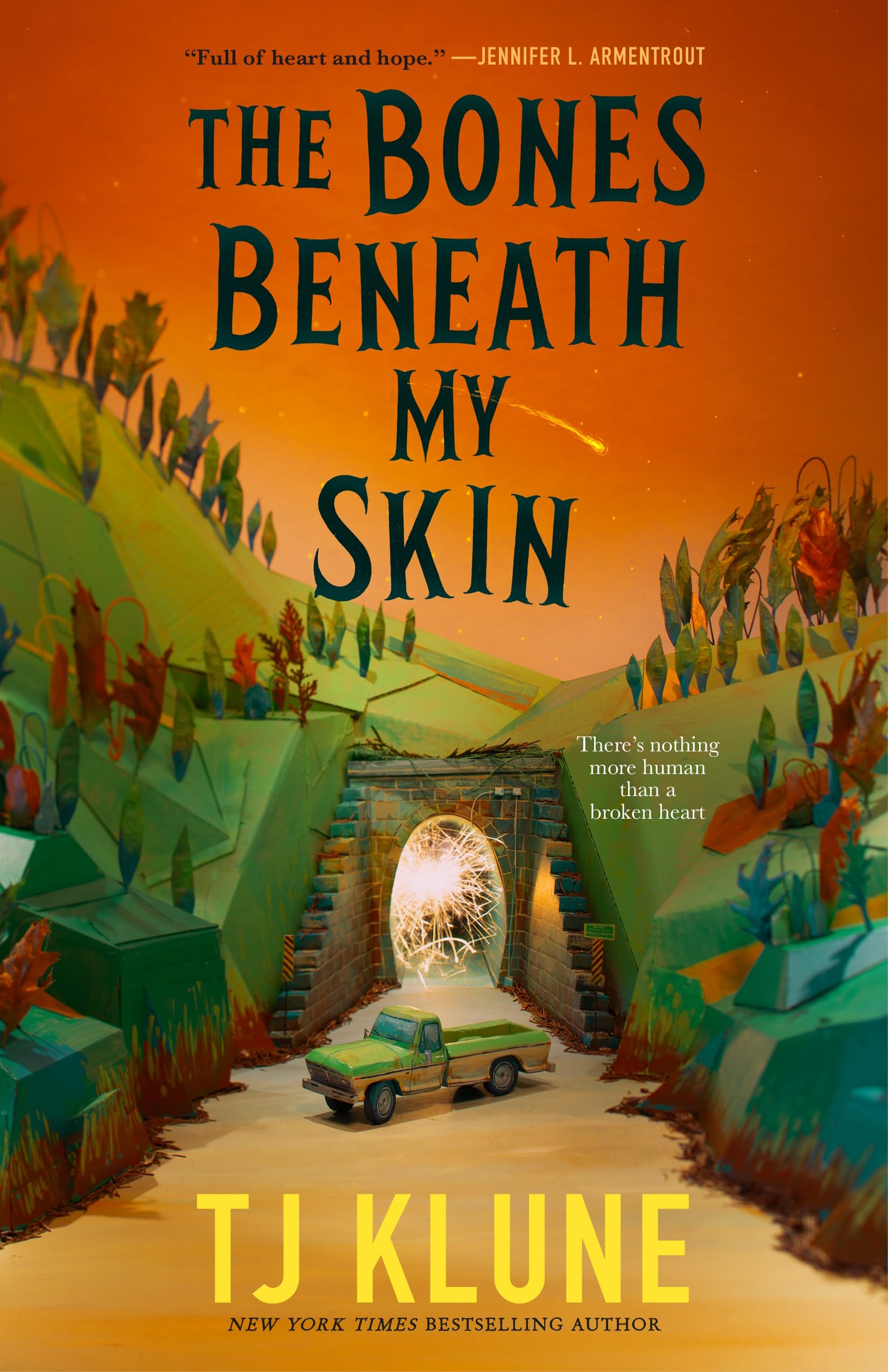
It’s well past time, I think, to declare TJ Klune one of my favorite authors. I have … eight books by him? Nine? Something like that, all of his adult novels, at least, and I’ve enjoyed all of them. In some ways, The Bones Beneath My Skin is one of his best books, up there with The House in the Cerulean Sea. It’s interestingly distinct from a lot of his other work, which usually has at least a little bit of the feel of a fairy tale about it, and one could make an argument that it’s his first science fiction novel. He calls it an “action movie” in the afterword, which I’m not completely convinced about but I see where it’s coming from.
At any rate, this book tells the story of Nate Cartwright, a reporter journalist (he never explains why he hates the word reporter so much, but damn, is he willing to be uppity about it) who in one fell swoop loses his family and his job at the Washington Post, and ends up at a family cabin deep in the woods in the middle of nowhere, where he is surprised to be greeted at gunpoint by a gut-shot, wounded Marine and a ten-year-old girl named Artemis Darth Vader. Shenanigans ensue. I don’t really want to spoil stuff all that much, to be honest, but it becomes quite clear really quickly that Artemis is not at all what she seems to be, and not just because she likes bacon more than any four normal people. (I burst out laughing when I randomly took the dust jacket off the book and discovered two pieces of bacon imprinted into the front cover. Bacon is a thing in this book.)
Klune’s strengths are on full display here– found family, great characters (Artemis is entirely unforgettable, although I can picture a reader she’s a bit much for) and a wry sense of humor. Artemis may be my favorite of all of his characters, although this book has some weaknesses, and it will be interesting to see whether the passage of a few months dulls the edges from the things I didn’t like about this book or brings them to the forefront. If I remember correctly I read Cerulean Sea similarly early in the year– February, maybe?– and it was still one of the best books I’d read that year when I got to The List. We shall see if history repeats itself.
But I want to talk about some of those weaknesses, because they’re interesting, so I’m going to put a little line here and then talk spoiler talk. Wander off now if you don’t want to see anything, but feel free to come back later.
This book was originally self-published, after Klune’s editor told him that it wasn’t great as a romance novel because there was “only one” sex scene. I contest the label of “romance novel” altogether; I don’t mind romance every now and again but while this book certainly has a romance subplot it is absolutely not part of that genre, but what I found interesting was that the book’s sole sex scene feels almost entirely out of place given the rest of the book. Maybe I’m off base here, but I feel like you can have a ten-year-old girl as a main character or a scene with explicit butt sex but maybe you shouldn’t have both. To be clear, the ten-year-old girl isn’t involved in the butt sex in any way, but still.
The book also pulls directly from the Comet Hale-Bopp/Heaven’s Gate mass suicide of 1997, to the point where it’s set at the same time, has a comet with a different name making an appearance (but the comet’s name is still hyphenated!) and there’s a mass suicide that is identical to Hale-Bopp right down to the silk coverings over the dead people’s faces and them all dying barefoot in bed. The entire subplot ties in to a character who is important to Artemis, but when I realized that he was literally just rewriting Heaven’s Gate and changing a couple of minor details, it almost killed the book for me.
It’s kind of ironic for me to say this, given that I’ve defended him in the past for pulling inspiration from tragic real events, but (to briefly recap that post) the influence of the Sixties Scoop on Cerulean Sea is so reworked and altered that many readers don’t notice it until it’s pointed out. This is not that– he has lifted the entire mass suicide and stuck it in his book. My problem isn’t with taking inspiration from real-world events, here; it’s that he’s doing so sloppily. There is absolutely no way anyone could have been alive and aware of the world in 1997 and not recognize the parallels here; they’re that glaring. And it throws you into oh no he didn’t mode in what should be one of the climactic events of the book, and the whole thing could have been done so so so much better, even if the main guy in the cult needed to be in the book somehow.
But again, in six months, who knows if this will still bug me when I think about this book. If I just remember how awesome Artemis is, you can expect this to show up at the end of the year, and one way or another it’s absolutely still a hit for Klune. I just wish he’d reworked parts of it a bit more before Tor reissued it.
This is very much not a book review. Don’t get me wrong, I’m still gonna tag it under “Reviews,” but the Epic of Gilgamesh is four thousand years old and the notion of putting a star rating on it is kind of ludicrous. Now, Stephen Mitchell’s new translation includes a decently long introduction and 80 or so pages of translation notes, so I could “review” that, but I did not pick this up to read his notes or his introduction; I picked it up because I realized I didn’t have a decent translation of the epic in the house anywhere and I got a wild hair up my ass about it.
Now, that said: Mitchell’s translation– well, his adaptation, and I’ll get to the distinction in a bit– is in fact a lovely read, and it combines being compulsively readable in English with a fine poetic feel that makes reading it out loud flow beautifully. I’m not an expert here by any means– I considered shifting my Master’s degree away from Hebrew Bible and more toward Babylonian studies in grad school before deciding to abandon the entire affair, but that’s as close as I get.
The problem is neither is Stephen Mitchell, who openly admits that he “doesn’t read cuneiform and has no knowledge of Akkadian.” Which makes the decision to publish a new translation, or adaptation, or version, which is his word … interesting? He basically sat down with a bunch of English versions (of, remember, fragmentary texts in one of the oldest languages that humanity can still understand) and some scholarly treatments of the work and pulled together his text from that, first doing a prose pass and then converting it to English verse.
(There’s a whole post or maybe a series of them in here about how one translates poetry from one language to another; needless to say it’s hellaciously complicated and requires a lot of expertise in both of the languages involved and in writing poetry. I could never.)
Fun fact: the Epic of Gilgamesh contains the oldest reference to blowjobs I’m aware of. From Book VI:
‘Sweet Ishullanu, let me suck your rod, touch my vagina, caress my jewel.‘
Except! In the translation notes at the end, Mitchell states that the literal translation is “eat your vigor,” which … okay, that sounds like a blowjob too, but since he doesn’t know any Akkadian it’s hard to say how reasonable that leap is, right? An actual scholar of the language and the culture might be able to provide some details there that led to that specific choice of words; for Mitchell it’s basically just vibes. This bothers the nearly-dead Bible scholar in me; it may not be especially relevant to other people.
There’s a bit where Enkidu tears the “thigh” off of a bull and throws it at Ishtar, and she takes it and puts it on an altar and makes it a centerpiece, and I’m thinking that maybe it wasn’t the thigh he actually tore off? Would love to see what a scholar had to say about that. But that’s not this version!
Anyway. I enjoyed reading this even if I had some issues with it, and maybe I’ll take a deep breath and find something more academic about the work and maybe a more traditional translation to compare the two. Or maybe not! It’s not like I don’t have a shitton of other stuff (including, remember, a whole other book called Gilgamesh) to read.
Really, the phrase “bisexual nun” was all I needed.
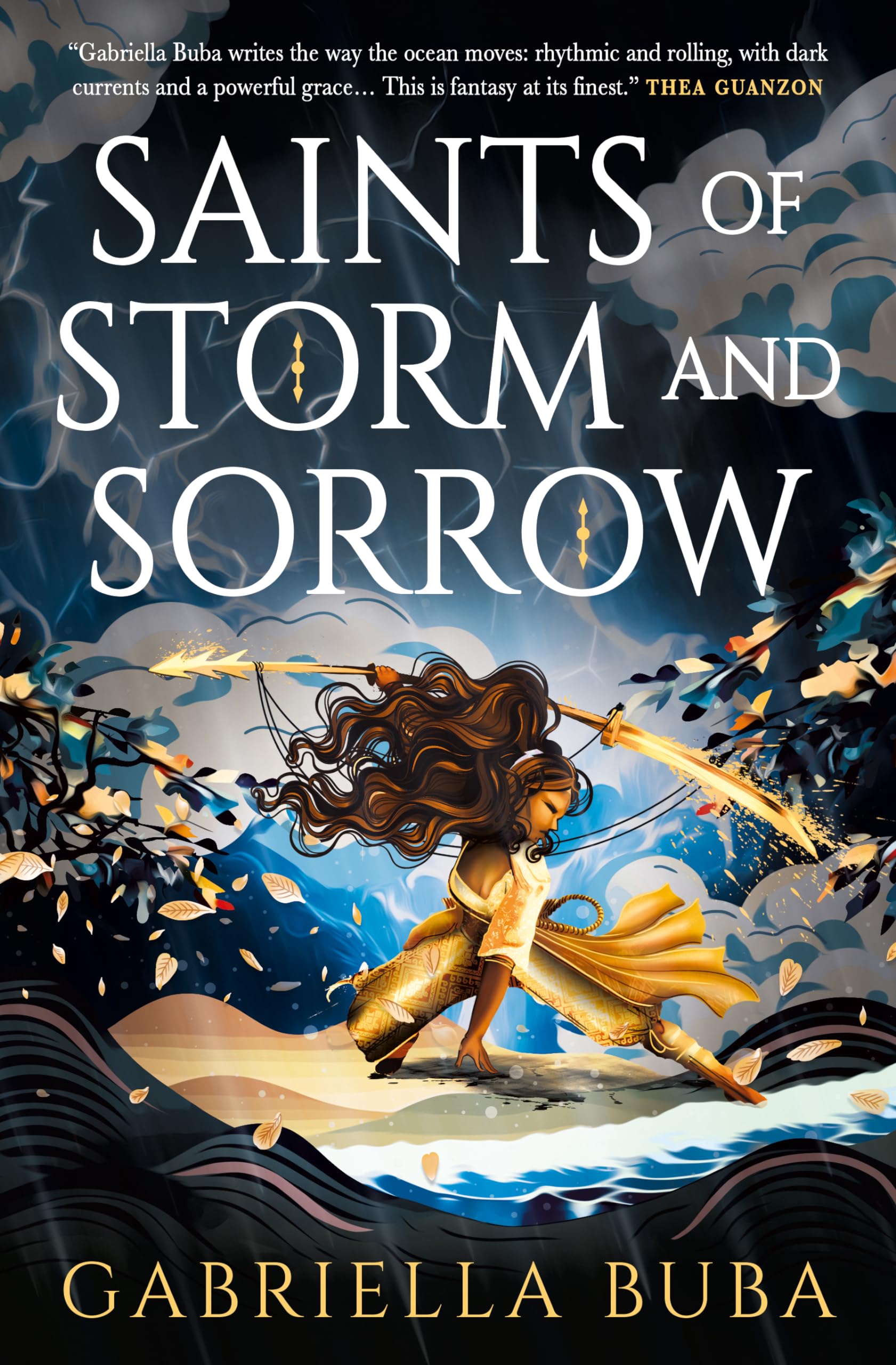
Here’s the thing about Gabriella Buba’s Saints of Storm and Sorrow: it’s one of those books where a lot of what I have to say about it is negative, but I’ve already pre-ordered the sequel, out this summer, and I’m genuinely looking forward to reading it. I lost some sleep to reading this book, and several times I had to force myself to put it down at the end of the night to go to bed. There’s something compelling and propulsive about Buba’s writing that ended up outweighing some of the things about this book that didn’t make sense or didn’t quite work, and I guess I just need you to keep that in mind while you’re reading this, because I want to talk about the weird stuff. I ended up four-starring this, but in a different mood I could have been talked into a three, and for most of the first half it was going to be a five. So one way or another it’s kind of all over the place, but the tl;dr to this whole post is that the book is well worth the time to read it even if there are some issues.
So here’s the thing. The main character, Lunurin, is a nun. She is also a priestess, quite possibly against her will, of a storm goddess called Aman Sinaya. Now, when I first read this in whatever blurb or online review I saw that caused me to order this, along with the phrase “bisexual nun” and the phrase “Filipino-inspired,” I assumed that this meant that this book wasn’t set on Earth.
And … technically, it isn’t? But it totally is. Lunurin is a Catholic nun. The bad guys are the Spaniards. They speak Spanish. They’re in the Philippines. I’m pretty sure the word “Catholic” never shows up, but … there is no attempt to be subtle here. Lunurin and her female love interest are both Catholic nuns, biracial and despised for being so, in a colonial atmosphere that is more or less identical to the Spaniards colonizing the Philippines. (Do you know any Filipinos? Ever notice how they all have Hispanic-sounding last names? There’s a reason for that.) And the book wants to get into the syncretism that happened whenever Catholicism ran into indigenous religion, which is a fascinating and complex subject, but if the colonized people can literally call down typhoons while being literally possessed by their gods, and Jesus … doesn’t do any of that? It kind of wreaks havoc on your worldbuilding. Christianity toppled, say, Norse religion, sure. But you know who the Norse didn’t have? Actual fucking Thor. And Lunurin can call down lightning by letting her hair down. And everyone just acts like Christianity is a reasonable alternative to that, just because the priests say so?
Nah.
I would kind of love for a book where Christian missionaries run into a religion that literally grants powers to its priesthood, but this isn’t that book and that’s not the story that Buba is interested in telling. She wants to start a book that is already past the colonization phase and so that’s what she gives us, and it’s not exactly the book’s fault that it sent my brain down all sorts of other pathways once I realized what was going on. There’s something to be said about having trouble accepting the basic premise, of course, but I’m a lifelong fantasy/sci-fi reader and suspending disbelief is something I’m good at. But I’m not going to pretend it wasn’t an issue.
Let’s see, what else? This is something that’s going to get fleshed out better in the sequels, I’m sure, but I never quite understood the relationships between any of the main characters. Two of them end up married, and I’m not sure either of them wanted it except one of them kinda did and the other sort of shrugs and rolls with it, and the nun female love interest is an absolute mess of a character, which is yet another complaint that may or may not represent a problem with the book. Messy people exist! But holy shit is Catalina a mess. She’s inconsistent, jealous and a religious fanatic (nun, remember) and there’s also a healthy degree of self-loathing going on as well as some internalized racial hatred, and … she’s realistic, in a lot of ways, I think, maybe? But that doesn’t automatically make her fun to read about.
There are a couple of explicit sex scenes that tonally really do not match the rest of the book, too, so be aware of that. This is not a romantasy by any stretch of the imagination, and I let that fool me into thinking that at no point would glistening cocks be involved. Or, well, one cock that glistens at least once. And, again, I’m not convinced that the people fucking actually like each other, or whether they’re trying to play each other, and it’s okay for the characters to not know each other’s motivations, and it’s okay for the characters to be inconsistent in their motivations, but I definitely don’t get them and I’m not convinced the author did either. The problem is that in this particular scenario complicated characters come off exactly the same as characters with no actual arc and no planning, and I genuinely can’t tell which one this is.
So yeah. Again, I’ve bought the sequel. Lunurin’s relationship with her actual goddess– as opposed to Jesus, who doesn’t seem to be real and doesn’t occupy a lot of her time despite the nunnery going on– is fascinating, and again, she doesn’t appear to like her very much, and while I have my problems with the setting as it currently exists, it’s got its positives just out of sheer originality. It may be that I’ll read book two and tap out for what I’m presuming will be a third book in the future (this may be a duology, I’m not sure) or I might shift into full-throated approval. We’ll see. But I’m giving this one a thumbs-up regardless, now that you’ve read all the caveats and quid pro quos and such.
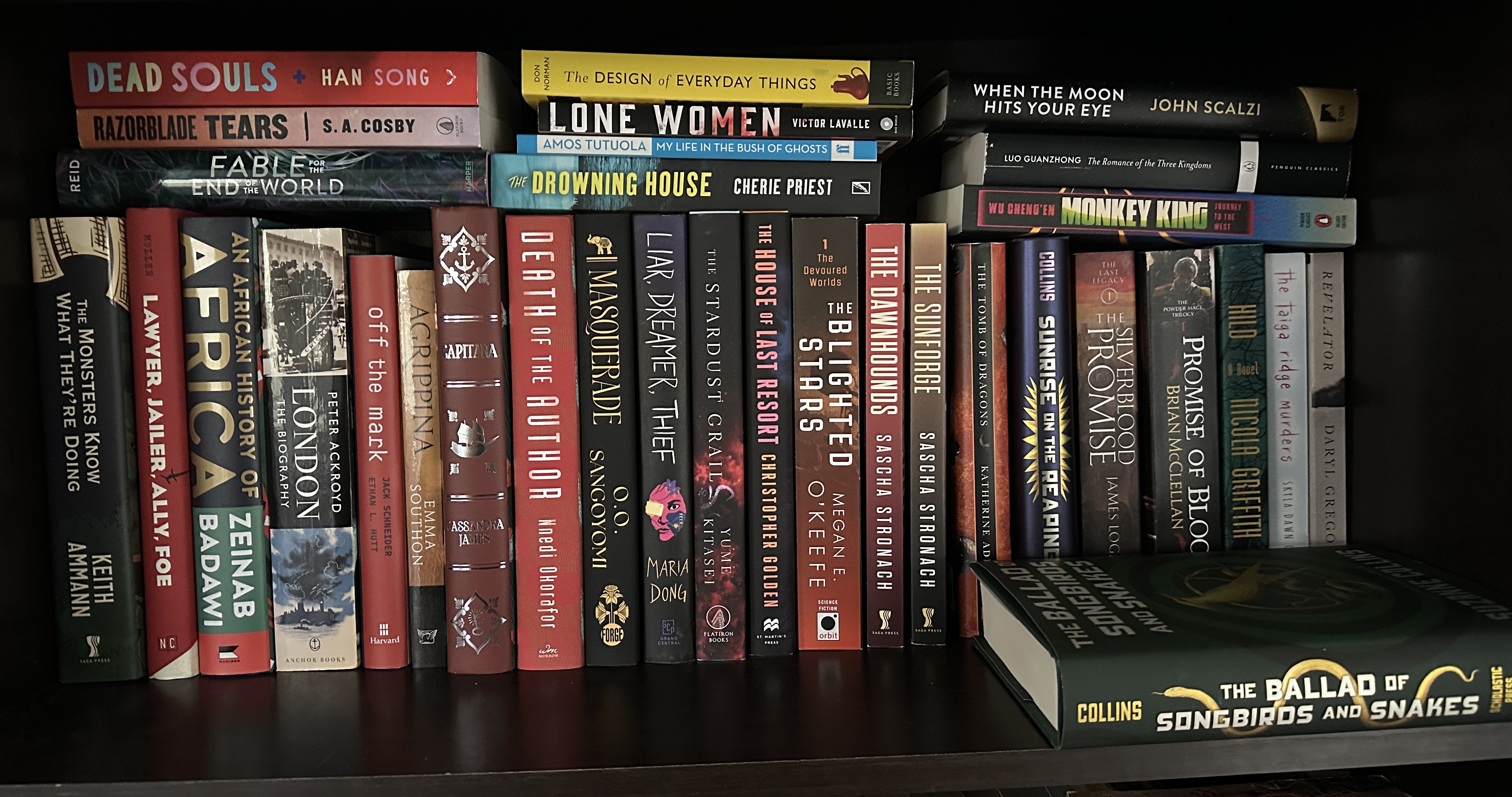
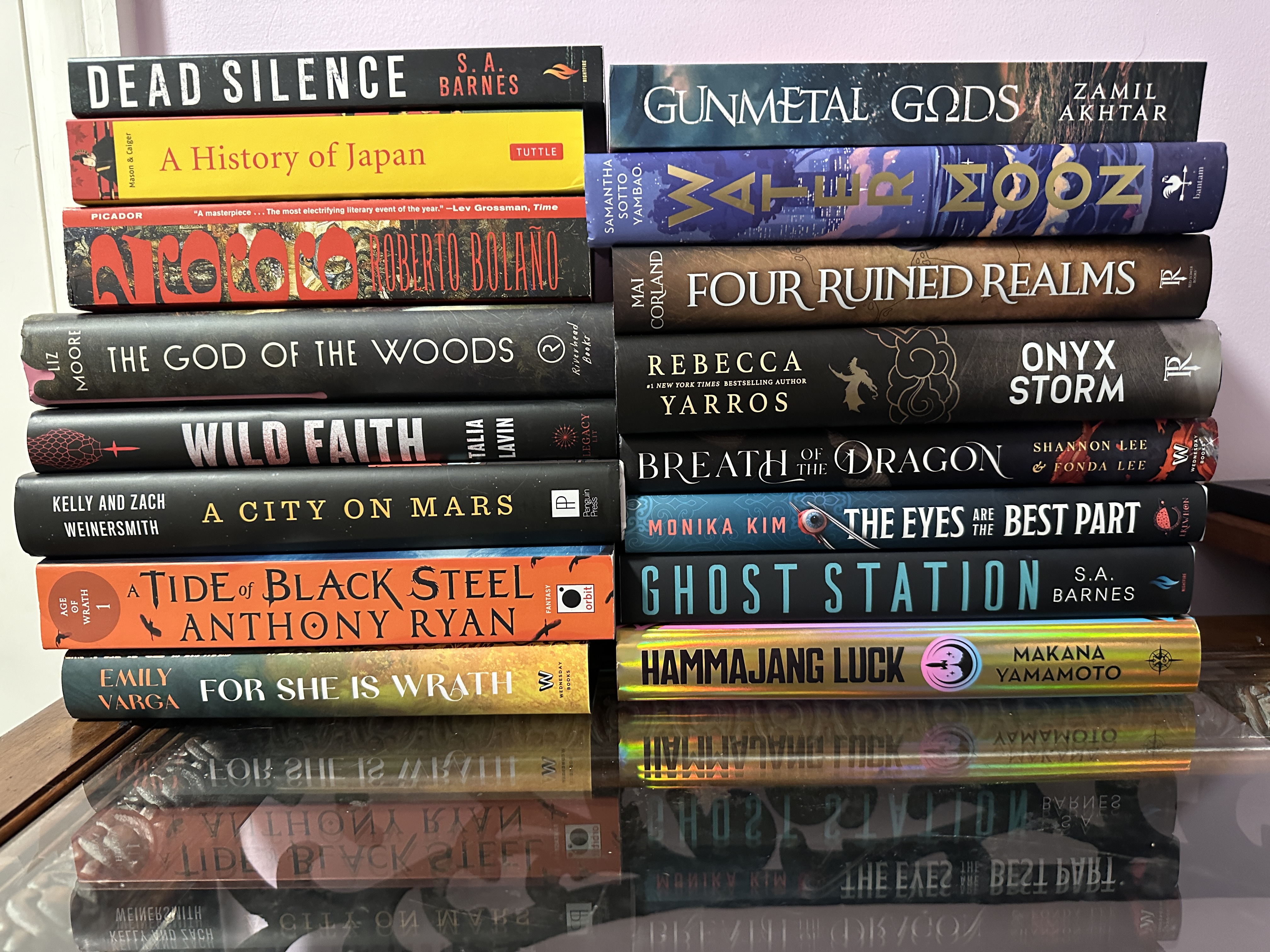
A couple of these arrived today, and I almost didn’t include them in the picture until I realized I had two books called “Gilgamesh” (one a new translation of the epic, the other a historical fiction) and two featuring the rather improbable combination of the words “blood” and “promise” in their titles.



 Welcome to infinitefreetime dot com